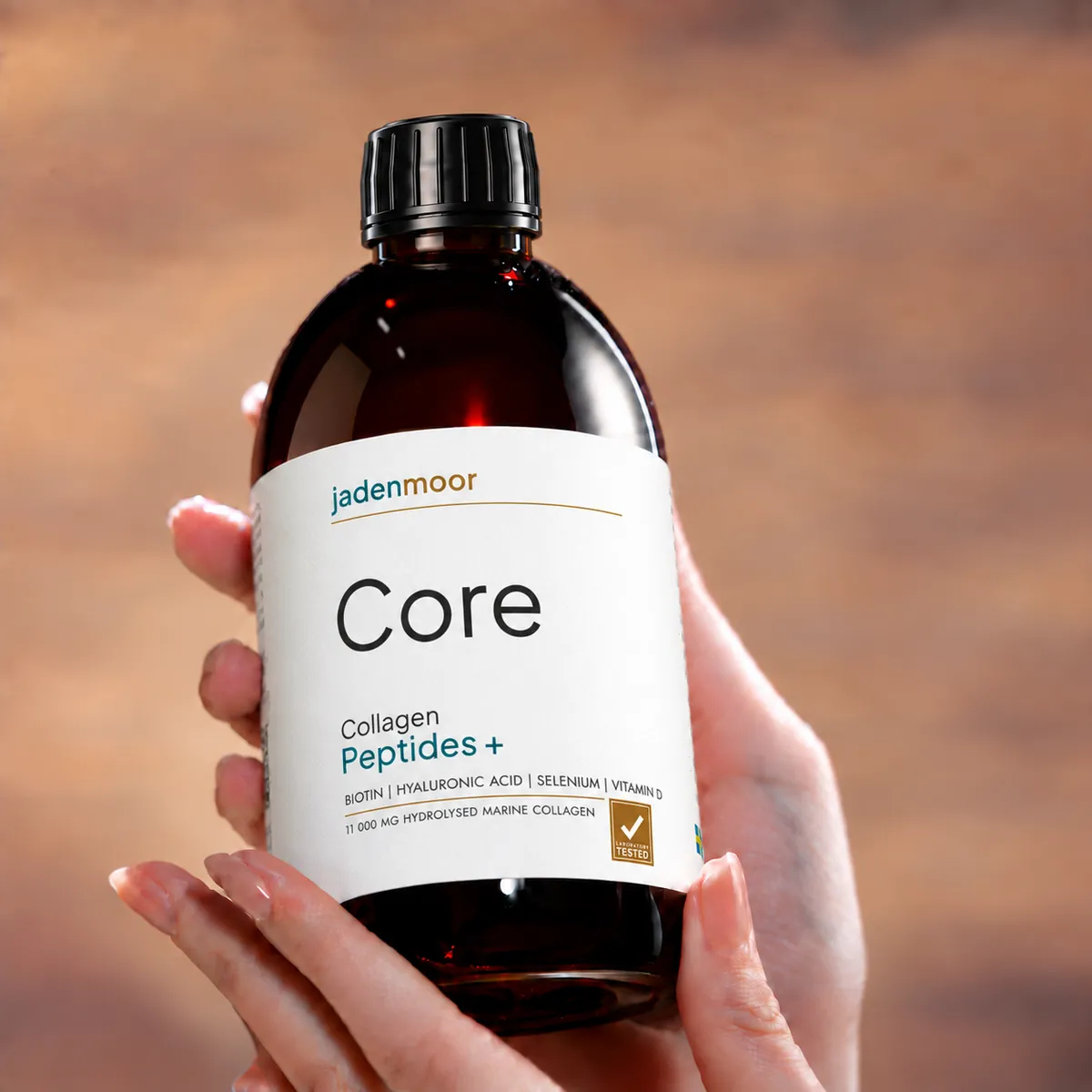
Look for nutrients whose benefit is written into the EU list of permitted health claims, and check the amount on the label. The table below does that for Core™, area by area.
- Vitamins and selenium get a claim. Each row quotes the permitted sentence in full, for a nutrient that is in Core™.
- Collagen gets studies. Its rows report trials in postmenopausal and menopausal women, and in women aged 45 to 65.
- The nutrients are in one drink. Every vitamin and mineral row is in the same portion, taken once a day.
of 106 women felt the appearance of their skin improved after 8 weeks on our liquid marine collagen. That is a result for the whole drink, as reported by the women themselves.
- 81%reported firmer skin
- 86%reported healthier hair
- 76%reported stronger nails
Which vitamins should you look for in menopause?
Look for the vitamins and minerals with a permitted EU sentence for the area you care about, such as vitamin C for skin, biotin and selenium for hair, vitamin D for bones and vitamin B6 for hormonal activity. A steady way to choose is to ask one plain question of every ingredient: what is anyone permitted to say about it?
For vitamins and minerals in the EU, that question has a written answer. Regulation (EU) No 432/2012 holds the list of permitted health claims, and each sentence on it belongs to a named nutrient.1 A label may use the sentence as it stands.
None of those sentences is written for menopause. They are worded for the general population, and they read the same at any age.
To build the checklist, we took the areas you might read a label for, from skin and hair to bones and thyroid function. For each one we looked at Core's specification, found the nutrient, and copied out its amount and its permitted sentence.2 Where a longer article exists, the row links to it.
The checklist: what is in Core™, and what may be said about it?
One portion of Core™ holds vitamins C, D, B5, B6 and B12, biotin and selenium, each with authorised EU wording for areas from skin, hair and nails to bones, thyroid function and the immune system. Read each row across, from the area to what one portion holds and then the authorised wording, quoted exactly.
The menopause nutrient checklist for Core™
One row per area. Amounts are per portion. NRV is the EU reference intake used on labels.
| Area | In one Core™ portion | Authorised EU wording | Read more |
|---|---|---|---|
| Skin | Vitamin C, 120 mg (150% NRV). Biotin, 5,000 µg | Vitamin C contributes to normal collagen formation for the normal function of skin. Biotin contributes to the maintenance of normal skin. | Vitamin C and collagen |
| Hair | Biotin, 5,000 µg. Selenium, 27.5 µg (50% NRV) | Biotin contributes to the maintenance of normal hair. Selenium contributes to the maintenance of normal hair. | Hair and menopause |
| Nails | Selenium, 27.5 µg (50% NRV) | Selenium contributes to the maintenance of normal nails. | Selenium for hair and nails |
| Bones | Vitamin D, 60 µg. Vitamin C, 120 mg (150% NRV) | Vitamin D contributes to the maintenance of normal bones. Vitamin C contributes to normal collagen formation for the normal function of bones. | Bones and muscles |
| Muscle function | Vitamin D, 60 µg | Vitamin D contributes to the maintenance of normal muscle function. | Bones and muscles |
| Cartilage | Vitamin C, 120 mg (150% NRV) | Vitamin C contributes to normal collagen formation for the normal function of cartilage. | Bones and muscles |
| Tiredness and fatigue | Vitamin C, 120 mg (150% NRV). Vitamin B5, 5 mg (83% NRV). Vitamin B6, 1.7 mg (121% NRV). Vitamin B12, 24 µg (960% NRV) | Vitamin C contributes to the reduction of tiredness and fatigue. Pantothenic acid (vitamin B5) contributes to the reduction of tiredness and fatigue. Vitamin B6 contributes to the reduction of tiredness and fatigue. Vitamin B12 contributes to the reduction of tiredness and fatigue. | Tiredness and brain fog |
| Mental performance | Vitamin B5, 5 mg (83% NRV) | Pantothenic acid (vitamin B5) contributes to normal mental performance. | Vitamins and brain fog |
| Hormonal activity | Vitamin B6, 1.7 mg (121% NRV) | Vitamin B6 contributes to the regulation of hormonal activity. | Vitamin B6, B5 and hormones |
| Thyroid function | Selenium, 27.5 µg (50% NRV) | Selenium contributes to the normal thyroid function. | Selenium and thyroid |
| Immune system | Vitamin C, 120 mg. Vitamin D, 60 µg. Vitamin B6, 1.7 mg. Vitamin B12, 24 µg. Selenium, 27.5 µg | Vitamin C contributes to the normal function of the immune system. Vitamin D contributes to the normal function of the immune system. Vitamin B6 contributes to the normal function of the immune system. Vitamin B12 contributes to the normal function of the immune system. Selenium contributes to the normal function of the immune system. | Vitamins and the immune system |
| Protection of cells from oxidative stress | Vitamin C, 120 mg (150% NRV). Selenium, 27.5 µg (50% NRV) | Vitamin C contributes to the protection of cells from oxidative stress. Selenium contributes to the protection of cells from oxidative stress. | Antioxidants and skin |
| Collagen: study findings in place of a claim. The second column gives the collagen and daily amount each trial studied | |||
| Skin elasticity, postmenopausal women | Studied: 5 g of marine collagen hydrolysate a day for 4 weeks | Study finding. Cheek skin elasticity improved compared with placebo in a randomised, double-blind trial of 36 postmenopausal women, and the difference was still there four weeks after stopping.3 | Collagen and menopause |
| Skin elasticity, menopausal women | Studied: 5 g a day of collagen from freshwater fish skin for 6 months | Study finding. Skin elasticity improved by 12.23% from baseline in the collagen group of 20 women, significantly more than placebo, in a randomised trial of menopausal women aged 45 to 60.4 | Collagen and skin firmness |
| Eye wrinkles, women aged 45 to 65 | Studied: 2.5 g of collagen peptides a day for 8 weeks | Study finding. Eye-wrinkle volume was significantly lower than placebo after 4 weeks and after 8 weeks (about 20%) in a randomised, double-blind trial of 114 women.5 | Collagen for wrinkles |
How do you read a row?
- The sentence belongs to the nutrient. It describes what that vitamin or mineral does in the body. It is a line about the nutrient, and we leave it there.
- The percentage is a labelling figure. NRV is the reference intake printed on EU labels, so you can compare one product with another.
- One nutrient can sit in several rows. Vitamin C appears beside skin, bones, cartilage and more, because the permitted list gives it a separate sentence for each.1
Read each row as one nutrient, its amount in a portion and the permitted sentence that belongs to it. Core™ also has 50 mg of hyaluronic acid and 50 mg of silica in each portion.2 The table keeps to nutrients with a permitted sentence, so they sit outside it.
assets/img/blog/mc2-list.webpWhere does collagen fit?
Collagen fits on the checklist through published trials, since the claims list is silent on it, and the most useful ones for this page chose their volunteers by life stage. It is also the reason Core™ exists.
Two of the trials below recruited only women in or after menopause, and the third recruited women aged 45 to 65. Each card is its own study, with its own collagen, dose and length.
Cheek elasticity ahead of placebo
Volunteers took either 5 g of marine collagen hydrolysate or a placebo every day. At the 4-week reading, elasticity of the cheek skin was better with collagen. A follow-up reading four weeks after the last dose still showed the gap.3
36 postmenopausal women · randomised, double-blind, placebo-controlled
Elasticity up 12.23% from baseline
This trial ran for 6 months on 5 g a day of collagen made from freshwater fish skin. The 20 women in the collagen group finished with skin elasticity 12.23% above their own starting reading, a significantly larger change than placebo produced.4
Menopausal women aged 45 to 60 · randomised, placebo-controlled
Eye-wrinkle volume about 20% lower than placebo
With 2.5 g of collagen peptides a day, the volume of eye wrinkles was significantly below the placebo group's at week 4 and again at week 8 (about 20%). Skin samples at week 8 held 18% more elastin in the collagen group than in the placebo group.5
114 women aged 45 to 65 · randomised, double-blind, placebo-controlled
For the fuller story of the menopause trials, our guide to collagen and menopause walks through them one at a time.
As for Core™, one portion holds 11,000 mg of hydrolysed marine collagen, types I and III.2
How do you take it?
- One portion a day. Shake the pack, pour into the cap and drink it straight, or stir it into water or a smoothie.2
- Keep it cold. Once the pack is open it lives in the fridge, where you will see it every morning.
Take one portion of Core™ a day, straight or stirred into water or a smoothie. You can see the full label and order on the Core™ product page.
What did women report on our liquid marine collagen?
In a user trial of our liquid marine collagen, 95% of 106 women felt the appearance of their skin improved and 89% reported more moisture and glow after taking it daily for 8 weeks.2 These are answers about the whole drink, given by the women themselves.
felt the appearance of their skin improved.
reported more moisture and glow.
found it easy to include in their daily routine.
Women in that trial reported visible results in as little as 4 weeks, with further improvement by week 8. They also reported more energy and better joint flexibility.2
“The taste is amazing and it is sugar free! Love what it does to my hair, nails and skin.”
★★★★★
Suzanne H.Verified purchase · Amazon, United Kingdom · 26 August 2024
“I can really see the visible changes in my skin and nails.”
★★★★★
Check4YouVerified purchase · Amazon, Germany · 27 December 2023
Verified buyer reviews of our liquid marine collagen, as sold under our manufacturer's own label.
If skin is the row you care about most, the 8-week photographs from our studies are gathered in collagen before and after.
Questions about menopause vitamins
What vitamins should I take during menopause?
Choose by area, because the EU list of permitted health claims has no menopause section: vitamin C for skin, biotin and selenium for hair, vitamin D for bones and vitamin B6 for hormonal activity are examples from the table. Pick the rows in the table that matter to you, then check that a product contains the nutrient named there. Every vitamin and mineral named in the table is in one portion of Core™.
What is the best supplement for menopause?
Choose by two checks rather than a brand name: what the permitted list allows to be said about each vitamin and mineral on the label, and what the trials that enrolled menopausal and postmenopausal women found, such as the two collagen trials in the table.
Has collagen been studied in menopausal women?
Yes, in a randomised, double-blind trial of 36 postmenopausal women, 5 g of marine collagen hydrolysate a day for 4 weeks improved cheek skin elasticity compared with placebo. A separate 6-month trial in menopausal women aged 45 to 60 used 5 g a day of collagen from freshwater fish skin and recorded a 12.23% rise in elasticity from baseline in the collagen group of 20 women, significantly more than placebo.
Are the vitamins and minerals on the checklist all in one Core™ portion?
Yes, each vitamin and mineral row names a nutrient that is in Core™, with its amount per portion. The collagen rows report published trials, and one portion of Core™ holds 11,000 mg of hydrolysed marine collagen.
How long should you take Core™ for?
Core's directions are one portion a day. In our user trial, women took our liquid marine collagen daily for 8 weeks.