The authorised EU wording names vitamin D and vitamin C. Vitamin D contributes to the maintenance of normal bones, and vitamin D contributes to the maintenance of normal muscle function.
- Calcium and phosphorus. Vitamin D contributes to normal absorption/utilisation of calcium and phosphorus.
- Bones and cartilage. Vitamin C contributes to normal collagen formation for the normal function of bones. Vitamin C contributes to normal collagen formation for the normal function of cartilage.
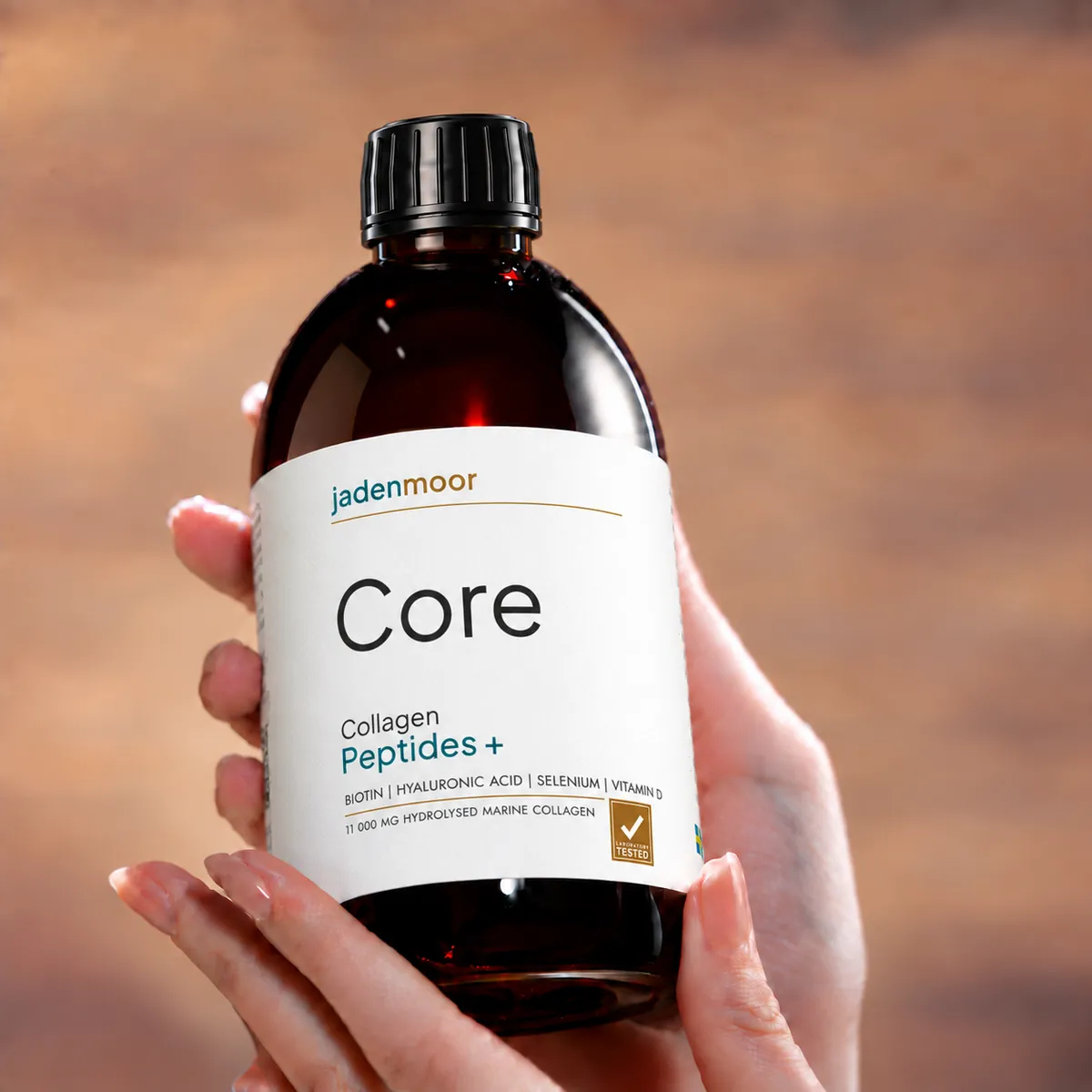
- One portion. A portion of Core™ has 60 µg of vitamin D and 120 mg of vitamin C.
of 106 women taking our liquid marine collagen daily for 8 weeks found it easy to include in their daily routine.
- 81%reported firmer skin
- 95%felt the appearance of their skin improved
- 89%reported more moisture and glow
Which vitamins matter for bones after menopause?
Vitamin D and vitamin C are the two vitamins in Core™ that the EU register of permitted health claims names for bones, and each has its own line.1
- Vitamin D for bones. Vitamin D contributes to the maintenance of normal bones.
- Vitamin D for muscle. Vitamin D contributes to the maintenance of normal muscle function.
- Vitamin C for bones. Vitamin C contributes to normal collagen formation for the normal function of bones.
- Vitamin C for cartilage. Vitamin C contributes to normal collagen formation for the normal function of cartilage.
Those four sentences are fixed wording, each resting on an EFSA opinion, and we quote them as written. What sits behind them is explained below.
Menopause is the point at which many women turn their attention to bones and muscles. It is already a busy time for skin: as much as 30% of skin collagen is lost in the first five years after menopause.2 We cover that side in collagen and menopause. Here we stay with your frame, and with the vitamins that have a line of their own for it.
What does vitamin D do?
Vitamin D promotes calcium absorption in the gut and helps keep blood calcium and phosphate at adequate concentrations, and it is an unusual fat-soluble vitamin, because your body also makes it itself when ultraviolet rays from sunlight strike the skin.3
One of its jobs is with calcium. According to the NIH fact sheet on vitamin D, the vitamin promotes calcium absorption in the gut and helps keep blood calcium and phosphate at adequate concentrations.3
EFSA, the European Food Safety Authority, set out the basis for the bone claim in a 2009 opinion: adequate vitamin D status is required for efficient calcium absorption and for maintaining normal blood calcium and phosphate, which are needed for the normal mineralisation of bone and teeth.4 The panel concluded that a cause and effect relationship has been established between dietary vitamin D intake and the maintenance of normal bone and teeth.4
Muscle came next. In a 2010 opinion, EFSA concluded that a cause and effect relationship has been established between dietary vitamin D intake and the maintenance of normal muscle function.5
Vitamin D carries five authorised lines that belong in this article:
- Vitamin D contributes to the maintenance of normal bones.
- Vitamin D contributes to the maintenance of normal muscle function.
- Vitamin D contributes to normal absorption/utilisation of calcium and phosphorus.
- Vitamin D contributes to normal blood calcium levels.
- Vitamin D contributes to the maintenance of normal teeth.
The EU nutrient reference value for vitamin D is 5 µg per day.6 It is a labelling reference.

assets/img/blog/bm-walk.webpWhat does vitamin C have to do with bones and cartilage?
Vitamin C's connection with bones and cartilage is collagen. Its authorised wording on collagen formation names several tissues, and bones and cartilage are on the list.
Humans, unlike most animals, cannot make vitamin C in the body, so it has to come from the diet. The NIH fact sheet on vitamin C states that vitamin C is required for the biosynthesis of collagen, which is an essential component of connective tissue.7
EFSA's opinion on vitamin C describes the chemistry. In collagen synthesis, vitamin C acts as a coenzyme for the enzymes that add hydroxyl groups to the amino acids proline and lysine in the collagen molecule. This step stabilises collagen's triple-helix structure.8
On that basis the panel concluded that a cause and effect relationship has been established between the dietary intake of vitamin C and normal collagen formation, with the general population as the target population.8 The EU list then authorises parallel wordings by tissue, bones and cartilage among them.1
- Vitamin C contributes to normal collagen formation for the normal function of bones.
- Vitamin C contributes to normal collagen formation for the normal function of cartilage.
The adult daily reference intake for vitamin C on EU labels is 80 mg.6 If you would like the longer story of this vitamin, it is in vitamin C and collagen.
Where does collagen come into it?
Collagen is where the vitamin C wording points, and your body keeps it in bone, cartilage, skin, teeth, tendon, muscle and blood vessels. A review of hydrolysed collagen sets out the map: type I collagen is the most common type in skin, bone, teeth and tendon, type II is present in cartilage, and type III is most commonly found in skin, muscle and blood vessels.9
Type I is also the most plentiful. A medical reference text puts it at over 90% of the total collagen in the human body, out of at least 28 types identified.10
Both sources describe the collagen your own body makes and holds. The authorised wording on normal collagen formation for bones and cartilage belongs to vitamin C, and the wording on bones and muscle function belongs to vitamin D. This article is built on those two vitamins for that reason.
Core™ puts both vitamins in the same portion as 11,000 mg of hydrolysed marine collagen.11 If you are curious about the numbering, our guide to the types of collagen explains it.
What is in one Core™ portion?
One portion of Core™ holds 60 µg of vitamin D and 120 mg of vitamin C (150% NRV), alongside 11,000 mg of hydrolysed marine collagen, each vitamin shown below beside its authorised wording.
Vitamin D and vitamin C in one portion of Core™
Amount per portion, with the authorised EU wording for bones, muscle, calcium, teeth and cartilage.
| Nutrient | Amount per portion | Authorised claim |
|---|---|---|
| Vitamin D | 60 µg | Vitamin D contributes to the maintenance of normal bones. Vitamin D contributes to the maintenance of normal muscle function. Vitamin D contributes to normal absorption/utilisation of calcium and phosphorus. Vitamin D contributes to normal blood calcium levels. Vitamin D contributes to the maintenance of normal teeth. |
| Vitamin C | 120 mg (150% NRV) | Vitamin C contributes to normal collagen formation for the normal function of bones. Vitamin C contributes to normal collagen formation for the normal function of cartilage. |
Everything in that table comes with the collagen. Each portion also gives you 9.9 g of protein, with a natural berry flavour, sugar free and fat free.11
The routine is one portion a day. Shake the pack, pour into the cap, then drink it straight or stir it into water or a smoothie. The pack lives in the fridge once opened. You will find the full label on the Core™ product page.
What did women in our trial report?
In our own trial of 106 women taking our liquid marine collagen every day for 8 weeks, 99% found it easy to include in their daily routine, 95% felt the appearance of their skin improved and 81% reported firmer skin.11 Their answers describe the drink as a whole.
found it easy to include in their daily routine.
reported firmer skin.
felt that the appearance of their skin improved.
Participants in the trial also reported better joint flexibility.11 We pass that on as the women's own account of how they felt while taking the drink.
Some of them were photographed at the start and again at the end.


Participants in the 8-week user trial of our liquid marine collagen, photographed before and after.
In buyers' words
Three verified buyers put their experience of the drink like this.
“The taste is amazing and it is sugar free! Love what it does to my hair, nails and skin.”
★★★★★
Suzanne H.Verified purchase · Amazon, United Kingdom · 26 August 2024
“My skin looks great, with no fine lines. I'm 45 and will definitely keep using it.”
★★★★★
FrédériqueVerified purchase · Amazon, France · 18 May 2024
“I can really see the visible changes in my skin and nails.”
★★★★★
Check4YouVerified purchase · Amazon, Germany · 27 December 2023
Verified buyer reviews of our liquid marine collagen as sold under our manufacturer's own label.
Questions about bones and muscles after menopause
Which vitamin is good for bones after menopause?
The EU list of permitted health claims names vitamin D for bones: vitamin D contributes to the maintenance of normal bones. It names vitamin C too. Vitamin C contributes to normal collagen formation for the normal function of bones.
Does vitamin D do anything for muscles?
Yes: EFSA concluded in 2010 that a cause and effect relationship has been established between dietary vitamin D intake and the maintenance of normal muscle function. The authorised wording follows from it: vitamin D contributes to the maintenance of normal muscle function.
What does vitamin D have to do with calcium?
Vitamin D promotes calcium absorption in the gut, according to the NIH fact sheet on the vitamin. Vitamin D contributes to normal absorption/utilisation of calcium and phosphorus. Vitamin D contributes to normal blood calcium levels.
Is vitamin C good for cartilage?
The authorised wording says this: vitamin C contributes to normal collagen formation for the normal function of cartilage. It rests on EFSA's conclusion that a cause and effect relationship has been established between the dietary intake of vitamin C and normal collagen formation.
Is there collagen in bone?
Yes: a review of hydrolysed collagen lists bone among the tissues where type I collagen is the most common type, with skin, teeth and tendon. That describes the body's own collagen. The authorised wording on collagen formation for bones belongs to vitamin C: vitamin C contributes to normal collagen formation for the normal function of bones.
How much vitamin D and vitamin C are in Core™?
One portion has 60 µg of vitamin D and 120 mg of vitamin C, which is 150% NRV for vitamin C. Both sit in the same portion as 11,000 mg of hydrolysed marine collagen.