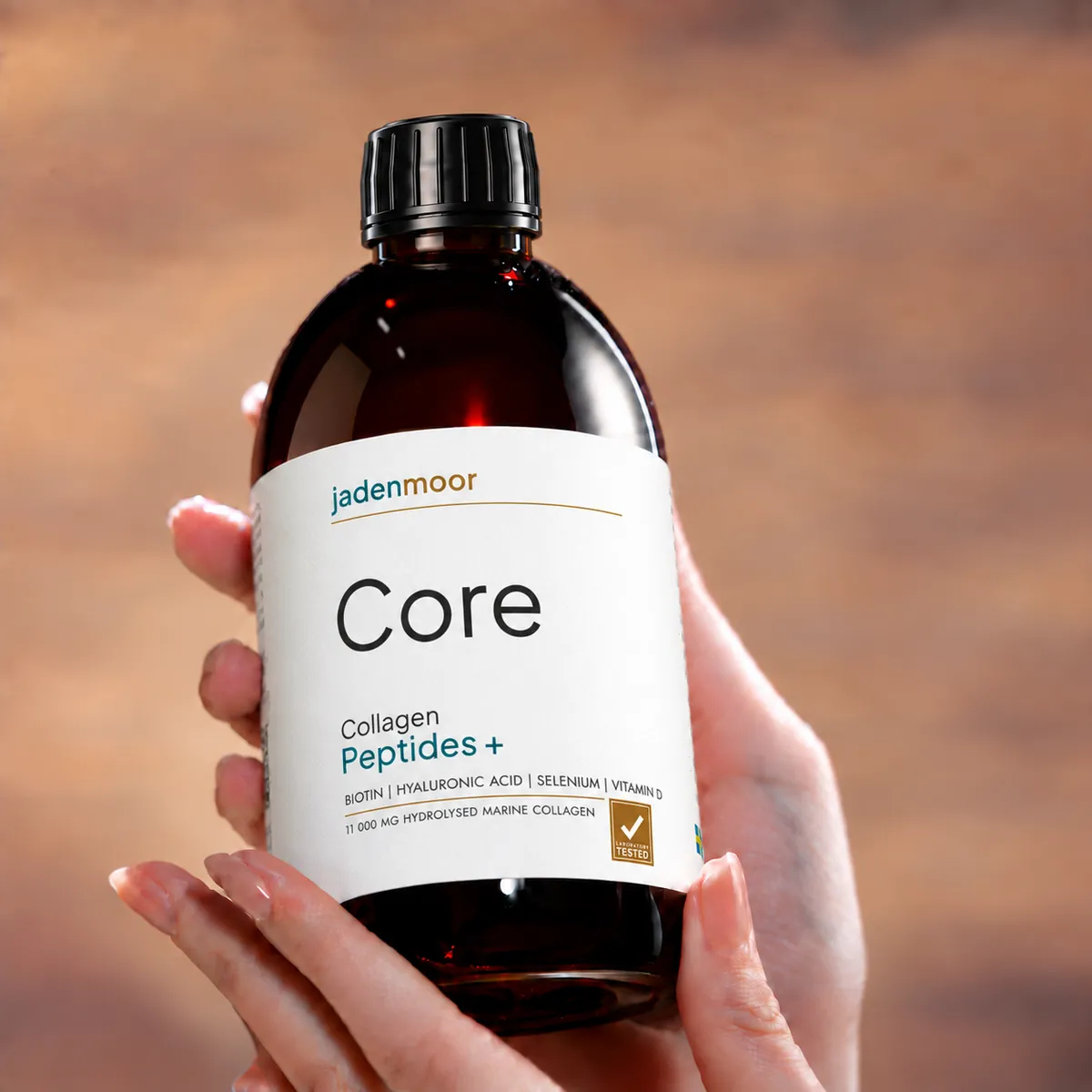
At least 28 types of collagen have been identified. Type I is the one your skin holds most of, at 80% to 90% of the collagen in skin.
- Type I is the most common type in skin, bone, teeth and tendon.
- Type II is present in cartilage. Type III is most commonly found in skin, muscle and blood vessels.
- Core™ contains hydrolysed marine collagen of types I and III: 11,000 mg in one portion.
of 106 women felt that the appearance of their skin improved after 8 weeks on our liquid marine collagen.
- 89%reported more moisture and glow
- 87%noticed fewer fine lines and wrinkles
- 81%reported firmer skin
How many types of collagen are there?
At least 28 types of collagen have been identified, more than most labels suggest, and types I to IV are the most prevalent.1 A 2024 mini review of collagen in skin arrives at the same count, a family of 28 members.2
The Roman numerals are names, one for each member of the family, and each member has its own places in the body. Together they add up to a great deal of you, because collagen is the most abundant structural protein in the body.1
You do not need to learn all 28 of them, and this guide follows only three, types I, II and III.
What are types I, II and III?
Types I, II and III are three members of the collagen family, set apart by where your body keeps them: type I is the most common type in skin, bone, teeth and tendon, type II is present in cartilage, and type III is most commonly found in skin, muscle and blood vessels. A standard cell-biology textbook, for example, calls type II the major collagen in cartilage.3
Types I, II and III: where your body keeps each one
Locations and shares as given in the published sources. They describe the body's own collagen.
| Type | Where it is found | What the sources add |
|---|---|---|
| Type I | The most common type in skin, bone, teeth and tendon.4 | Accounts for over 90% of the total collagen in the human body, according to a current medical reference.1 |
| Type II | Present in cartilage.4 | The textbook calls it the major collagen in cartilage.3 |
| Type III | Most commonly found in skin, muscle and blood vessels.4 | About 15% of the collagen in young skin.5 |
Read down the middle column and skin appears twice, beside type I and beside type III. Keep that pairing in mind if skin is why you are reading about collagen at all.
Which type of collagen is in your skin?
Mostly type I, with type III beside it. Type I makes up 80% to 90% of the collagen in skin, and young skin is about 80% type I and about 15% type III.5
Other papers land close by. One review of skin ageing puts type I at 80 to 90% of skin collagen and type III at 8 to 12%.6 The 2024 mini review looks at the dermis, the deeper layer of your skin, and gives types I and III roughly 80 to 85% and 8 to 11% of its extracellular matrix.2 The numbers shift a little from paper to paper, so treat them as approximate ranges, but all three papers put type I first and type III second.
of the collagen in skin is type I.
of the collagen in young skin is type III.
of the dry weight of skin is collagen.
Shares of the skin's own collagen, from published reviews. Dry weight is the weight of skin with its water taken out.
The last tile is about skin as a whole. Collagen is the main structural protein of skin, accounting for about 75% of its dry weight.6 Dry weight means skin measured without its water.
The review that gives the type shares adds a yearly figure, which is that from early adulthood the skin makes about 1.0% to 1.5% less collagen each year.5

assets/img/blog/ty-types.webpWhich type is in marine collagen?
Marine collagen comes from fish, and fish skin is a source of type I. A peer-reviewed review of fish collagen states that fish skin typically contains type I collagen with a high degree of purity.7 That makes the raw material a match for the type your skin has most of.
What a finished product contains depends on its own specification. Ours is short, and it says Core™ has 11,000 mg of hydrolysed marine collagen, types I and III, in one portion.8 Those are the two types the table places in skin.
If you are weighing fish against beef as a source, we set the two side by side in marine or bovine collagen.
Which type should you take for skin?
Type I, with type III beside it, matches what your skin holds, and the three placebo-controlled skin trials below used collagen peptides or fish collagen at between 1,000 mg and 10 g a day. They were all run in women, and each is described by the collagen it used and the result it recorded.
65% more procollagen type I in the skin than placebo
After 8 weeks on 2.5 g of collagen peptides a day, skin samples from the collagen group held 65% more procollagen type I and 18% more elastin than samples from the placebo group. Eye-wrinkle volume was significantly lower than placebo after 4 weeks and after 8 weeks (about 20%).9
114 women aged 45 to 65 · randomised, double-blind, placebo-controlled
Hydration ahead of placebo at week 6 and at week 12
The dose was 1,000 mg a day of low-molecular-weight fish collagen peptide. Skin hydration was significantly higher than placebo at both readings, and by week 12 crow's-feet wrinkling and skin elasticity were significantly better than placebo too.10
64 women aged 40 to 60 · randomised, double-blind, placebo-controlled
Wrinkle score down 35% from baseline on the right side of the face
Women in the collagen group took 10 g of hydrolysed fish collagen a day. Over 12 weeks their wrinkle score on the right side of the face fell 35% from baseline, a 24% greater reduction than placebo.11
Women aged 45 to 60 · randomised, triple-blind, placebo-controlled
The first card names a type as well. That trial took skin samples and measured procollagen type I in them, the same numeral that leads the table above.
The thinking behind a drink of types I and III follows from the skin figures. Skin is built mostly from type I, with type III beside it, and the marine collagen in Core™ is of those two types. Each of the three trials above measured skin and reported what changed. How collagen peptides travel after you swallow them has its own article: is collagen absorbed?
For skin, then, look for three things on a label:
- The types. Types I and III are the two that the sources place in skin, and they are the two in Core's marine collagen.
- The amount. The three trials above used between 1,000 mg and 10 g of collagen a day. One portion of Core™ gives you 11,000 mg.
- The form. Core's collagen is hydrolysed to a low molecular weight of about 1,500 daltons, and you take it as one portion a day, straight or stirred into water or a smoothie.
Core™ also carries 120 mg of vitamin C in every portion. Vitamin C contributes to normal collagen formation for the normal function of skin.12
What did women report?
In our user trial, 106 women took our liquid marine collagen daily for 8 weeks, and 95% felt the appearance of their skin improved, 89% reported more moisture and glow and 81% reported firmer skin.8
felt that the appearance of their skin improved.
reported more moisture and glow.
reported firmer skin.
Women in that trial reported visible results in as little as 4 weeks, with further improvement by week 8.8 Some of them were photographed at the start and at the end.
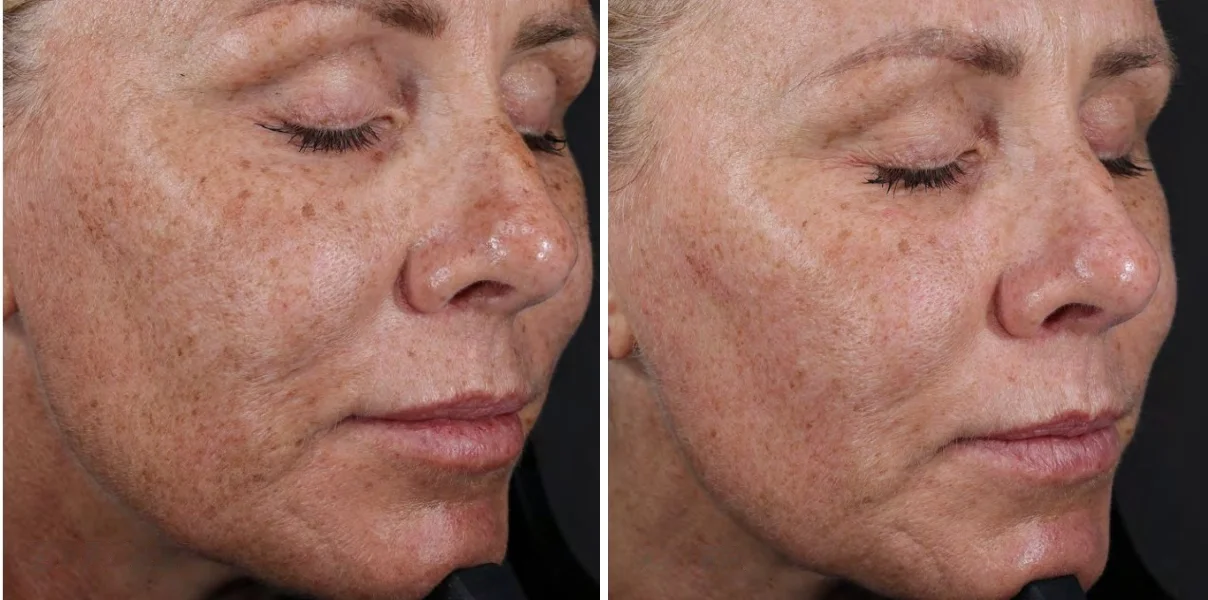
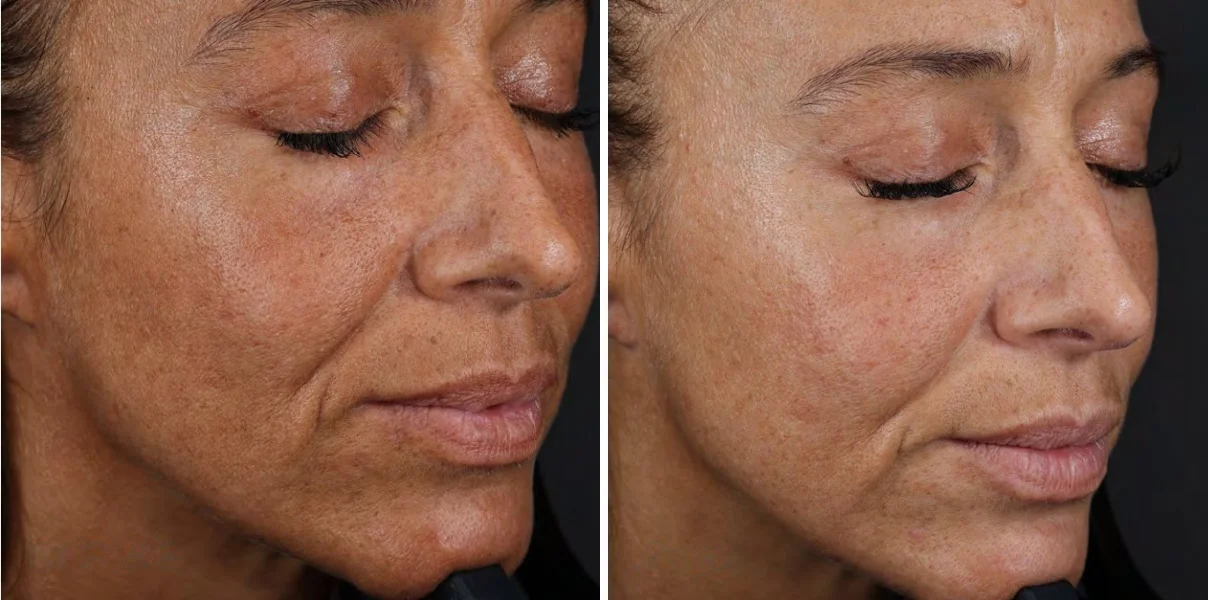
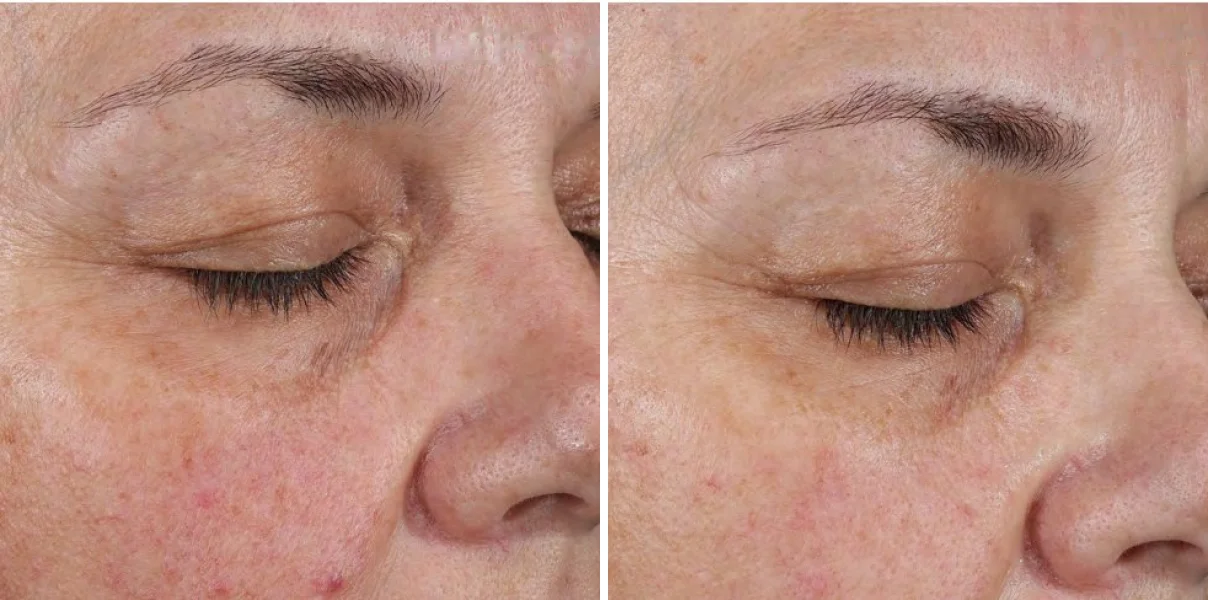
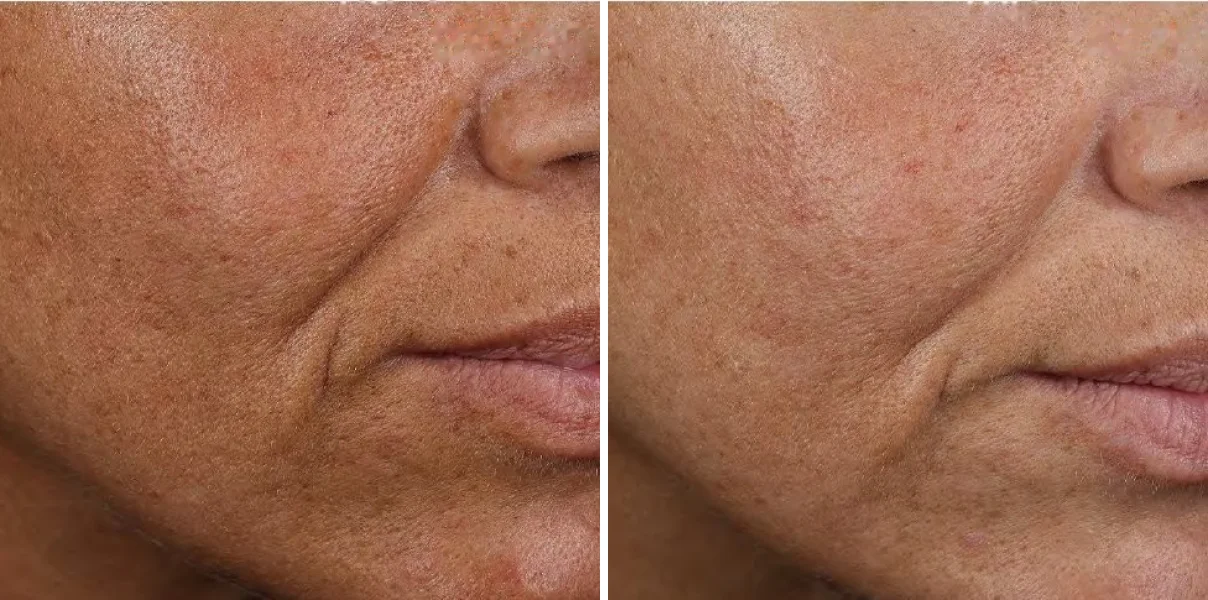
Participants in the 8-week user trial of our liquid marine collagen, photographed before and after. Each figure is the share of the 106 women who gave that answer.
Two more voices, in their own words: a beauty editor who tried marine collagen for a magazine, and a buyer of our liquid marine collagen.
“And truthfully? My skin looks better than ever.”
She calls herself a sceptic. After taking marine collagen every day for two months she found her skin plumper, healthier and noticeably more radiant.
Shannon LawlorBeauty editor, writing in Marie Claire UK13
“I can really see the visible changes in my skin and nails.”
★★★★★
Check4YouVerified purchase · Amazon, Germany · 27 December 2023
An independent first-person account of marine collagen published by the outlet named, and a verified buyer review of our liquid marine collagen as sold under our manufacturer's own label.
If firmness is the change you are after, the trials on that single outcome are gathered in collagen for skin firmness.
Questions about collagen types
How many types of collagen are there?
At least 28 types have been identified, with types I to IV the most prevalent. Type I is by far the largest, accounting for over 90% of the total collagen in the human body.
What is the difference between collagen type 1, 2 and 3?
Types I, II and III differ in where your body keeps them, and type I is the most common type in skin, bone, teeth and tendon. Type II is present in cartilage, and type III is most commonly found in skin, muscle and blood vessels.
Which type of collagen is best for skin?
Skin's own collagen is mostly types I and III: type I makes up 80% to 90% of the collagen in skin, and young skin is about 15% type III. The skin trials described above used between 1,000 mg and 10 g of collagen a day. Core™ supplies 11,000 mg of marine collagen of types I and III.
What type of collagen is marine collagen?
A peer-reviewed review states that fish skin typically contains type I collagen with a high degree of purity. Each product has its own specification, and the marine collagen in Core™ is types I and III.
Is type I or type III the main collagen in skin?
Type I is the main collagen in skin, at 80% to 90% of skin collagen. Type III comes second, at about 15% of the collagen in young skin. Core™ contains both.
Can you take collagen types I and III together?
Yes, Core™ already pairs types I and III, and one portion holds 11,000 mg of hydrolysed marine collagen, types I and III. Take one portion a day, straight or stirred into water or a smoothie.