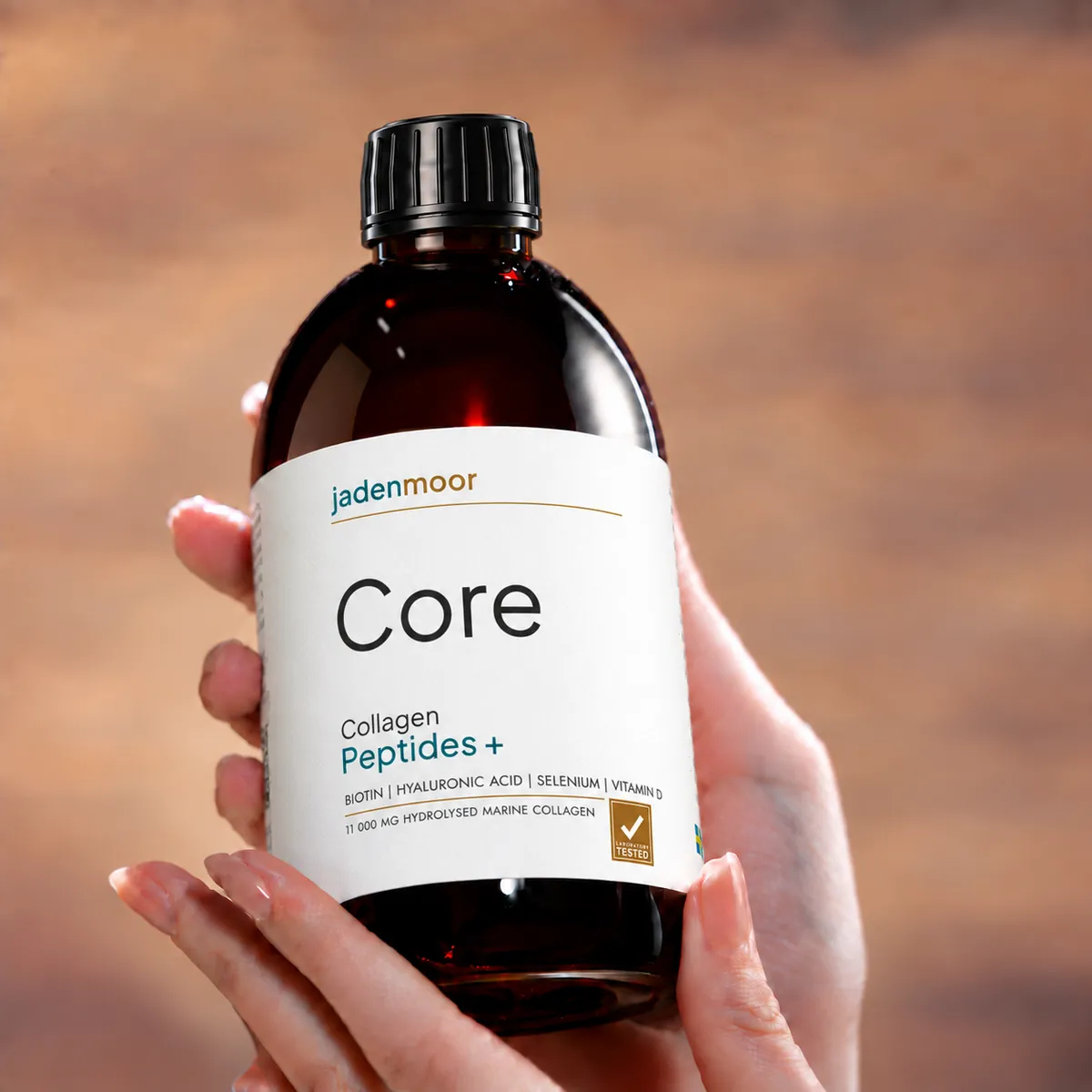
Most of the pooled skin trials used fish. Of 26 trials pooled in a 2023 meta-analysis, 14 used fish-derived collagen, and its authors described fish as the optimal source for improving skin hydration.
- 14 of 26 pooled trials used fish-derived collagen. Two used porcine, one bovine and one chicken, and nine did not report the source.
- A bovine collagen peptide drink has a placebo-controlled trial too: skin hydration up 28.0% from baseline in the collagen group, against 9.0% with placebo, on a 12-week drink that also held acerola extract, vitamin C, zinc, vitamin E and biotin.
- Core™ is marine: 11,000 mg of hydrolysed marine collagen, types I and III, in each portion.
of 106 women felt the appearance of their skin improved after 8 weeks on our liquid marine collagen.
- 89%reported more moisture and glow
- 87%noticed fewer fine lines and wrinkles
- 81%reported firmer skin
Is marine collagen better than bovine?
Marine collagen has the larger body of skin evidence, because most of the pooled skin trials used fish. A 2023 meta-analysis pooled 26 randomised controlled trials with 1,721 participants and found that oral collagen significantly improved skin hydration and elasticity compared with placebo.1 When its authors sorted those trials by where the collagen came from, 14 had used fish-derived collagen. Two had used porcine collagen, one bovine and one chicken, and nine did not report the source.1
For skin hydration, the authors concluded that fish was the optimal source.1 Their reading rests on the pooled results for one outcome, hydration. A bovine collagen peptide drink has a placebo-controlled trial of its own, shown in the last card below.
14 of the 26 pooled trials used fish-derived collagen
The analysis found oral collagen significantly improved skin hydration and elasticity compared with placebo, with a larger hydration effect when collagen was taken for more than 8 weeks.1
26 randomised controlled trials · 1,721 participants
Fish, porcine and bovine collagen all raised collagen peptides in blood
Six healthy adults took a single 10 g dose of fish-skin, porcine-skin and bovine-hide collagen hydrolysates of 2,000 Da in a 2024 crossover study. All three raised blood levels of collagen peptides.2
Six healthy adults · randomised crossover
Skin hydration up 28.0% from baseline, against 9.0% with placebo
The drink held 2.5 g of bovine collagen peptides plus acerola extract, vitamin C, zinc, vitamin E and biotin. From baseline, the collagen group also saw wrinkle depth fall 26.8% (placebo 6.4%) and skin density rise 24.8% (placebo 6.8%).3
72 women aged 35 and over, 36 per group · randomised, placebo-controlled
An earlier single-blind crossover study in five healthy men compared type I gelatin hydrolysates from fish scale, fish skin and porcine skin. It found that the amount and structure of the hydroxyproline-containing peptides appearing in blood depended on the source.4 Both studies measured blood, and our article on whether collagen is absorbed walks through that research step by step.
Where does each collagen come from?
Marine collagen comes from fish, while bovine collagen comes from cattle. A peer-reviewed review states that fish skin typically contains type I collagen with a high degree of purity.5 Scales are used as well, and two of the trials further down tested fish-scale collagen peptides.
Marine collagen can also be made from what fish processing leaves behind. A second review reports that fish-processing waste represents approximately 25% of total production, and its authors conclude that marine organisms and their wastes can be a sustainable, eco-friendly source of collagen.6
Bovine collagen comes from cattle. The bovine hydrolysate in the 2024 blood study was made from bovine hide.2
Whichever animal it starts in, the studies here tested the hydrolysed form: fish collagen peptides, marine collagen hydrolysate and bovine collagen peptides.

assets/img/blog/mb-source.webpWhich collagen did the skin trials use?
Seven of the eight skin trials in our evidence used fish or marine collagen and one used bovine collagen, though papers do not all use the same word. Some say fish, some say marine and some name the part of the fish, so the table keeps each study's own label.
Eight skin trials, sorted by the collagen they used
Collagen source as each paper states it, the daily amount, and what the trial measured.
| Study | Collagen source as stated | What was measured |
|---|---|---|
| Kim 20187 | Low-molecular-weight fish collagen peptide, 1,000 mg a day | Trial of 64 women aged 40 to 60 over 12 weeks. Skin hydration was significantly higher than placebo at 6 weeks and at 12 weeks. Crow's-feet wrinkling and skin elasticity were significantly better than placebo at 12 weeks. |
| Evans 20218 | Hydrolysed fish collagen, 10 g a day | Women aged 45 to 60 over 12 weeks. Wrinkle score fell 35% from baseline on the right side of the face, a 24% greater reduction than placebo. |
| Reilly 20249 | Marine collagen drink: 8 g of hydrolysed collagen plus vitamin C a day | Adults aged 40 to 60, about 90% of them women, over 12 weeks. In the collagen group, the authors reported hydration up 13.8% and elasticity up 22.7% at 12 weeks. |
| Sangsuwan 202110 | Marine collagen hydrolysate, 5 g a day | Trial of 36 postmenopausal women over 4 weeks. Cheek skin elasticity improved compared with placebo, and the difference was still there four weeks after stopping. |
| Duangjai 202511 | Collagen from freshwater fish skin, 5 g a day | Menopausal women aged 45 to 60 over 6 months. Skin elasticity improved by 12.23% from baseline in the collagen group of 20 women, significantly more than placebo. |
| Jung 202112 | Fish-scale collagen peptides, 1,000 mg a day | Adults aged 35 to 60 with dry skin over 12 weeks (50 randomised, 44 completed). A skin moisture reading improved by 7.33%, against 2.83% with placebo. |
| Koizumi 201813 | Fish-scale collagen peptides, 3,000 mg in a 20 ml daily drink | Trial of 71 healthy women aged 30 to 60 over 12 weeks. Periorbital wrinkles fell significantly versus placebo, and facial skin moisture and elasticity rose in the collagen group. |
| Bolke 20193 | Bovine collagen peptides, 2.5 g a day, in a drink with acerola extract, vitamin C, zinc, vitamin E and biotin | Trial of 72 women aged 35 and over across 12 weeks. From baseline, the collagen group's skin hydration rose 28.0% (placebo 9.0%) and wrinkle depth fell 26.8% (placebo 6.4%). |
Every row but the last is fish or marine collagen, at daily amounts from 1,000 mg to 10 g. The Reilly and Bolke rows are drinks with added nutrients, so their figures belong to the whole drink. If hydration is your main interest, our guide to collagen for skin hydration goes deeper into how those readings are taken.
What types of collagen are in marine collagen?
Marine collagen from fish skin is typically type I, and the marine collagen in Core™ is types I and III, two of the many kinds of collagen your body makes. At least 28 types have been identified, with types I to IV the most prevalent, and type I accounts for over 90% of the total collagen in the human body.14
- Type I is the most common type in skin, bone, teeth and tendon.15
- Type II is present in cartilage.15
- Type III is most commonly found in skin, muscle and blood vessels.15
Skin is mostly type I, which makes up 80% to 90% of its collagen, and young skin is about 80% type I and about 15% type III.16
On the marine side, the fish collagen review quoted above states that fish skin typically contains type I collagen.5 The marine collagen in Core™ is types I and III, as set out in its product specification.17
Why does Core™ use marine collagen?
Core™ uses marine collagen for four reasons: its record in skin trials, its collagen types, a source that can be sustainable, and the fact that it carries no religious restrictions.
- The trial record. Fish-derived collagen was used in 14 of the 26 pooled skin trials, and the authors of that analysis described fish as the optimal source for improving skin hydration.1
- The types. Core's hydrolysed marine collagen is types I and III.17
- What a review says about the source. According to a peer-reviewed review of marine collagen in general, it can be made from fish-processing by-products, and its authors conclude that marine organisms and their wastes can be a sustainable, eco-friendly source of collagen.6
- Who can take it. The same review notes that marine collagen carries no religious restrictions.6
The collagen in Core™ is also hydrolysed to a low molecular weight of about 1,500 daltons. Native collagen is about 300,000 daltons, roughly 200 times larger.17 One portion of Core™ holds 11,000 mg of it, in a sugar-free drink with a natural berry flavour.17
What did women report on our liquid marine collagen?
In our user trial, 95% of 106 women felt the appearance of their skin improved after taking our liquid marine collagen daily for 8 weeks. They described visible results in as little as 4 weeks, with further improvement by week 8.17
felt that the appearance of their skin improved.
reported more moisture and glow.
found it easy to include in their daily routine.


Participants in the 8-week user trial of our liquid marine collagen, photographed before and after.
Two writers who chose marine collagen
Both published accounts below are about marine collagen.
“And truthfully? My skin looks better than ever.”
A self-confessed sceptic, she took marine collagen every day for two months and found her skin plumper, healthier and noticeably more radiant.
Shannon LawlorBeauty editor, writing in Marie Claire UK18
“To my surprise, these worked.”
After around six months on 10,000 mg of marine collagen a day she reported glowier, more even skin that held on to hydration for longer, and nails that were less brittle.
Charlotte BitmeadWriting in Stylist19
“The taste is amazing and it is sugar free! Love what it does to my hair, nails and skin.”
★★★★★
Suzanne H.Verified purchase · Amazon, United Kingdom · 26 August 2024
Independent first-person accounts of marine collagen published by the outlets named, and a verified buyer review of our liquid marine collagen as sold under our manufacturer's own label.
For everything this ingredient is studied for beyond the source question, see our guide to marine collagen for women.
Questions about marine and bovine collagen
Is marine collagen better than bovine collagen for skin?
In a 2023 meta-analysis of 26 trials, 14 used fish-derived collagen and one used bovine, and the authors described fish as the optimal source for improving skin hydration. That conclusion is theirs and applies to hydration.
What is the difference between fish collagen and beef collagen?
Fish collagen and beef collagen differ in the animal they come from: marine collagen is made from fish, including fish skin, scales and fish-processing by-products, while bovine collagen comes from cattle. In the studies here, both were taken in hydrolysed form.
What type of collagen is marine collagen?
Marine collagen from fish skin is typically type I collagen with a high degree of purity, according to a peer-reviewed review. The marine collagen in Core™ is types I and III. Type I makes up 80% to 90% of the collagen in skin.
Is marine collagen suitable if I do not eat beef or pork?
Yes, the collagen in Core™ is hydrolysed marine collagen, made from fish rather than beef or pork. A peer-reviewed review of marine collagen notes that it carries no religious restrictions.
Does bovine collagen work for skin too?
Bovine collagen has skin evidence too: in one placebo-controlled trial, women on a drink with 2.5 g of bovine collagen peptides plus acerola extract, vitamin C, zinc, vitamin E and biotin saw skin hydration rise 28.0% from baseline over 12 weeks, against 9.0% with placebo.
How much marine collagen is in one portion of Core™?
One portion has 11,000 mg of hydrolysed marine collagen, types I and III. You take one portion a day, straight or stirred into water or a smoothie.