The trials say yes for elasticity, the measurable side of firmness. Skin elasticity improved compared with placebo at 4 weeks in one trial, at 8 weeks in a second and at 12 weeks in a third.
- Cheek elasticity better than placebo after 4 weeks, in a trial of 36 postmenopausal women, with 5 g of marine collagen hydrolysate a day.
- Elasticity up 12.23% from baseline after 6 months in the collagen group of 20 women, in a trial of 5 g a day of collagen from freshwater fish skin.
- 26 trials, 1,721 participants: a 2023 meta-analysis found that oral collagen significantly improved skin elasticity compared with placebo.
of 106 women reported firmer skin after 8 weeks on our liquid marine collagen.
- 95%felt the appearance of their skin improved
- 87%noticed fewer fine lines and wrinkles
- 89%reported more moisture and glow
What is the difference between skin firmness and elasticity?
Firmness is how your skin feels, while elasticity is the mechanical side of the same thing: how far skin stretches, and how completely it returns. Firmness is how your cheek sits when you smile, and how your skin answers when you press a fingertip into it. A laboratory has no dial marked "firm", so the collagen trials in this article report elasticity.
Skin elasticity is usually measured with a Cutometer. A small probe applies suction to the skin, then records how far the skin is drawn in and how fully it springs back.1 One of its readings is R2, or gross elasticity: the ratio of final retraction to maximal deformation. A higher R2 means more elastic skin.1 Different trials report different readings, so treat each result below as belonging to its own study.
Why does skin lose its spring with age?
Skin loses its spring with age because the two proteins behind it decline: collagen production falls while breakdown rises, and elastin is barely renewed in adult life. Collagen is the main structural protein of skin and accounts for about 75% of its dry weight. Type I makes up 80 to 90% of skin collagen and type III 8 to 12%.2 Elastic fibres, built from elastin, give skin its stretch and recoil, yet they make up only about 2% to 4% of the fat-free dry weight of the dermis.3
With age, collagen production falls and breakdown rises, and the fibres in aged skin are fragmented.2 Elastin is laid down mainly before and shortly after birth, so it is barely renewed in adult life.3 Both changes lie behind skin that feels less springy, and behind every search for help with sagging skin.
The years around menopause add their own chapter: a review of oestrogen and skin reports that elasticity can fall by about 1.5% a year in early postmenopause,4 a subject we follow in collagen and menopause.

assets/img/blog/fm-spring.webpHow could a collagen drink change skin elasticity?
In an 8-week trial of 114 women aged 45 to 65 taking 2.5 g of collagen peptides a day or placebo, skin samples taken at the end showed 65% more procollagen type I and 18% more elastin in the collagen group than in the placebo group.5
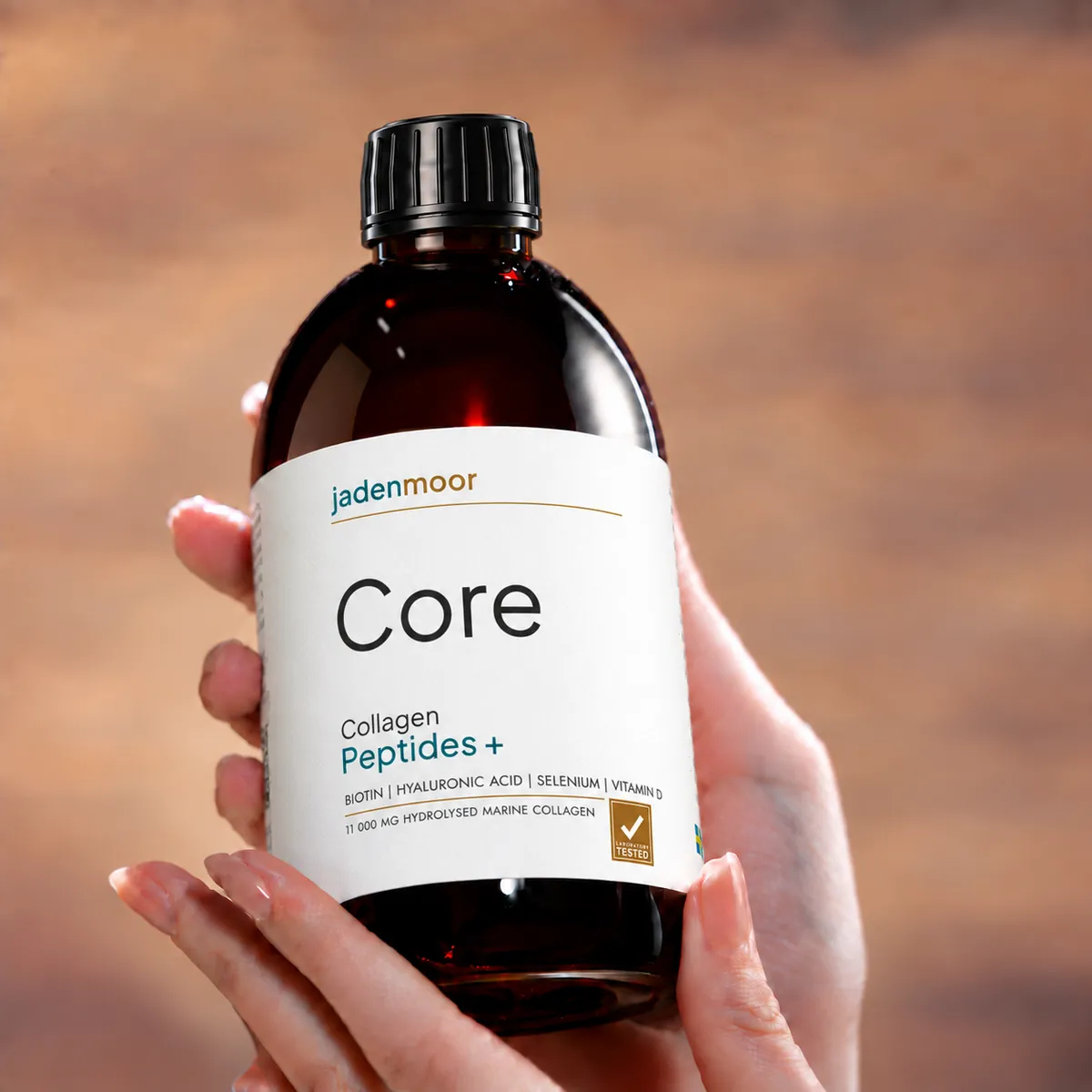
Core™ is built for the same daily habit. Its marine collagen is hydrolysed to about 1,500 daltons, where native collagen is about 300,000 daltons, roughly 200 times larger. One portion holds 11,000 mg of it, types I and III, alongside 120 mg of vitamin C.6 Vitamin C contributes to normal collagen formation for the normal function of skin.
Does collagen help sagging skin? The elasticity trials
Pooled trial results point to yes for skin elasticity: a 2023 meta-analysis of 26 randomised controlled trials with 1,721 participants found that oral collagen significantly improved skin elasticity compared with placebo.7 A 2021 meta-analysis of 19 randomised double-blind trials, with 1,125 participants aged 20 to 70 and about 95% of them women, concluded that 90 days of hydrolysed collagen improved skin elasticity.8
Single trials each have their own participants, amount and reading, and four of them follow.
Cheek elasticity better than placebo
With 5 g of marine collagen hydrolysate a day, cheek skin elasticity improved compared with placebo in 4 weeks. The gap between the groups was still there four weeks after the last dose.9
36 postmenopausal women · randomised, double-blind, placebo-controlled
Both amounts improved elasticity
Women took 2.5 g or 5.0 g of collagen hydrolysate, or placebo, once daily. Elasticity improved significantly in both collagen groups compared with placebo. In older women it was still higher 4 weeks after the last dose.10
69 women aged 35 to 55 · double-blind, placebo-controlled
Elasticity up 12.23% from baseline
On 5 g a day of collagen from freshwater fish skin, elasticity rose 12.23% from baseline in the collagen group of 20 women, significantly more than placebo.11
Menopausal women aged 45 to 60 · randomised, placebo-controlled
Authors reported elasticity +22.7% in the collagen group
The drink supplied 8 g of hydrolysed collagen plus vitamin C each day. In the collagen group, the authors reported elasticity up 22.7% at 12 weeks.12
Adults aged 40 to 60, about 90% of them women · randomised, double-blind, placebo-controlled · 48 on collagen, 52 on placebo
The elasticity trials side by side
Who took part, how much collagen they took each day, and what the study recorded.
| Study | Daily amount | People | What changed | When |
|---|---|---|---|---|
| Sangsuwan 20219 | 5 g of marine collagen hydrolysate | 36 postmenopausal women | Cheek elasticity improved compared with placebo | 4 weeks |
| Proksch 201410 | 2.5 g or 5.0 g of collagen hydrolysate | 69 women aged 35 to 55 | Elasticity improved significantly in both collagen groups compared with placebo | 8 weeks |
| Kim 201813 | 1,000 mg of low-molecular-weight fish collagen peptide | 64 women aged 40 to 60 | Elasticity significantly better than placebo | 12 weeks |
| Reilly 202412 | A marine collagen drink with 8 g of hydrolysed collagen plus vitamin C | Adults aged 40 to 60, about 90% of them women; 48 on collagen | Elasticity +22.7% in the collagen group, the authors reported | 12 weeks |
| Duangjai 202511 | 5 g of collagen from freshwater fish skin | Menopausal women aged 45 to 60; collagen group of 20 | Elasticity up 12.23% from baseline, significantly more than placebo | 6 months |
| Pilot trial, 201814 | A 30 ml drink with 10 g of fish-derived collagen peptide plus 400 mg ornithine | 22 Japanese adults aged 31 to 48 | Change in Cutometer reading from baseline better than placebo: 0.766 to 0.784 with the drink, 0.818 to 0.779 with placebo, measured at the neck | 8 weeks |
Across the rows, the daily amounts ran from 1,000 mg to 10 g, and the readings were taken anywhere from 4 weeks to 6 months in.
Elasticity is one of several skin outcomes these studies tracked. The lines are covered in collagen for wrinkles, and moisture in collagen for skin hydration.
Before and after: what 106 women reported after 8 weeks
In the user trial of our liquid marine collagen, 81% of 106 women reported firmer skin after drinking it daily for 8 weeks. Only you can say whether your skin feels firmer, so the women answered a questionnaire.6 These figures are shares of women, not instrument readings.
reported firmer skin.
felt that the appearance of their skin improved.
noticed a reduction in fine lines and wrinkles.
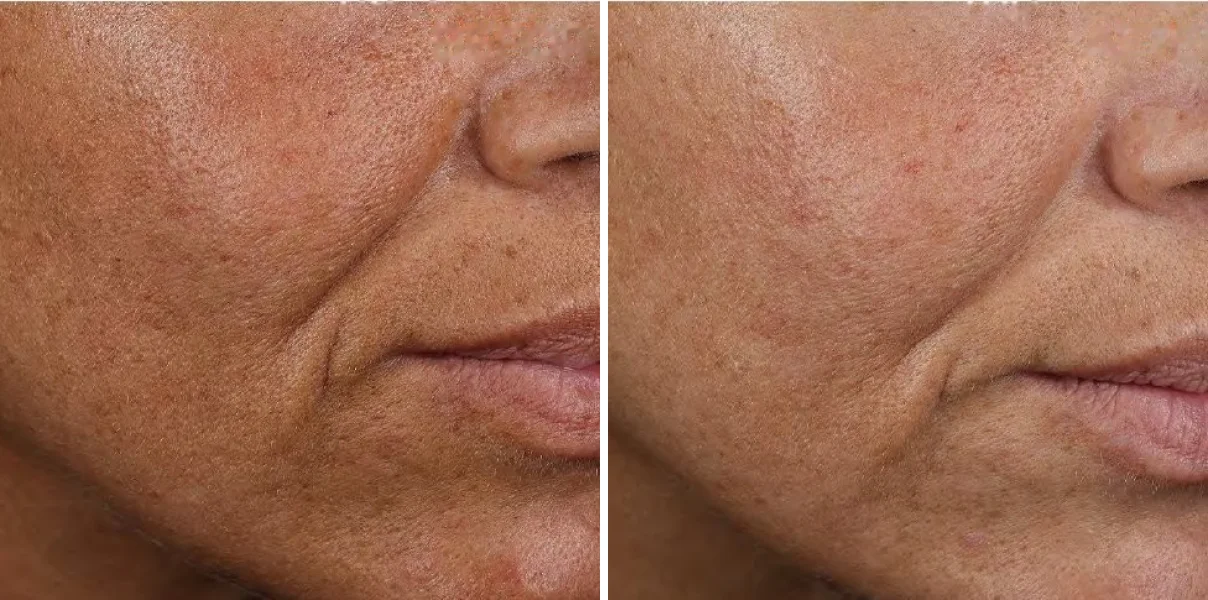
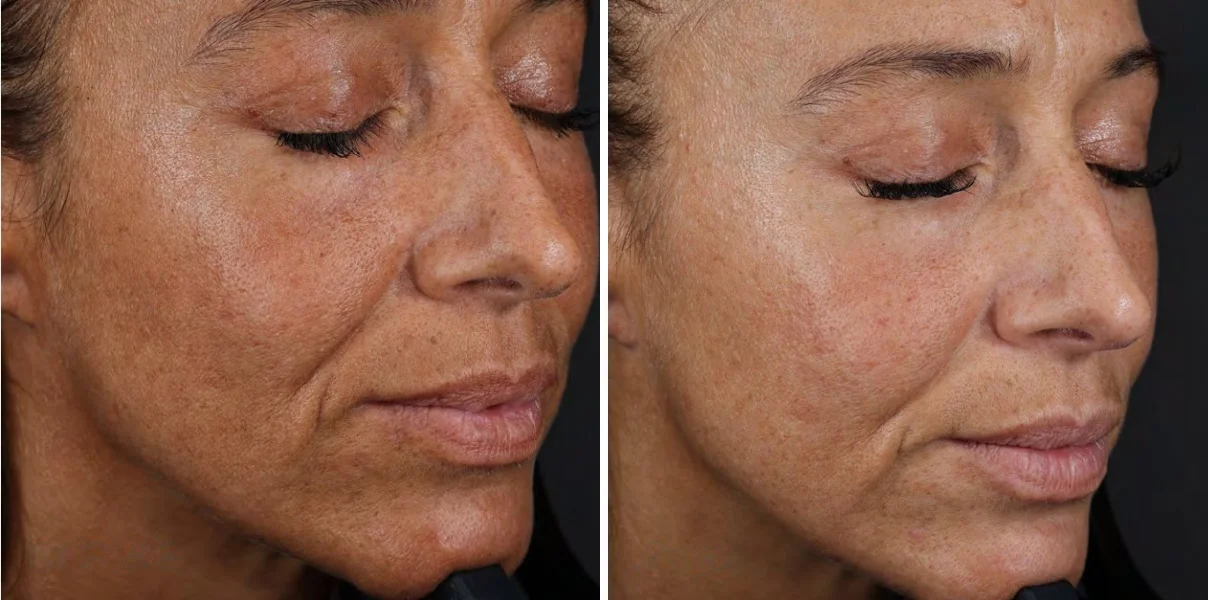
Participants in the 8-week user trial of our liquid marine collagen, photographed before and after.
Women in that trial reported visible results in as little as 4 weeks, with further improvement by week 8.6 For the week-by-week view across skin, hair and nails, see how long collagen takes to work.
What women say about plumper skin
Two beauty editors described their skin as plumper after two or three months of daily marine collagen, and between them sits a buyer of our own formula who says her skin looks great.
“And truthfully? My skin looks better than ever.”
She began as a self-confessed sceptic. Two months of marine collagen every day left her skin plumper, healthier and noticeably more radiant.
Shannon LawlorBeauty editor, writing in Marie Claire UK15
“My skin looks great, with no fine lines. I'm 45 and will definitely keep using it.”
★★★★★
FrédériqueVerified purchase · Amazon, France · 18 May 2024
“The fine lines have definitely softened.”
Her first month brought softer, smoother skin. By the end of three months of daily marine collagen it had turned plumper and glowier.
Eleanor VousdenBeauty editor, writing in Who What Wear UK16
Independent first-person accounts of marine collagen published by the outlets named, and a verified buyer review of our liquid marine collagen as sold under our manufacturer's own label.
How to take collagen for skin firmness
- Once a day. Every elasticity trial in the table used a daily amount. With Core™ that is one portion: shake, pour into the cap, then drink it straight or stir it into water or a smoothie.
- A full amount. The clinical trials behind our articles used between 1 g and 10 g of collagen peptides a day. One portion of Core™ gives you 11,000 mg of hydrolysed marine collagen.
- With vitamin C in the same portion. Vitamin C contributes to normal collagen formation for the normal function of skin, and Core™ carries 120 mg of it.
- Long enough to judge. The elasticity readings above came at 4 weeks, 8 weeks, 12 weeks and 6 months, all on daily collagen.
Questions about collagen, firmness and elasticity
Does collagen make skin firmer?
Trials measure elasticity rather than firmness, and the ones here found it improved: in a trial of 36 postmenopausal women, 5 g of marine collagen hydrolysate a day improved cheek elasticity compared with placebo in 4 weeks. In our own 8-week trial of our liquid marine collagen, 81% of 106 women reported firmer skin.
What is the difference between skin firmness and skin elasticity?
Firmness is how skin feels to you, while elasticity is how far skin stretches and how fully it springs back, which a Cutometer records using suction through a small probe. Trials report elasticity, and questionnaires ask about firmness.
How much collagen did the skin elasticity trials use?
The elasticity trials in this article used between 1,000 mg and 10 g a day. In a trial of 69 women aged 35 to 55, both 2.5 g and 5.0 g improved elasticity significantly compared with placebo after 8 weeks. Core™ provides 11,000 mg of hydrolysed marine collagen per portion.
How long does collagen take to improve skin elasticity?
The shortest trial here recorded better cheek elasticity than placebo at 4 weeks, and others took their readings at 8 weeks, 12 weeks and 6 months. In our user trial, women reported visible results in as little as 4 weeks, with further improvement by week 8.
Is marine collagen good for skin elasticity?
Marine collagen was the ingredient in the 4-week trial of 36 postmenopausal women, where cheek elasticity improved compared with placebo. In a 12-week trial of a marine collagen drink, the authors reported elasticity up 22.7% in the collagen group. Core's collagen is hydrolysed marine collagen, types I and III.
Does skin stay more elastic after you stop taking collagen?
Yes, in the two trials here that checked: in the trial of 36 postmenopausal women, the difference in cheek elasticity was still there four weeks after stopping. In the trial of 69 women, elasticity in older women was still higher 4 weeks after the last dose.