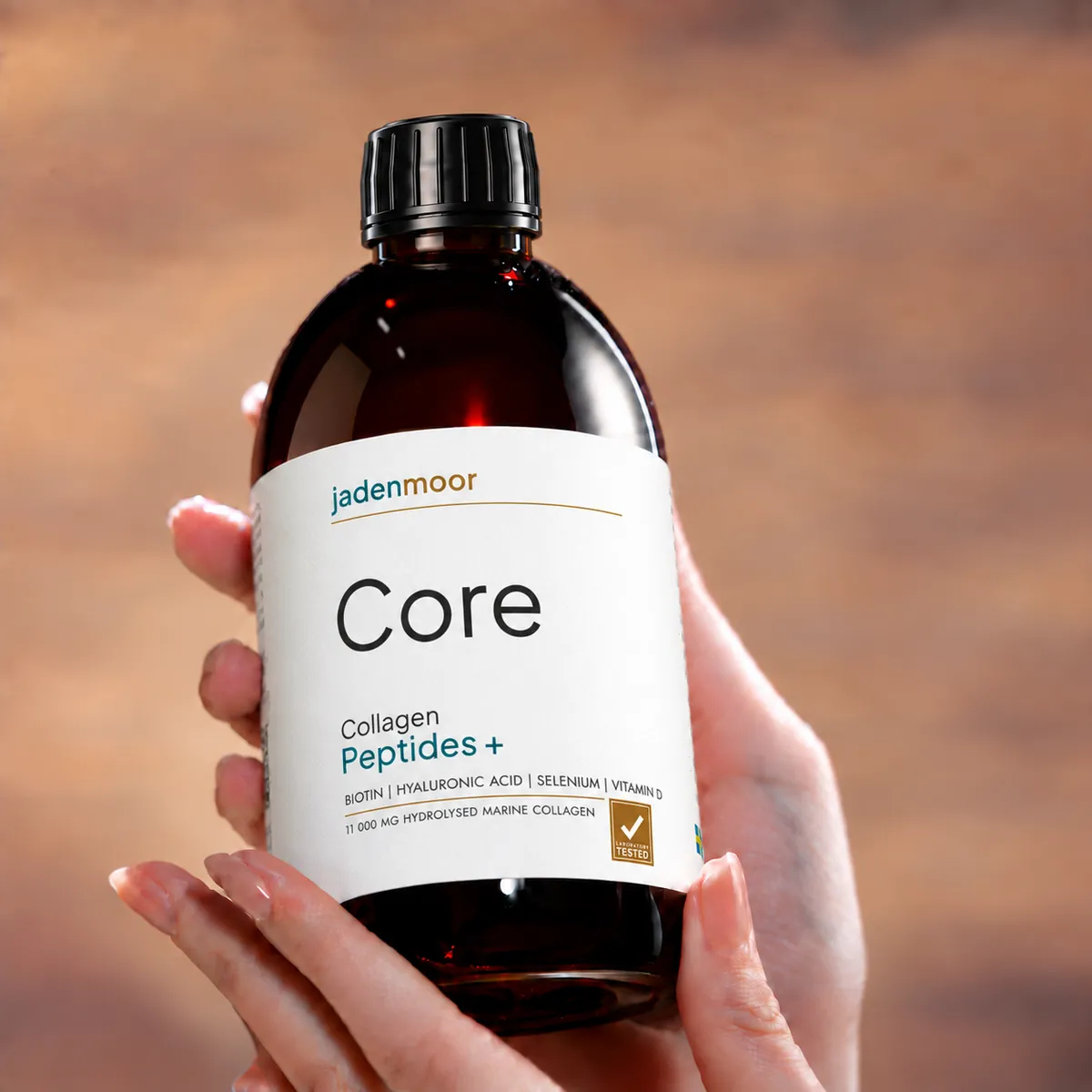
The EU list of permitted claims has two lines about hormones for vitamins in Core™. The first: vitamin B6 contributes to the regulation of hormonal activity.
- The second line. Pantothenic acid (vitamin B5) contributes to normal synthesis and metabolism of steroid hormones, vitamin D and some neurotransmitters.
- The science under them. For each line, EFSA concluded that a cause and effect relationship has been established between dietary intake of the vitamin and the role the line names.
- In one Core™ portion. 1.7 mg of vitamin B6 (121% NRV) and 5 mg of vitamin B5 (83% NRV).
of 106 women reported firmer skin after 8 weeks on our liquid marine collagen, in our user trial of the whole drink.
- 99%found it easy to include in their daily routine
- 95%felt the appearance of their skin improved
- 86%reported healthier hair
Which vitamins have an authorised claim about hormones?
Vitamin B6 and pantothenic acid (vitamin B5) are the two vitamins in Core™ with authorised wording about hormones, taken from the single list the EU keeps of the health wording a food label is permitted to carry, where every line is tied to a named nutrient, substance or food.1
Read that list with Core's label beside you and the word hormone turns up for two of its vitamins: vitamin B6 and pantothenic acid, the official name for vitamin B5.2 These are the two lines, exactly as authorised.1
- Vitamin B6. Vitamin B6 contributes to the regulation of hormonal activity.
- Vitamin B5. Pantothenic acid contributes to normal synthesis and metabolism of steroid hormones, vitamin D and some neurotransmitters.
Those are the authorised roles of two vitamins in Core™, and we are glad to print them in full. We stay within those two sentences and add the part a label has no room for, which is what each vitamin is and what the European Food Safety Authority (EFSA) looked at before each line was approved.
What does vitamin B6 do?
Vitamin B6 works in its active coenzyme forms as a small helper that enzymes need, and its authorised hormone line covers the regulation of hormonal activity. It belongs to the B group, which the author of a scientific review describes as eight water-soluble vitamins.3 The NIH fact sheet on vitamin B6 adds that its active coenzyme forms take part in more than 100 enzyme reactions, mostly concerned with protein metabolism.4 A coenzyme is a small helper that an enzyme needs in order to do its work.
One of those active forms is called pyridoxal phosphate, PLP for short, and it is the centre of the hormone line. EFSA's opinion on vitamin B6 and hormonal activity rests on the role of PLP in controlling the action of certain hormones: those that work by binding to a nuclear receptor protein and modulating gene expression.5
In everyday language, these are hormones that deliver their message by attaching to a receptor and changing how active particular genes are. EFSA's opinion points to the role of PLP in controlling that action.
EFSA's examples in this context include androgens, oestrogens, progesterone, glucocorticoids and thyroid hormone.5 The list is EFSA's own, of hormones acting through this kind of receptor.
EFSA concluded that a cause and effect relationship has been established between dietary vitamin B6 intake and the regulation of hormonal activity, and it considers this regulation beneficial to human health.5 The opinion is published as EFSA Journal 2009;7(9):1225.
The same vitamin has other entries on the permitted list. Vitamin B6 contributes to normal energy-yielding metabolism, for example, and our article on B vitamins and metabolism takes that line apart in the same way.1

assets/img/blog/mh-pour.webpWhat does pantothenic acid (vitamin B5) do?
According to the NIH fact sheet, vitamin B5 is a water-soluble B vitamin whose main job is to help make coenzyme A, usually shortened to CoA.6 CoA is essential for building and breaking down fatty acids.6
CoA is also where the hormone wording comes from. EFSA's opinion on pantothenic acid notes that, in the form of coenzyme A, it is required for the synthesis of cholesterol, steroid hormones and vitamin D.7 The vitamin's part here is as a component of coenzyme A.
EFSA concluded that a cause and effect relationship has been established between dietary pantothenic acid intake and the normal synthesis and metabolism of steroid hormones, vitamin D and some neurotransmitters.7 You can find it as EFSA Journal 2009;7(9):1218.
Three things are named in that sentence, and the authorised wording keeps all three together. That is why we always quote it whole: pantothenic acid contributes to normal synthesis and metabolism of steroid hormones, vitamin D and some neurotransmitters.1
The same EFSA opinion describes pantothenic acid, as a component of CoA, as having central roles in energy, carbohydrate, protein and lipid metabolism.7
What do these claims mean in menopause?
The vitamin B6 and B5 hormone claims mean the same in menopause as at any other time. EFSA assessed both lines for the general population, and the authorised wording is the same for everyone. They describe the normal role of a vitamin in the body.
Menopause may be the moment you begin reading a supplement label line by line, and "hormones" is a word that catches the eye. If that is you, you now have the two sentences behind that word in Core™, and the opinion that stands under each one, and the connection goes no further than that.
Where our blog covers what happens in the body after menopause, the subject is skin. As much as 30% of skin collagen is lost in the first five years after menopause, and total skin collagen then declines by an average of 2.1% per postmenopausal year over 15 years.8 We cover that separately in collagen and menopause.
What is in one Core™ portion?
One portion of Core™ provides 1.7 mg of vitamin B6, which is 121% NRV, and 5 mg of vitamin B5, which is 83% NRV.2 NRV stands for nutrient reference value, the daily reference intake EU food labels use to work out the percentage: 1.4 mg for vitamin B6 and 6 mg for pantothenic acid.9
The two vitamins in Core™ with authorised wording about hormones
Amount per portion, the EU reference intake used on labels, the permitted claim, and the basis EFSA gave for it.
| Nutrient | In one portion | EU reference intake | Authorised claim | What EFSA's opinion rests on |
|---|---|---|---|---|
| Vitamin B6 | 1.7 mg (121% NRV) | 1.4 mg | Vitamin B6 contributes to the regulation of hormonal activity. | The role of its active form, pyridoxal phosphate (PLP), in controlling the action of hormones that work by binding to a nuclear receptor protein and modulating gene expression.5 |
| Vitamin B5 (pantothenic acid) | 5 mg (83% NRV) | 6 mg | Pantothenic acid contributes to normal synthesis and metabolism of steroid hormones, vitamin D and some neurotransmitters. | In the form of coenzyme A, pantothenic acid is required for the synthesis of cholesterol, steroid hormones and vitamin D.7 |
Both vitamins sit in the same pour as 11,000 mg of hydrolysed marine collagen, in a sugar free portion with a natural berry flavour.2 The full label, nutrient by nutrient, is on the Core™ product page.
One neighbouring mineral has its own article. Selenium contributes to the normal thyroid function, and selenium and the thyroid explains that line on its own terms.1
What did women in our trial report?
In our user trial, 95% of 106 women felt the appearance of their skin improved and 81% reported firmer skin after taking our liquid marine collagen every day for 8 weeks. A user trial records an experience and speaks for the drink as a whole, and these are the women's answers about what they had noticed.2
reported firmer skin.
felt that the appearance of their skin improved.
found it easy to include in their daily routine.
Women in the trial also spoke about timing and reported visible results in as little as 4 weeks, with further improvement by week 8.2 The photographs below come from participants in that trial.


Participants in the 8-week user trial of our liquid marine collagen, photographed before and after.
“I can really see the visible changes in my skin and nails.”
★★★★★
Check4YouVerified purchase · Amazon, Germany · 27 December 2023
“My skin looks great, with no fine lines. I'm 45 and will definitely keep using it.”
★★★★★
FrédériqueVerified purchase · Amazon, France · 18 May 2024
Verified buyer reviews of our liquid marine collagen, as sold under our manufacturer's own label.
Ease came top of the trial answers. The routine is one portion a day. Shake, pour into the cap, and drink it straight or stir it into water or a smoothie.2 Once opened, the pack lives in the fridge.
Questions about vitamin B6, B5 and hormones
Which vitamins have an authorised claim about hormones?
Vitamin B6 and pantothenic acid (vitamin B5) are the two nutrients in Core™ with an authorised claim about hormones. Vitamin B6 contributes to the regulation of hormonal activity. Pantothenic acid (vitamin B5) contributes to normal synthesis and metabolism of steroid hormones, vitamin D and some neurotransmitters.
Are there vitamins for hormone balance?
Vitamin B6 is the vitamin with authorised wording on the regulation of hormonal activity, an exact sentence from the EU list of permitted claims that we use. Vitamin B6 contributes to the regulation of hormonal activity. EFSA concluded that a cause and effect relationship has been established between dietary vitamin B6 intake and the regulation of hormonal activity.
What is the vitamin B6 claim based on?
The vitamin B6 claim rests on the active form of the vitamin, pyridoxal phosphate. EFSA's opinion points to its role in controlling the action of hormones that work by binding to a nuclear receptor protein and modulating gene expression. EFSA considers this regulation beneficial to human health.
Is pantothenic acid the same as vitamin B5?
Yes, pantothenic acid is the name the EU list uses for vitamin B5. The NIH fact sheet describes it as a water-soluble B vitamin whose main job is to help make coenzyme A.
How much vitamin B6 and B5 is in Core™?
One portion has 1.7 mg of vitamin B6, which is 121% NRV, and 5 mg of vitamin B5, which is 83% NRV. The EU reference intakes behind those percentages are 1.4 mg and 6 mg.
Are these vitamin claims specific to menopause?
No, the vitamin B6 and B5 claims are general. EFSA assessed both lines for the general population, and the authorised wording is the same for everyone. They state the normal role of each vitamin. For what the research says about skin after menopause, see our article on collagen and menopause.