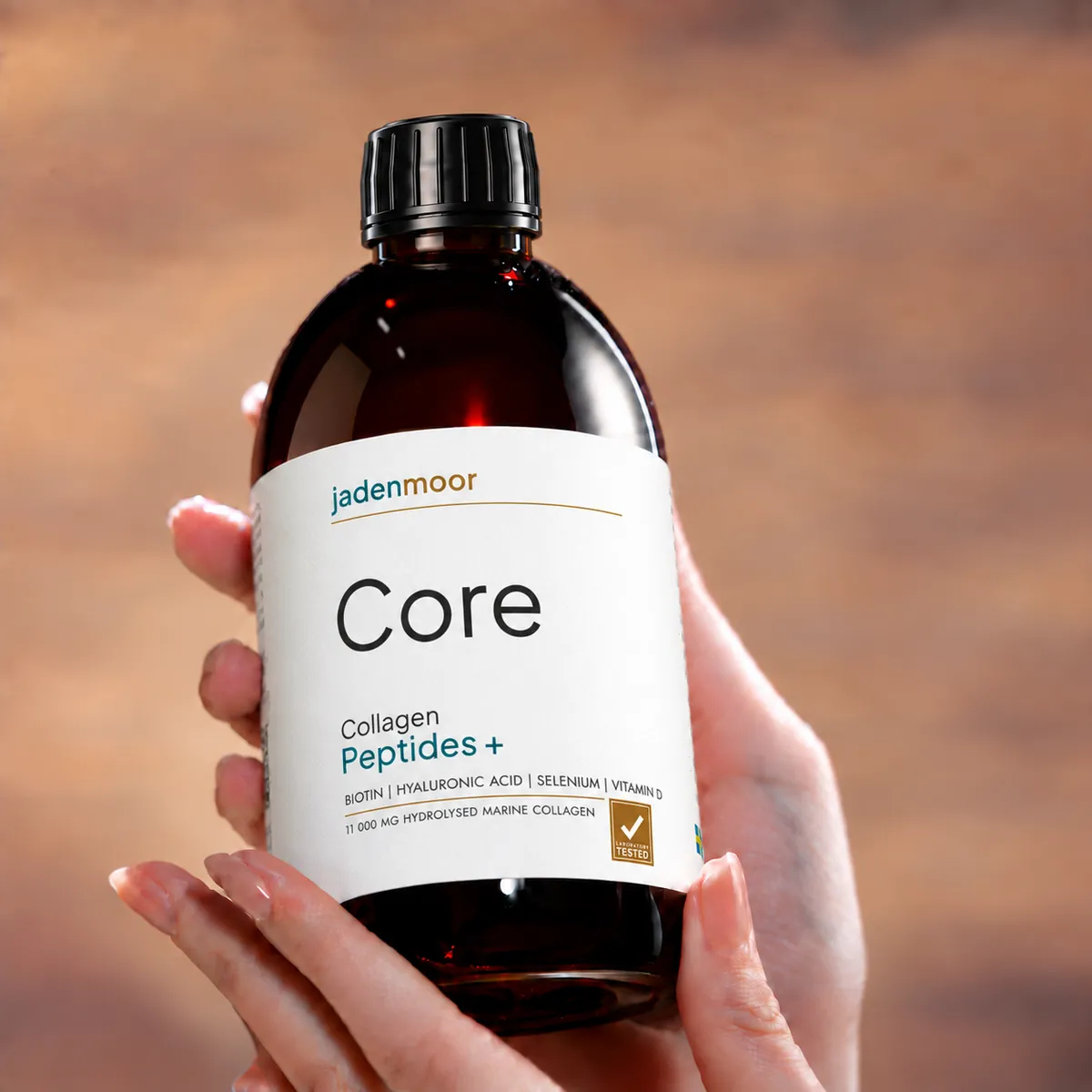
The EU list of permitted health claims answers it by name. Vitamin C, vitamin D, vitamin B6, vitamin B12 and selenium each contribute to the normal function of the immune system, and Core™ has all five.
- One wording, five nutrients. The phrase is identical for each: "the normal function of the immune system".
- Amounts on the label. Vitamin C 120 mg, vitamin D 60 µg, vitamin B6 1.7 mg, vitamin B12 24 µg and selenium 27.5 µg per portion.
- A second wording for two of them. Vitamin C contributes to the protection of cells from oxidative stress, and selenium contributes to the protection of cells from oxidative stress.
of 106 women said our liquid marine collagen was easy to include in their daily routine across an 8-week user trial.
- 95%felt their skin's appearance improved
- 86%reported healthier hair
- 76%reported stronger nails
Vitamin C, D, B6, B12: which vitamins contribute to the normal function of the immune system?
Vitamin C, vitamin D, vitamin B6, vitamin B12 and selenium are the five nutrients in Core™ that hold the EU's immune system wording, a far shorter answer than a search bar gives. A health claim on a food in the EU has to be on the official list of permitted health claims, and that list gives the wording for each named nutrient.1
Go through the Core™ label with that list beside you and five names qualify: vitamin C, vitamin D, vitamin B6, vitamin B12 and selenium.1 Four are vitamins, and selenium, a mineral, holds the same phrase.
What follows shows you the phrase, the five nutrients entitled to it, and the amount of each in a portion of Core™ liquid marine collagen. We quote the list as written and add nothing to it.
What does the EU list say, word for word?
The EU list uses the phrase "the normal function of the immune system", attached to one nutrient at a time and never to a whole product. The table gives each line in full, with the amount Core's label gives for that nutrient.2
The five nutrients in Core™ with the immune system wording
Authorised wording from the EU list of permitted health claims, with the amount in one portion of Core™.
| Nutrient | Authorised wording | In one Core™ portion |
|---|---|---|
| Vitamin C | Vitamin C contributes to the normal function of the immune system. | 120 mg (150% NRV) |
| Vitamin D | Vitamin D contributes to the normal function of the immune system. | 60 µg |
| Vitamin B6 | Vitamin B6 contributes to the normal function of the immune system. | 1.7 mg (121% NRV) |
| Vitamin B12 | Vitamin B12 contributes to the normal function of the immune system. | 24 µg (960% NRV) |
| Selenium | Selenium contributes to the normal function of the immune system. | 27.5 µg (50% NRV) |
In the right-hand column, NRV stands for nutrient reference value, the daily reference intake that EU labelling law sets for vitamins and minerals. It is 80 mg for vitamin C, 1.4 mg for vitamin B6, 2.5 µg for vitamin B12 and 55 µg for selenium.3 The percentage tells you where an amount sits against that labelling reference, and nothing more. Core's label states vitamin D by amount, 60 µg per portion.2

assets/img/blog/im-shot.webpWhat is each of these nutrients?
Vitamin C is the one your body cannot make, vitamin D is fat-soluble, vitamins B6 and B12 are water-soluble vitamins that work with enzymes, and selenium is a mineral built into 25 selenoproteins. The profiles come from reference fact sheets and one review. They describe the nutrients themselves, and each card ends with that nutrient's line from the EU list.
The one your body cannot make
Humans, unlike most animals, cannot make vitamin C in the body, so it has to come from the diet.4 Vitamin C contributes to the normal function of the immune system.1
120 mg per portion · 150% NRV
The fat-soluble one
Vitamin D is a fat-soluble vitamin. It promotes calcium absorption in the gut, and it is needed for bone growth and bone remodelling.5 Vitamin D contributes to the normal function of the immune system.1
60 µg per portion
A coenzyme in more than 100 reactions
Vitamin B6 is water-soluble. Its active coenzyme forms take part in more than 100 enzyme reactions, mostly concerned with protein metabolism.6 Vitamin B6 contributes to the normal function of the immune system.1
1.7 mg per portion · 121% NRV
A cofactor for two enzymes
Vitamin B12 is a water-soluble vitamin that works as a cofactor for two enzymes, methionine synthase and L-methylmalonyl-CoA mutase. It is required for healthy red blood cell formation and DNA synthesis.7 Vitamin B12 contributes to the normal function of the immune system.1
24 µg per portion · 960% NRV
The mineral inside 25 selenoproteins
Selenium is built into 25 selenoproteins in the human body. These proteins play roles in thyroid hormone metabolism, DNA synthesis and protection from oxidative damage.8 Selenium contributes to the normal function of the immune system.1
27.5 µg per portion · 50% NRV
Vitamin B6 and vitamin B12 belong to the same family. The B vitamins are a group of eight water-soluble vitamins, and the author of a review of the B vitamins reported that they act as coenzymes in a large share of the body's enzymatic processes.9
Several of these five have a longer story elsewhere on this blog. Selenium has its own piece on selenium and the thyroid, and vitamin C has one too, vitamin C and collagen. The B vitamins return in our guide to the vitamins with the EU wording on the reduction of tiredness and fatigue.
What about protection of cells from oxidative stress?
Vitamin C and selenium, two of the five above, also hold protection of cells from oxidative stress, a second phrase on the EU list treated the same way, with fixed words and named nutrients.1
- Vitamin C. Vitamin C contributes to the protection of cells from oxidative stress. One Core™ portion has 120 mg.
- Selenium. Selenium contributes to the protection of cells from oxidative stress. One Core™ portion has 27.5 µg.
The reference literature has a line on selenoproteins too. The NIH fact sheet lists protection from oxidative damage among the roles played by the body's selenoproteins.8 That sentence is about the proteins, and the authorised wording is the one in the list above.
Vitamin C and selenium therefore each appear twice here, once under the immune system and once under oxidative stress. Both phrases are quoted in full.
What is in one Core™ portion?
One portion of Core™ holds the five nutrients alongside 11,000 mg of hydrolysed marine collagen, the ingredient Core™ is named for. Everything below is per portion, taken from the product specification.2
- Marine collagen. 11,000 mg of hydrolysed marine collagen, types I and III, with 9.9 g of protein.
- The five in this article. Vitamin C 120 mg, vitamin D 60 µg, vitamin B6 1.7 mg, vitamin B12 24 µg and selenium 27.5 µg.
- The rest of the label. Hyaluronic acid 50 mg, silica 50 mg, biotin 5,000 µg and vitamin B5 5 mg.
- The drink itself. Natural berry flavour, sugar free and fat free, in a 500 ml pack.
The routine takes a moment. Shake the pack, pour a portion into the cap, and drink it straight or stirred into water or a smoothie. Once opened, the pack goes in the fridge. One portion a day is the serving.2
What did women in our trial report?
Women in our trial reported on the drink as a whole: 99% found it easy to include in their daily routine, 95% felt the appearance of their skin improved and 89% reported more moisture and glow. In that user trial, 106 women took our liquid marine collagen daily for 8 weeks and reported what they noticed. The questions covered skin, hair, nails and how the habit went.2
found it easy to include in their daily routine.
felt the appearance of their skin improved.
reported more moisture and glow.
Women in the trial reported visible results in as little as 4 weeks, with further improvement by week 8. Participants also reported more energy and better joint flexibility.2 These are the women's own reports about the complete drink over those 8 weeks.


Participants in the 8-week user trial of our liquid marine collagen, photographed before and after.
“The taste is amazing and it is sugar free! Love what it does to my hair, nails and skin.”
★★★★★
Suzanne H.Verified purchase · Amazon, United Kingdom · 26 August 2024
“My skin looks great, with no fine lines. I'm 45 and will definitely keep using it.”
★★★★★
FrédériqueVerified purchase · Amazon, France · 18 May 2024
“I can really see the visible changes in my skin and nails.”
★★★★★
Check4YouVerified purchase · Amazon, Germany · 27 December 2023
Verified buyer reviews of our liquid marine collagen, as sold under our manufacturer's own label.
Questions about vitamins and the immune system
Which vitamins are on the EU list for the immune system?
Vitamin C, vitamin D, vitamin B6, vitamin B12 and selenium, five of the nutrients in Core™, each contribute to the normal function of the immune system. The phrase is the same for all five.
Is vitamin D on that list too?
Yes, vitamin D is on the EU list for the immune system. Vitamin D contributes to the normal function of the immune system, in the same words used for vitamin C. One Core™ portion has 60 µg of vitamin D.
Is selenium a vitamin?
No, selenium is a mineral, and it holds the same authorised phrase as the four vitamins. Selenium contributes to the normal function of the immune system. A Core™ portion has 27.5 µg, which is 50% of the EU reference value of 55 µg per day.
How much vitamin C is in a Core™ portion?
A Core™ portion has 120 mg of vitamin C, shown on the label as 150% NRV. The EU daily reference intake for vitamin C is 80 mg, and that figure is a labelling reference.
Which nutrients have the wording on oxidative stress?
In Core™, vitamin C and selenium have the oxidative stress wording. Vitamin C contributes to the protection of cells from oxidative stress, and selenium contributes to the protection of cells from oxidative stress. Both are in every portion.
Do I take the five nutrients separately from the collagen?
No, the five nutrients and the collagen are in the same drink. One portion of Core™ has all five alongside 11,000 mg of hydrolysed marine collagen, and the serving is one portion a day.