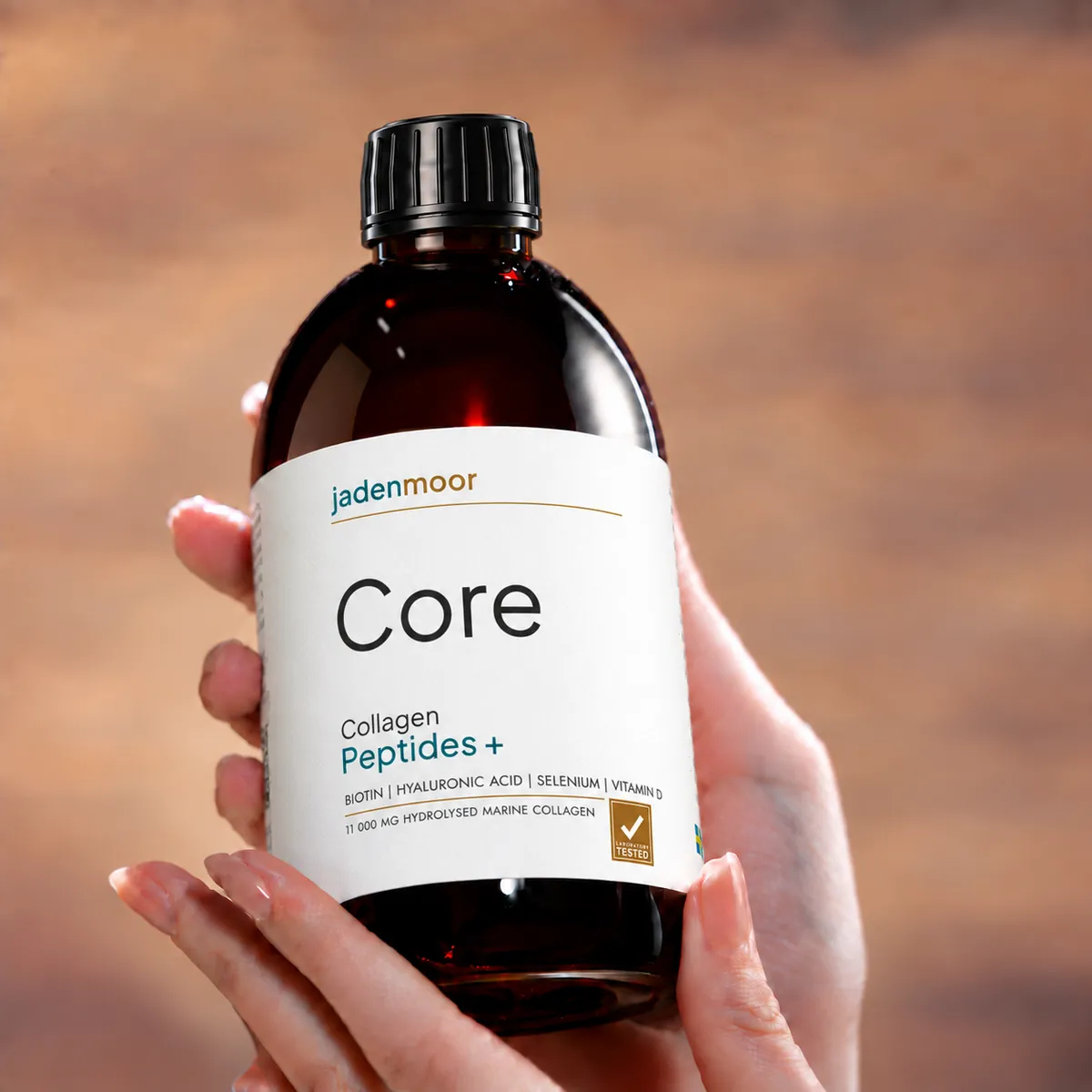
Two placebo-controlled trials whose age ranges take in the forties and fifties recorded better hair readings with daily collagen, and two nutrients in Core™ hold an authorised hair claim.
- Thickness, measured. In a 16-week trial of 44 healthy women aged 39 to 75, hair thickness rose by 1.93 micrometres on average with 2.5 g of collagen peptides a day, while placebo showed a slight dip of 0.99 micrometres.
- Appearance, graded. In a 12-week trial in adults aged 40 to 60, the expert-graded score for healthy hair appearance had improved by 31.9% on average with a marine collagen drink, against 9.4% with placebo.
- Claims, authorised. Biotin contributes to the maintenance of normal hair. Selenium contributes to the maintenance of normal hair.
of 106 women reported healthier hair after 8 weeks on our liquid marine collagen. The figure describes the complete drink.
- 76%reported stronger nails
- 95%felt the appearance of their skin improved
- 99%found it easy to include in their daily routine
Is hair change common in menopause?
Hair change was common when one research team counted it: more than half of 178 postmenopausal women in Thailand had female pattern hair loss, mostly of the mildest grade.
In one study of 178 postmenopausal women in Thailand, 52.2% had female pattern hair loss, and 73.2% of those cases were the mildest grade.1 Among the women in that study it was common and usually the mildest grade.
From counting we go on to anatomy, then to the measurements and the authorised wording.
Where does a hair grow from?
A hair grows from a follicle in the skin, below the part you can see. The length you colour, dry and pin up is the hair shaft, and the shaft is made of keratin, a protein.2 Each shaft is produced by a hair follicle, and each follicle sits in the dermis.2
The dermis is the layer that houses the hair follicles. Its deeper part is dense connective tissue made of collagen fibre bundles.3 Keratin is the strand and collagen belongs to the layer the strand grows out of, two different proteins in two different places.
Scalp hair grows about 1 cm a month.2 At that pace new length takes its time to arrive, and the two trials further down ran for 12 and 16 weeks.
The thinking behind the collagen hair research is that a follicle is only as well housed as the dermis around it. What the two trials below report is a reading taken from the hair.
assets/img/blog/mt2-part.webpWhat did collagen hair trials measure?
Two randomised, placebo-controlled trials measured hair: one tracked average hair thickness over 16 weeks, and the other an expert-graded score for healthy hair appearance over 12 weeks. Collagen has no authorised hair claim, so its case comes from studies like these. Neither is described as a menopause study, though the people who took part make them worth your time. The age range of the first runs from 39 to 75, and the second enrolled adults aged 40 to 60.
Average hair thickness: up 1.93 micrometres with collagen peptides, against a slight dip with placebo
The researchers measured how thick the hair was at the start and again after 16 weeks. On 2.5 g of collagen peptides a day, the average went up by 1.93 micrometres. On placebo it showed a slight dip of 0.99 micrometres. The difference between the groups was significant.4
44 healthy women aged 39 to 75 · randomised, placebo-controlled
Expert-graded score for healthy hair appearance: improved by 31.9% on average, against 9.4% with placebo
This trial relied on expert grading of how healthy the hair looked. Once the 12 weeks were up, the expert-graded score had improved by 31.9% on average in the group taking a daily marine collagen drink, against 9.4% with placebo. That is a change in a score. Each daily drink held 8 g of hydrolysed collagen plus vitamin C.5
Adults aged 40 to 60, about 90% of them women · randomised, double-blind, placebo-controlled · daily-dose groups: 48 on collagen, 52 on placebo
The 12-week trial asked a second kind of question too, and this time the answers are shares of participants. When the questionnaire came round, 66.7% of the collagen group agreed their hair felt thicker, against 44.2% on placebo. On the smoothness question, 77.1% agreed in the collagen group, against 55.8% on placebo.5
The two trials tested different ingredients, collagen peptides in the 16-week one and a marine collagen drink in the 12-week one. They used different yardsticks on different people, so each stands alone and they are not added up.
If you want the charts for these two studies, they live in our article on collagen for hair. For skin at this life stage, where trials did enrol menopausal and postmenopausal women, see collagen and menopause.
Which nutrients carry an authorised hair claim?
Biotin and selenium are the two nutrients in Core™ with an authorised hair claim, and the wording is fixed by law. The EU list of permitted health claims, Regulation (EU) No 432/2012, sets out the sentence a food may print.6 For hair, these are the two that apply to Core™:
- Biotin. Biotin contributes to the maintenance of normal hair.
- Selenium. Selenium contributes to the maintenance of normal hair.
Each word in the phrase is there for a reason. "Maintenance" and "normal" are the claim. Those are the words the regulation uses, and we add nothing to them.
Biotin's sentence has a scientific opinion behind it. EFSA's NDA Panel, in an opinion adopted on 2 July 2009, reached its conclusion on biotin and hair: a cause and effect relationship is established between dietary biotin intake and the maintenance of normal hair.7 The regulation lets a food print that sentence once it is at least a source of biotin.6
Selenium is a mineral, and its hair sentence on the EU list reads the same way.6 The longer story of both nutrients is told in vitamins for hair shedding.
What does one Core™ portion hold for hair?
One portion of Core™ holds 11,000 mg of hydrolysed marine collagen, 5,000 µg of biotin and 27.5 µg of selenium, the three ingredients on this page. Line by line, each portion contains:8
- Hydrolysed marine collagen, 11,000 mg. Types I and III. Collagen's hair evidence is the pair of trials above, which used 2.5 g of collagen peptides a day and a marine collagen drink with 8 g of hydrolysed collagen plus vitamin C.
- Biotin, 5,000 µg. Biotin contributes to the maintenance of normal hair.
- Selenium, 27.5 µg (50% NRV). Selenium contributes to the maintenance of normal hair.
The routine is short enough to survive a busy morning. Shake the pack, pour into the cap, then take it neat, or stirred through water or a smoothie. Once opened, the pack lives in the fridge.8
The drink is sugar free and fat free, with a natural berry flavour.8 You can read the full label on the Core™ product page.
What did women taking our liquid marine collagen report?
In our own user trial, 86% of 106 women reported healthier hair, a result that describes the drink as a whole. For 8 weeks they had a daily measure of our liquid marine collagen and then reported what they had noticed.8
reported healthier hair.
reported stronger nails.
felt the appearance of their skin improved.
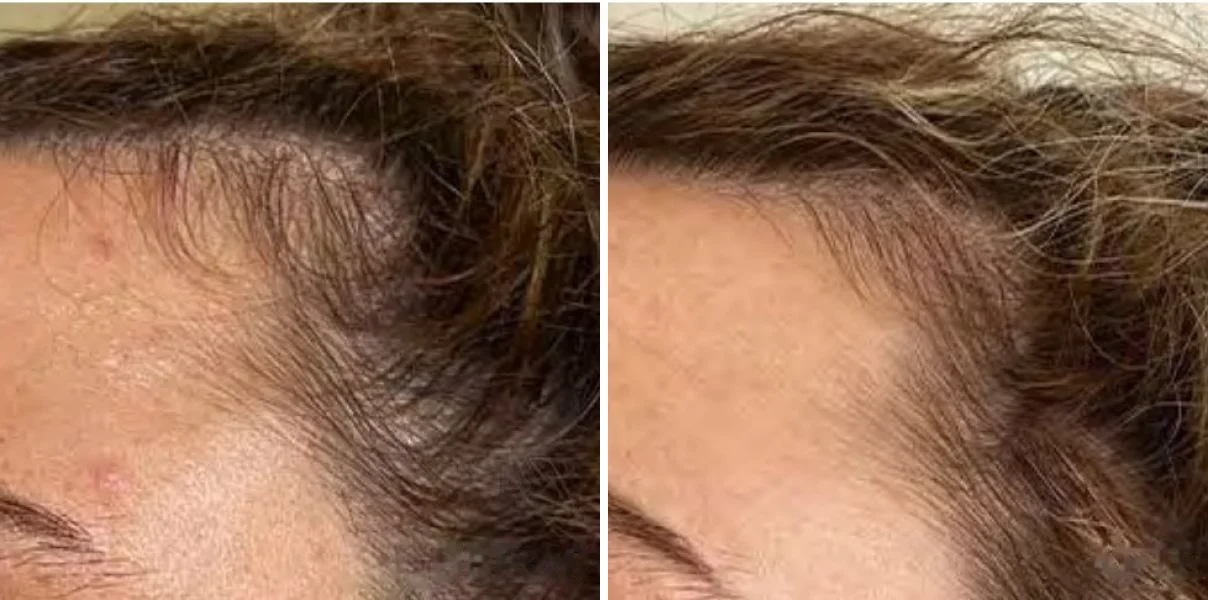
A participant in the 8-week user trial of our liquid marine collagen, photographed before and after. This is what it looked like for one woman in our studies.
"Healthier hair" is what the women reported about their own hair. The figure belongs to the complete drink and to that group of 106 women. The same women were asked how the habit fitted into their day, and 99% found it easy to include in their daily routine too.8
How do two women describe it?
Charlotte Dormon, in Hip & Healthy, wrote that her hair felt thicker and fuller by month six on marine collagen, and Suzanne H., a verified buyer of our liquid marine collagen, loves what it does to her hair, nails and skin. Two accounts say how a change feels in your own hands, which a percentage cannot.
Hair that felt thicker and fuller by month six.
Turning 40 was her starting line for marine collagen. Her skin was the early news, more hydrated within the first month. Hair took the longest to report in, arriving at the six-month mark.
Charlotte DormonWriting in Hip & Healthy9
“The taste is amazing and it is sugar free! Love what it does to my hair, nails and skin.”
★★★★★
Suzanne H.Verified purchase · Amazon, United Kingdom · 26 August 2024
An independent first-person account of marine collagen published by the outlet named, and a verified buyer review of our liquid marine collagen as sold under our manufacturer's own label.
Questions about hair in menopause
Is hair thinning common in menopause?
It was common in one study: of 178 postmenopausal women in Thailand, 52.2% had female pattern hair loss, and 73.2% of those cases were the mildest grade.
Has collagen been tested for hair in women my age?
Yes, one trial measured hair in 44 healthy women aged 39 to 75: over 16 weeks hair thickness went up by 1.93 micrometres on average with 2.5 g of collagen peptides a day, while placebo showed a slight dip of 0.99 micrometres. The difference between the groups was significant.
Is there hair evidence for marine collagen?
One 12-week trial tested a daily marine collagen drink in adults aged 40 to 60, about 90% of them women. The expert-graded score for healthy hair appearance had improved by 31.9% on average with the drink, which held 8 g of hydrolysed collagen plus vitamin C, against 9.4% with placebo. That is a change in a score. Separately, in the questionnaire, 66.7% of the collagen group agreed their hair felt thicker, against 44.2% on placebo.
Which nutrients have an authorised hair claim?
Biotin and selenium, two of the nutrients in Core™, have one on the EU list. Biotin contributes to the maintenance of normal hair. Selenium contributes to the maintenance of normal hair.
How much biotin and selenium are in Core™?
One portion has 5,000 µg of biotin and 27.5 µg of selenium, which is 50% NRV for selenium. They come with 11,000 mg of hydrolysed marine collagen, types I and III, and you take one portion a day.
What did your own trial find for hair?
In our user trial, 86% of 106 women reported healthier hair once they had taken our liquid marine collagen every day for 8 weeks. It is a self-reported result, and it describes the drink as a whole.