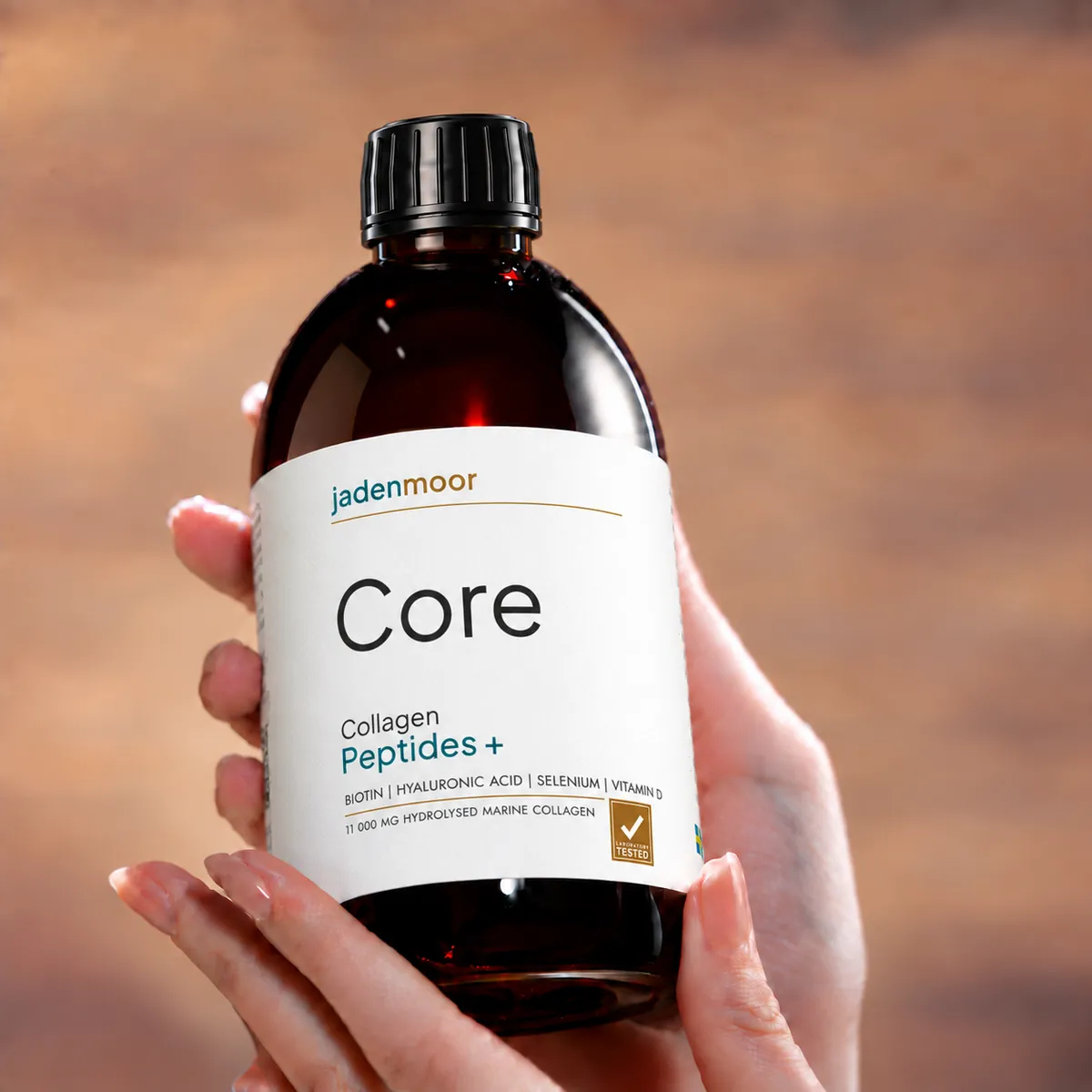
A Core™ portion pairs hydrolysed marine collagen with seven vitamins and minerals. Each of the seven has benefit wording authorised in the EU, quoted on this page word for word.
- Six vitamins, one mineral. Vitamin C, biotin, vitamin D, pantothenic acid, vitamin B6, vitamin B12 and selenium.
- One section each. The amount per portion, what the nutrient is, and its authorised sentences.
- Two more on the label. Hyaluronic acid and silica are in the portion too, and we list them by amount.
of 106 women found our liquid marine collagen easy to include in their daily routine during an 8-week trial.
- 95%felt the appearance of their skin improved
- 86%reported healthier hair
- 76%reported stronger nails
What vitamins are in a Core™ portion?
A Core™ portion has seven, counting selenium, which is a mineral: vitamin C, biotin, vitamin D, pantothenic acid, vitamin B6, vitamin B12 and selenium.1 They sit in the same small portion as the collagen.
These seven differ from the collagen beside them in their paperwork. Regulation (EU) No 432/2012 is the EU's list of permitted health claims.2 Each sentence on it is tied to one named nutrient, and a label may print the sentence as written. For every vitamin and for selenium we can therefore tell you what may be said, and we quote it without touching a word.
The table uses one abbreviation. NRV stands for nutrient reference value, the daily reference intake that EU labelling rules set for each vitamin and mineral.3 It is a yardstick for reading labels, and where Core's specification gives a percentage of it, you will find that figure next to the amount.
The vitamins and minerals in one Core™ portion
The seven vitamins and minerals in label order, then hyaluronic acid and silica. Amounts are per portion. NRV is the EU reference intake used on labels.
| Nutrient | Amount per portion | Authorised claims | Read more |
|---|---|---|---|
| Vitamin C | 120 mg (150% NRV) | Vitamin C contributes to normal collagen formation for the normal function of skin. Vitamin C contributes to the protection of cells from oxidative stress. Vitamin C contributes to the reduction of tiredness and fatigue. | Vitamin C and collagen, antioxidants for skin |
| Biotin | 5,000 µg | Biotin contributes to the maintenance of normal hair. Biotin contributes to the maintenance of normal skin. Biotin contributes to normal macronutrient metabolism. | Biotin for hair, skin and nails |
| Vitamin D | 60 µg | Vitamin D contributes to the maintenance of normal bones. Vitamin D contributes to the maintenance of normal muscle function. Vitamin D contributes to the normal function of the immune system. | Bones and muscles, vitamins for the immune system |
| Pantothenic acid (vitamin B5) | 5 mg (83% NRV) | Pantothenic acid (vitamin B5) contributes to normal energy-yielding metabolism. Pantothenic acid (vitamin B5) contributes to normal mental performance. Pantothenic acid (vitamin B5) contributes to normal synthesis and metabolism of steroid hormones, vitamin D and some neurotransmitters. | B vitamins and metabolism |
| Vitamin B6 | 1.7 mg (121% NRV) | Vitamin B6 contributes to the regulation of hormonal activity. Vitamin B6 contributes to normal protein and glycogen metabolism. Vitamin B6 contributes to normal functioning of the nervous system. | Vitamin B6, B5 and hormones, nutrient checklist |
| Vitamin B12 | 24 µg (960% NRV) | Vitamin B12 contributes to normal red blood cell formation. Vitamin B12 contributes to the reduction of tiredness and fatigue. Vitamin B12 contributes to normal psychological function. | Vitamins, tiredness and energy |
| Selenium | 27.5 µg (50% NRV) | Selenium contributes to the maintenance of normal hair. Selenium contributes to the maintenance of normal nails. Selenium contributes to the normal thyroid function. | Selenium and thyroid, selenium for hair and nails |
| Hyaluronic acid | 50 mg | Listed by amount | Hyaluronic acid supplements |
| Silica | 50 mg | Listed by amount |
The table gives three authorised sentences for each nutrient. The sections below take the nutrients one at a time, in the same order. As for the collagen, each portion has 11,000 mg of hydrolysed marine collagen, types I and III.1 It has a page of its own: our guide to liquid marine collagen.
What does vitamin C do?
Vitamin C is required for the biosynthesis of collagen, and its authorised EU claims cover collagen formation for skin, the protection of cells from oxidative stress and the reduction of tiredness and fatigue. It heads the list at 120 mg per portion, which is 150% of the NRV.1
Humans have to get vitamin C from food and drink, because the body cannot make its own.4 It is required for the biosynthesis of collagen, which is an essential component of connective tissue.4
The permitted list gives it these sentences, among others:2
- Vitamin C contributes to normal collagen formation for the normal function of skin.
- Vitamin C contributes to the protection of cells from oxidative stress.
- Vitamin C contributes to the reduction of tiredness and fatigue.
The collagen sentence exists in parallel versions for bones, cartilage, gums, teeth and blood vessels.2
What does biotin do?
Biotin works as a cofactor for enzymes in the metabolism of fatty acids, glucose and amino acids, and its authorised EU claims name hair, skin and macronutrient metabolism. It follows, at 5,000 µg per portion.1
Biotin is a water-soluble B vitamin, also called vitamin B7, and an essential nutrient.5 Inside the body it works as a cofactor for five carboxylase enzymes, which catalyse critical steps in the metabolism of fatty acids, glucose and amino acids.5
Its authorised sentences cover hair and skin by name:2
- Biotin contributes to the maintenance of normal hair.
- Biotin contributes to the maintenance of normal skin.
- Biotin contributes to normal macronutrient metabolism.

assets/img/blog/cv-shot.webpWhat does vitamin D do?
Vitamin D promotes calcium absorption in the gut, and its authorised EU claims cover the maintenance of normal bones and muscle function and the normal function of the immune system. Third on the label, it comes at 60 µg in every portion.1
Vitamin D is fat-soluble, and your body also produces it when ultraviolet rays from sunlight strike the skin.6 It promotes calcium absorption in the gut and helps keep blood calcium and phosphate at adequate concentrations.6
The sentences the EU authorises for it include:2
- Vitamin D contributes to the maintenance of normal bones.
- Vitamin D contributes to the maintenance of normal muscle function.
- Vitamin D contributes to the normal function of the immune system.
What does pantothenic acid (vitamin B5) do?
Pantothenic acid (vitamin B5) helps make coenzyme A, and its authorised EU claims cover energy-yielding metabolism, mental performance and the synthesis of steroid hormones. Fourth is vitamin B5, at 5 mg per portion, or 83% of the NRV.1 The EU list calls it pantothenic acid, so that is the name its sentences use.
Vitamin B5 is a water-soluble B vitamin, and its main job is to help make coenzyme A.7 Coenzyme A is essential for building and breaking down fatty acids.7
Three of its authorised sentences follow:2
- Pantothenic acid (vitamin B5) contributes to normal energy-yielding metabolism.
- Pantothenic acid (vitamin B5) contributes to normal mental performance.
- Pantothenic acid (vitamin B5) contributes to normal synthesis and metabolism of steroid hormones, vitamin D and some neurotransmitters.
What does vitamin B6 do?
Through its active coenzyme forms, vitamin B6 takes part in more than 100 enzyme reactions, most of them in protein metabolism, and its authorised EU claims cover hormonal activity, protein and glycogen metabolism and the nervous system. It is fifth, at 1.7 mg per portion, which is 121% of the NRV.1
Vitamin B6 is water-soluble, and its active coenzyme forms take part in more than 100 enzyme reactions, most of them concerned with protein metabolism.8
These are among the sentences on the list for it:2
- Vitamin B6 contributes to the regulation of hormonal activity.
- Vitamin B6 contributes to normal protein and glycogen metabolism.
- Vitamin B6 contributes to normal functioning of the nervous system.
What does vitamin B12 do?
Vitamin B12 is needed for healthy red blood cell formation and DNA synthesis, and its authorised EU claims cover red blood cell formation, tiredness and fatigue, and psychological function. Sixth is vitamin B12, with 24 µg per portion, shown on the specification as 960% of the NRV.1 The reference value is a labelling figure, and the percentage places the amount against it.
Vitamin B12 is a water-soluble vitamin that works as a cofactor for two enzymes.9 The body requires it for healthy red blood cell formation and for DNA synthesis.9
Its authorised wording includes:2
- Vitamin B12 contributes to normal red blood cell formation.
- Vitamin B12 contributes to the reduction of tiredness and fatigue.
- Vitamin B12 contributes to normal psychological function.
Several nutrients in the portion share that tiredness sentence. We set them side by side in our article on vitamins, tiredness and energy.
What does selenium do?
Selenium is built into 25 selenoproteins with roles in thyroid hormone metabolism, DNA synthesis and protection from oxidative damage, and its authorised EU claims cover normal hair, normal nails and thyroid function. It is the last of the seven and the only mineral, at 27.5 µg per portion, which is 50% of the NRV.1
Your body builds selenium into 25 selenoproteins.10 Those proteins play roles in thyroid hormone metabolism, DNA synthesis and protection from oxidative damage.10 The thyroid gland holds a higher concentration of selenium than any other organ.10
The list gives selenium these sentences, among others:2
- Selenium contributes to the maintenance of normal hair.
- Selenium contributes to the maintenance of normal nails.
- Selenium contributes to the normal thyroid function.
What about hyaluronic acid and silica?
Hyaluronic acid and silica complete the label and are listed by amount: each portion has 50 mg of hyaluronic acid and 50 mg of silica.1
The sentences on the permitted list stay with the nutrients they name, so for these two we give you the amount, the same way we treat the collagen. If you would like the published research on the first of them, with the dose each study used, it is in our article on hyaluronic acid supplements.
What did women in our trial report?
Women in our user trial reported more moisture and glow (89%) and firmer skin (81%), and this part is about a whole drink rather than single nutrients. In that trial, 106 women took our liquid marine collagen every day for 8 weeks and then reported on it.1 Their answers describe the whole drink, as they experienced it.
found it easy to include in their daily routine.
reported more moisture and glow.
reported firmer skin.
Shares of the 106 women in the 8-week user trial of our liquid marine collagen.1
For a guide to what goes into a daily portion, the first figure is the one we like most, with 99% of the women finding it easy to include in their daily routine.1 Women in the trial reported visible results in as little as 4 weeks, with further improvement by week 8.1
Buyers of the same drink have left their own verdicts.
“The taste is amazing and it is sugar free! Love what it does to my hair, nails and skin.”
★★★★★
Suzanne H.Verified purchase · Amazon, United Kingdom · 26 August 2024
“I can really see the visible changes in my skin and nails.”
★★★★★
Check4YouVerified purchase · Amazon, Germany · 27 December 2023
“My skin looks great, with no fine lines. I'm 45 and will definitely keep using it.”
★★★★★
FrédériqueVerified purchase · Amazon, France · 18 May 2024
Verified buyer reviews of our liquid marine collagen, as sold under our manufacturer's own label.
The full ingredient list, the pack and the price are on the Core™ product page.
Questions about collagen with vitamins
What is in a collagen portion besides collagen?
Core™ also has vitamin C, biotin, vitamin D, vitamin B5, vitamin B6, vitamin B12 and selenium, plus hyaluronic acid and silica. The collagen itself is hydrolysed marine collagen, types I and III.
How much vitamin C is in Core™?
Each portion has 120 mg of vitamin C, which is 150% of the NRV. Vitamin C contributes to normal collagen formation for the normal function of skin.
Does Core™ contain biotin?
Yes, 5,000 µg in each portion. Biotin contributes to the maintenance of normal hair. Biotin contributes to the maintenance of normal skin.
Which B vitamins are in Core™?
Core™ has four: biotin, vitamin B5 (5 mg), vitamin B6 (1.7 mg) and vitamin B12 (24 µg). Each has its own section above, with its authorised sentences.
What does NRV mean on a supplement label?
NRV is the nutrient reference value, the daily reference intake set in EU food labelling rules. It lets you read one label against another and is a reference for labelling.
How do you take a collagen portion with vitamins?
Take one portion of Core™ a day: shake the pack, pour into the cap, then drink it straight or stir it into water or a smoothie. Keep the pack in the fridge once opened.