Collagen is a protein your body makes for itself. It is the body's most abundant structural protein, and the main structural protein of your skin.
- A family, not one thing. At least 28 types have been identified, with types I to IV the most prevalent.
- Most of your skin's dry weight. Collagen accounts for about 75% of it.
- A supplement is hydrolysed collagen. The large native molecule is cut into small peptides that dissolve in water.
of 106 women felt the appearance of their skin improved after 8 weeks on our liquid marine collagen.
- 89%reported more moisture and glow
- 86%reported healthier hair
- 76%reported stronger nails
What is collagen?
Collagen is a protein. More exactly, it is the most abundant structural protein in the body.1 Structural means building material, part of what a tissue is made from, the way timber is part of a house.
The word covers a whole family. At least 28 types of collagen have been identified, and types I to IV are the most prevalent. Type I dominates and accounts for over 90% of the total collagen in the human body.1
Nobody is born needing to buy it. Your body assembles its own collagen, and it needs a helper to do so. Vitamin C is required for the biosynthesis of collagen. Humans, unlike most animals, cannot make vitamin C in the body, so that part has to arrive with your food.2
Where is collagen in your body?
Collagen is found in skin, bone, teeth, tendon, cartilage, muscle and blood vessels, and each type has its own addresses. A review of collagen sources and uses sets out where three of the types are found:3
- Type I is the most common type in skin, bone, teeth and tendon.
- Type II is present in cartilage.
- Type III is most commonly found in skin, muscle and blood vessels.
The list is a map of the collagen you already have and of where your body puts each type. Skin is the one address that shows up twice, which is why skin gets its own section below. If the numerals interest you, our guide to the types of collagen goes through them one by one.
What does collagen do in skin?
Collagen makes up most of what skin is, once you set the water aside. It is the main structural protein of skin and accounts for about 75% of its dry weight. Type I leads here as well, at 80 to 90% of skin collagen.4
Under the thin outer surface lies the dermis, the layer that houses the hair follicles. The deeper part of the dermis is dense connective tissue made of collagen fibre bundles.5 When people call collagen the framework of skin, they are describing that anatomy.

assets/img/blog/wc-glass.webpWhat happens to collagen with age?
From early adulthood the skin makes about 1.0% to 1.5% less collagen each year.6 A second review adds that, with age, production falls while breakdown rises.4
For women there is one more date in the calendar. A paper on skin ageing reports that as much as 30% of skin collagen is lost in the first five years after menopause.7
Those figures are the background to the studies further down this page, two of which recruited women aged 40 and over.
What is a collagen supplement?
A collagen supplement is collagen from an animal source that has been hydrolysed, which means cut. Native collagen is a large molecule of roughly 285 to 300 kDa (kilodaltons, a unit of molecular size). Hydrolysis cuts it into collagen peptides, which a review of collagen sources and uses places at about 3 to 6 kDa.3
The cutting changes how the ingredient behaves in a glass. Hydrolysed collagen is highly soluble in water, and that is what allows it to be made into a ready-to-drink liquid. The review describes higher solubility as a main advantage of hydrolysed collagen over native collagen.3
So "collagen peptides", "collagen hydrolysate" and "hydrolysed collagen" on a label all point to this cut form. We explain the process, and the words around it, in what hydrolysed collagen is.
What have collagen trials measured?
Collagen trials have measured skin hydration, skin elasticity, eye wrinkles, hair thickness and nail growth. The widest view comes from a 2023 meta-analysis of 26 randomised controlled trials with 1,721 participants. It found that oral collagen significantly improved skin hydration and elasticity compared with placebo.8
Single studies each look at one thing, so the table gives one study per outcome, in a line each, with a link to the article that tells the rest.
Five outcomes, five separate studies
Each row is one study, with its own participants, its own daily amount of collagen and its own length.
| Outcome | What the study recorded | Read more |
|---|---|---|
| Skin hydration | Significantly higher than placebo at 6 weeks and at 12 weeks, in a trial of 64 women aged 40 to 60 that tested 1,000 mg a day of low-molecular-weight fish collagen peptide.9 | Collagen for skin hydration |
| Skin elasticity | Cheek skin elasticity improved compared with placebo after 4 weeks, in a trial of 36 postmenopausal women that tested 5 g of marine collagen hydrolysate a day.10 | Collagen for skin firmness |
| Wrinkles | Eye-wrinkle volume significantly lower than placebo after 4 weeks and after 8 weeks (about 20%), in a trial of 114 women aged 45 to 65 that tested 2.5 g of collagen peptides a day.11 | Collagen for wrinkles |
| Hair | Hair thickness rose by 1.93 micrometres on average with collagen, against a slight dip of 0.99 micrometres with placebo, in a 16-week trial of 44 healthy women aged 39 to 75 that tested 2.5 g of collagen peptides a day.12 | Collagen for hair |
| Nails | Nail growth rate rose 12% and the frequency of broken nails fell 42%, in an open-label study of 25 participants who took 2.5 g of collagen peptides daily for 24 weeks.13 | Collagen for nails |
Read the rows separately. The people, the amounts and the collagen differ from one study to the next, so no row predicts another. They do share a design, in which a daily amount is taken for weeks and then a measurement is made.
What women reported on our liquid marine collagen
In our user trial, 106 women took our liquid marine collagen daily for 8 weeks, and 95% felt the appearance of their skin improved, 86% reported healthier hair and 76% reported stronger nails. The numbers below are shares of those women.14
felt the appearance of their skin improved.
reported healthier hair.
reported stronger nails.
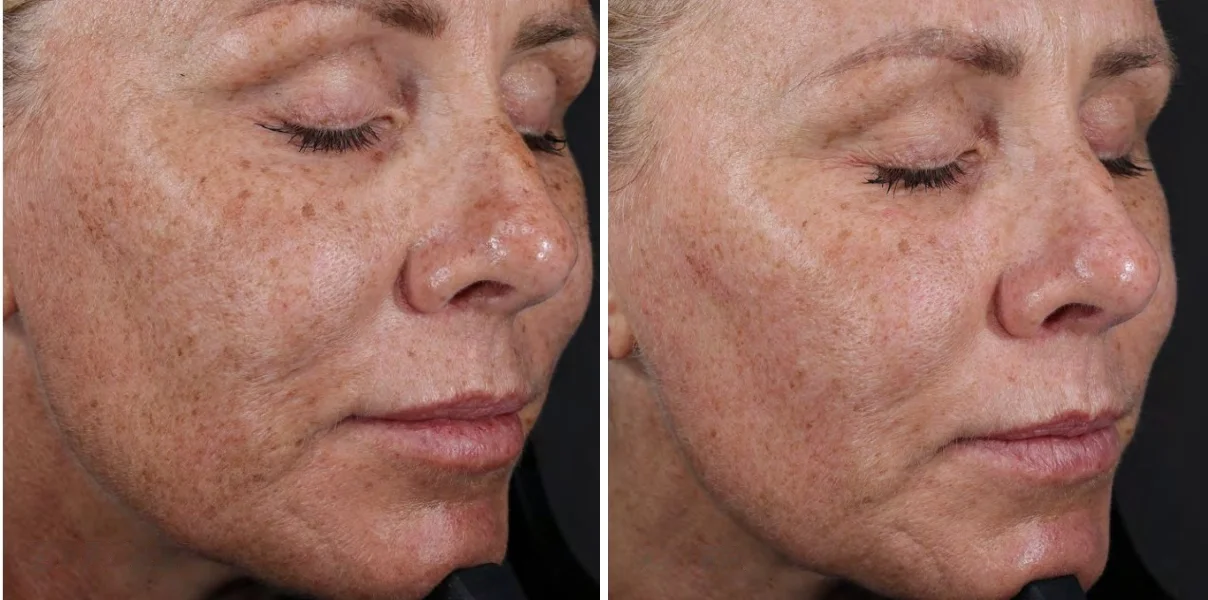
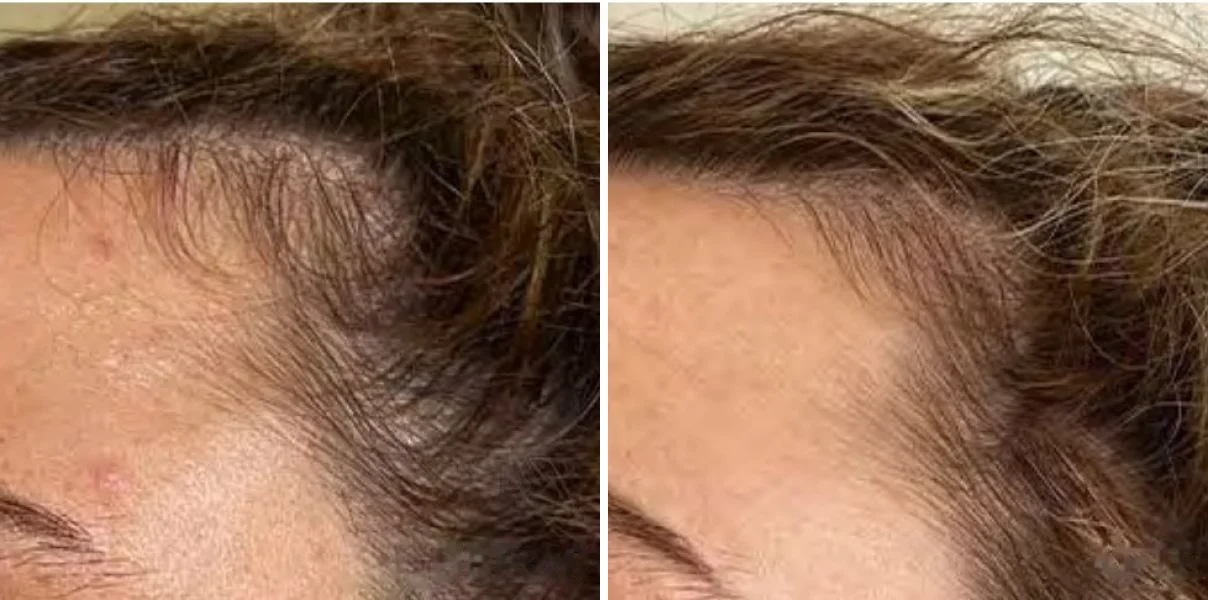
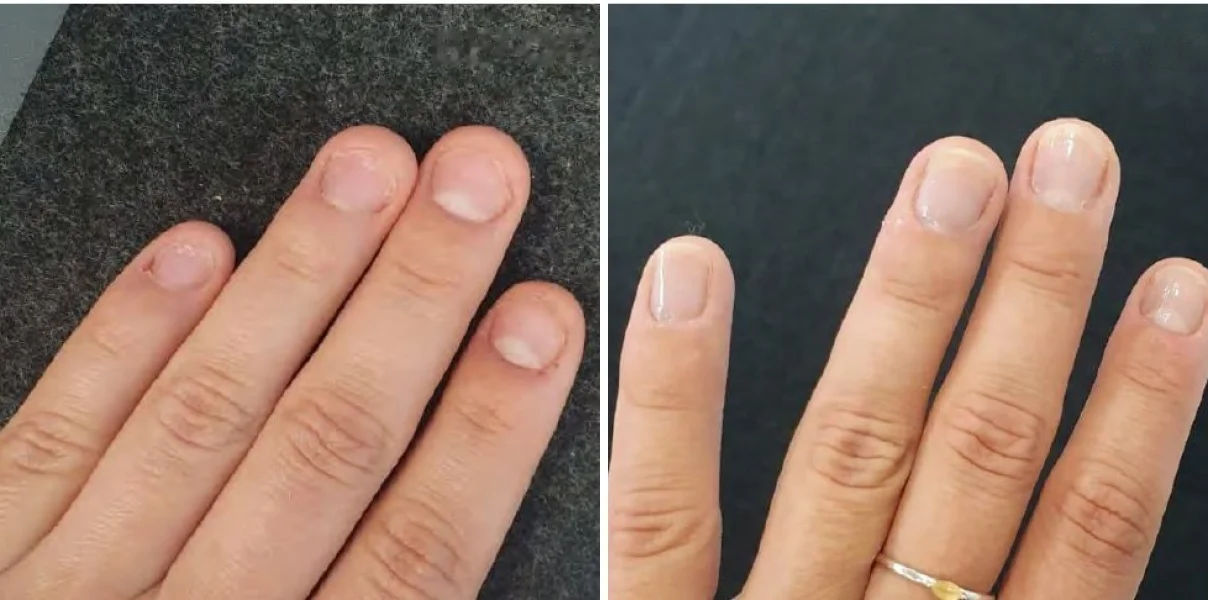
Participants in the 8-week user trial of our liquid marine collagen, photographed before and after.
What is in Core™?
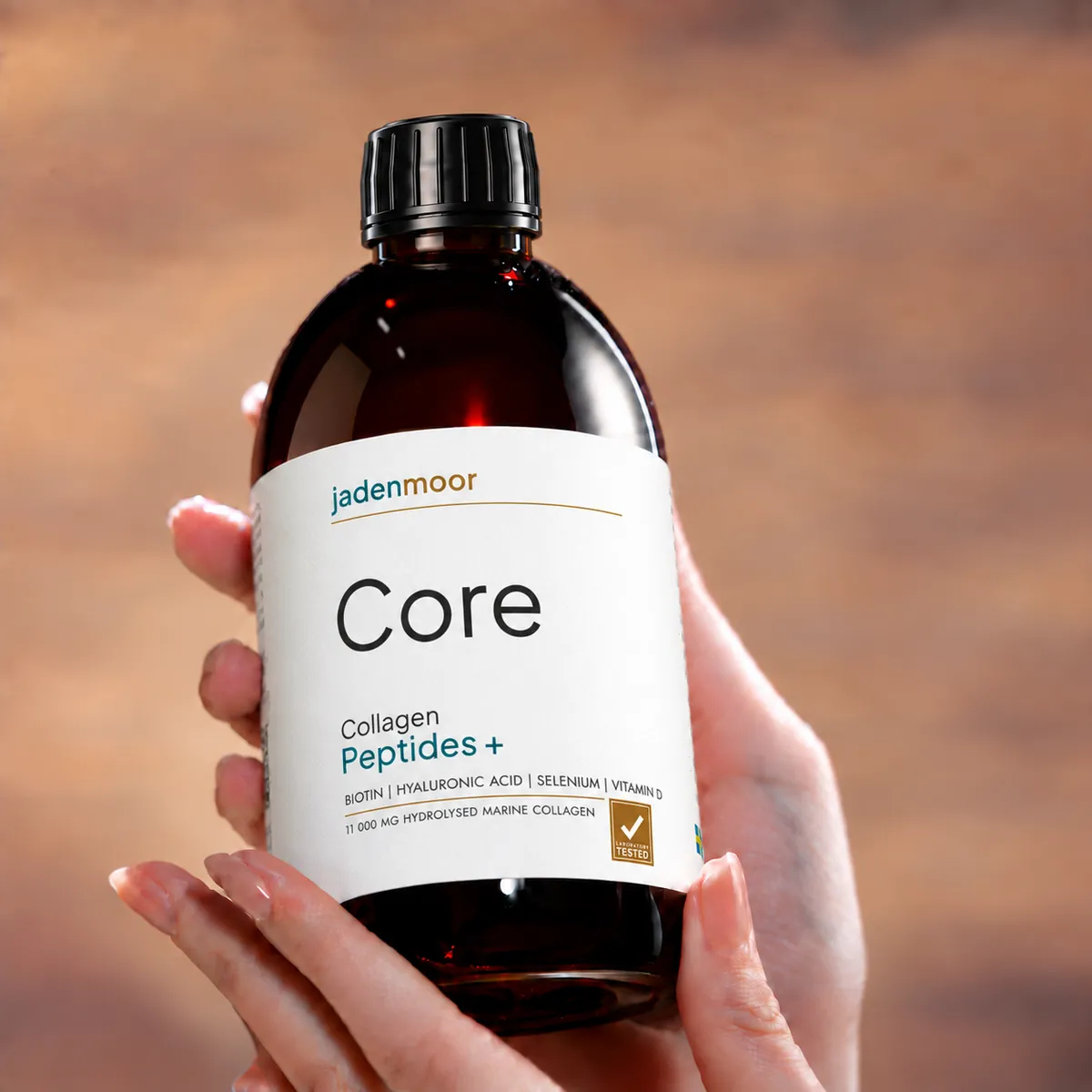
Each portion of Core™ holds 11,000 mg of hydrolysed marine collagen, types I and III, alongside hyaluronic acid, silica, vitamin C, biotin, selenium, vitamin D and vitamins B5, B6 and B12.14
- The collagen. 11,000 mg of hydrolysed marine collagen, types I and III, in one portion.
- Two companions. Hyaluronic acid, 50 mg, and silica, 50 mg.
- Vitamin C, 120 mg. Vitamin C contributes to normal collagen formation for the normal function of skin.
- Biotin, 5,000 µg. Biotin contributes to the maintenance of normal hair. Biotin contributes to the maintenance of normal skin.
- Selenium, 27.5 µg. Selenium contributes to the maintenance of normal nails.
- And the rest. Vitamin D and vitamins B5, B6 and B12 are in the same portion.
It tastes of berries and it is sugar free. You take one portion a day: shake, pour into the cap, and drink it straight or stirred into water or a smoothie.
Why a collagen drink carries vitamins at all is the subject of collagen with vitamins. The full label is on the Core™ page.
Questions about collagen
What is collagen, in simple terms?
Collagen is a protein, and the most abundant structural protein in the body. Your body makes it and builds tissue with it. In skin it accounts for about 75% of the dry weight.
What is collagen good for?
In a 2023 meta-analysis of 26 randomised controlled trials, oral collagen significantly improved skin hydration and elasticity compared with placebo. Separate studies recorded changes in eye wrinkles, hair thickness and nail growth.
Does your body make its own collagen?
Yes, your body makes its own collagen. Vitamin C is required for the biosynthesis of collagen, and it has to come from the diet. From early adulthood the skin makes about 1.0% to 1.5% less collagen each year.
How many types of collagen are there?
At least 28 types of collagen have been identified. Type I is the largest by far, at over 90% of the total collagen in the human body. The marine collagen in Core™ is types I and III.
What is the difference between collagen and collagen peptides?
Collagen peptides are native collagen cut into much smaller pieces by hydrolysis. Native collagen is a large molecule of roughly 285 to 300 kDa, and a review places the peptides at about 3 to 6 kDa.
How do you take Core™?
Take one portion of Core™ a day, which holds 11,000 mg of hydrolysed marine collagen. Keep the pack in the fridge once it is opened.