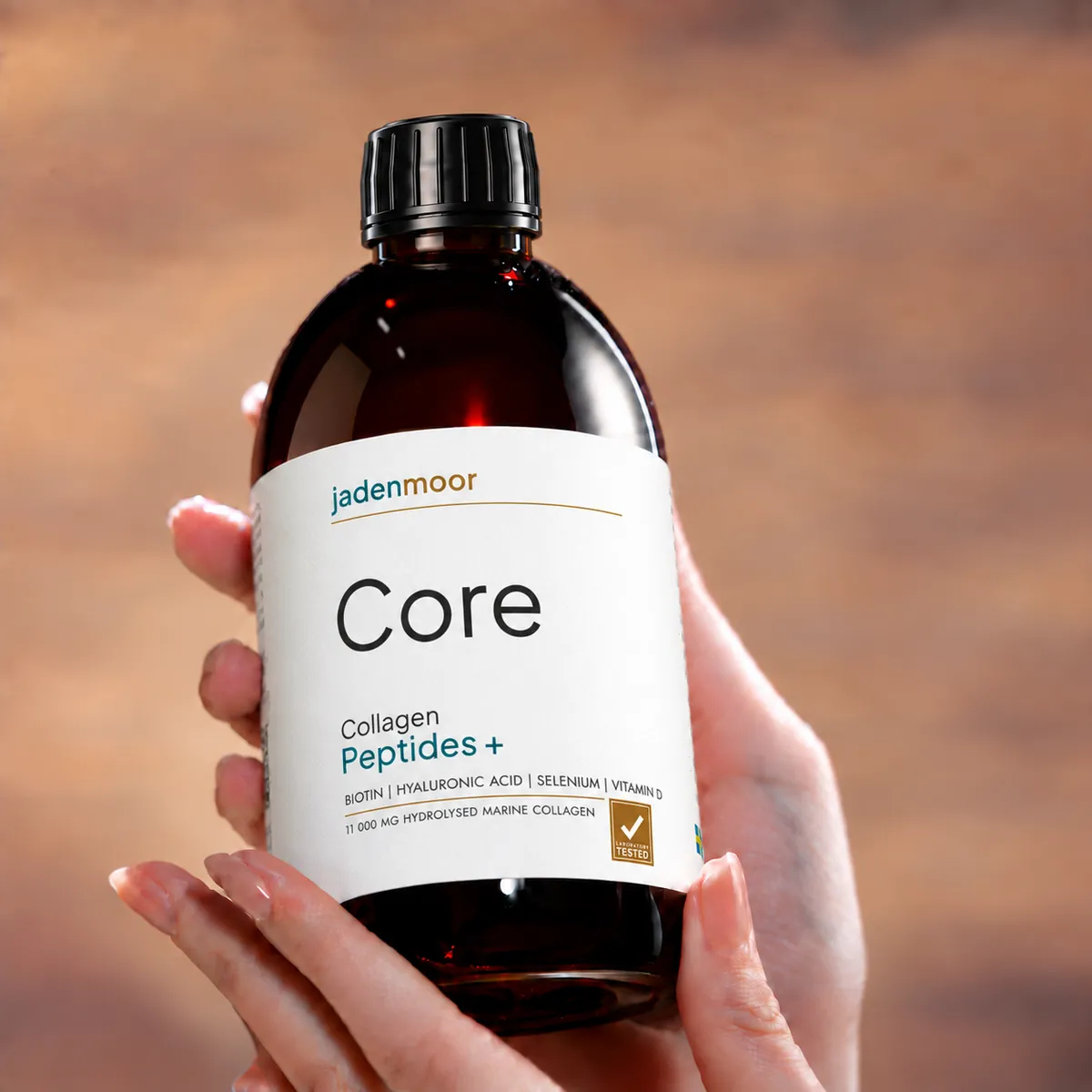
Hydrolysed collagen is collagen that has been cut by hydrolysis into short chains called collagen peptides. Daltons are the unit that says how big those chains are.
- Hydrolysed and peptides go together. The first word names the process. The second names what the process leaves behind.
- A dalton measures one molecule. A kilodalton, written kDa, is 1,000 of them.
- Core's figure is about 1,500 daltons. Native collagen is about 300,000 daltons, roughly 200 times larger.
of 106 women felt that the appearance of their skin improved after 8 weeks on our liquid marine collagen.
- 99%found it easy to include in their daily routine
- 89%reported more moisture and glow
- 81%reported firmer skin
What is hydrolysed collagen?
Hydrolysed collagen is collagen that has been cut into short chains with water. Collagen itself is the most abundant structural protein in the body.1 Our short guide to what collagen is covers the protein itself, so this page stays with the words printed around it.
Hydrolysis is the chemist's name for splitting something apart with water. Applied to collagen, it cuts the long native molecule into collagen peptides.2 "Hydrolysed" on a label reports that this step has been carried out before bottling.
Spelling changes with the country. British labels print hydrolysed, American ones print hydrolyzed, and both describe the same thing. On Core™ the line reads: 11,000 mg of hydrolysed marine collagen, types I and III, in one portion.3
Are collagen peptides the same thing?
Yes, in everyday label language hydrolysed collagen and collagen peptides name the same ingredient. A peptide is a short chain of amino acids, the building blocks every protein is made from. Collagen peptides are the chains that hydrolysis produces from collagen,2 so "hydrolysed collagen" names the process and "collagen peptides" names the result. A pack may print either term, or both.
The studies in our evidence use both wordings, and the three placebo-controlled trials below are each filed under the wording its own authors chose.
Eye-wrinkle volume about 20% lower than placebo after 8 weeks
The daily amount in this trial was 2.5 g of collagen peptides. Eye-wrinkle volume was significantly lower than in the placebo group at the 4-week reading and again at 8 weeks, by about 20%.4
114 women aged 45 to 65 · randomised, double-blind, placebo-controlled
Wrinkle score down 35% from baseline on the right side of the face
This team gave 10 g of hydrolysed fish collagen a day for 12 weeks. On the right side of the face the wrinkle score fell 35% from baseline, a 24% greater reduction than placebo.5
Women aged 45 to 60 · randomised, triple-blind, placebo-controlled
Skin hydration significantly higher than placebo at 6 and 12 weeks
This trial gave 1,000 mg a day of low-molecular-weight fish collagen peptide for 12 weeks. Hydration readings were significantly above placebo at week 6 and week 12.6
64 women aged 40 to 60 · randomised, double-blind, placebo-controlled
Those three papers write it down in three ways, and the vocabulary on your pack is the vocabulary of the research, which is a good reason to learn it.
What is a dalton?
A dalton is a unit of mass built for things far too small to put on a scale: atoms and molecules. One dalton is roughly the mass of a single hydrogen atom. Add up every atom in a molecule and the total is its molecular weight, given in daltons and shortened to Da.
Large molecules run to big numbers, so chemists also count in thousands. A kilodalton, written kDa, is 1,000 daltons, in the same way that a kilogram is 1,000 grams.
On a collagen label the word tells you how heavy one average piece of the collagen is, and therefore how long the chain is. Core's product specification gives two figures, and the gap between them is the work that hydrolysis has done.3
daltons, about: one molecule of native collagen.
daltons, about: the hydrolysed marine collagen in Core™.
roughly how many times larger native collagen is.
Figures from the Core™ product specification. They describe the size of the collagen in the pack.
In kilodaltons, the first tile is about 300 kDa and the second is about 1.5 kDa, the same facts in shorter numbers.
What does low molecular weight mean on a label?
"Low molecular weight" on a collagen product tells you the collagen has been hydrolysed into small pieces, and the dalton figure beside it tells you how small. Molecular weight is the size of a molecule counted in daltons.
The authors of a peer-reviewed review of hydrolysed collagen place collagen peptides at about 3 to 6 kDa.2 The figure describes the category as the review sees it, and it is not a measurement of any one product.
A product's own number comes from its specification. For Core™ that number is about 1,500 daltons.3
The phrase also turns up in research: the 64-woman trial in the third card above describes its ingredient as a low-molecular-weight fish collagen peptide.6
Read the phrase as a description of size, and when a label prints the daltons too, you have the description and the measurement side by side.

assets/img/blog/hd-pour.webpWhy is hydrolysed collagen used in drinks?
Hydrolysed collagen is used in drinks because it is highly soluble in water, and the review quoted above names that higher solubility as a main advantage it has over native collagen.2 That solubility allows it to be made as a ready-to-drink liquid.
In a 2024 crossover study, each 10 g dose of collagen hydrolysate was dissolved in 200 mL of water before the volunteers took it.7
Core™ arrives already dissolved. You shake the pack, pour into the cap and drink it straight, or stir it into water or a smoothie.3
What did blood studies find?
Blood studies found collagen peptides in the blood of volunteers who had taken a collagen or gelatin hydrolysate. In one study, volunteers drank a gelatin hydrolysate, and collagen peptides appeared in their blood and peaked within one to two hours.8
The 2024 study mentioned above gave six healthy adults a single 10 g dose of collagen hydrolysate. Blood levels of free hydroxyproline and of collagen-derived peptides rose afterwards.7 Hydroxyproline is an amino acid these teams use as a marker for collagen.
Both are readings taken from blood, and each team used its own hydrolysate. The full set of studies, with a table, is in our article on whether collagen is absorbed.
The label words at a glance
The table puts the whole glossary in one place, with the matching line from a pack of Core™ in the last column.
Five words on a collagen label
What each word means, and what Core's label and specification say for it.
| Word on the label | What it means | In Core™ |
|---|---|---|
| Collagen | The most abundant structural protein in the body.1 | Marine collagen, types I and III.3 |
| Hydrolysed | Cut by hydrolysis, which turns native collagen into collagen peptides.2 Also spelt hydrolyzed. | 11,000 mg of hydrolysed marine collagen in one portion. |
| Peptides | Short chains of amino acids. Collagen peptides are the chains hydrolysis leaves. | The form the hydrolysed collagen in Core™ takes. |
| Daltons (Da) | The unit for the mass of one molecule. 1 kDa is 1,000 daltons. | About 1,500 daltons. |
| Low molecular weight | Small when counted in daltons. Native collagen is about 300,000 daltons. | Hydrolysed to a low molecular weight. Native collagen is roughly 200 times larger. |
Once the five words are familiar, the next line to look for is the amount of collagen in a serving. Our checklist for choosing a liquid collagen picks up from there.
What did women report?
In our own user trial, 106 women took our liquid marine collagen every day for 8 weeks, and 95% of them felt the appearance of their skin had improved, while 99% found it easy to include in their daily routine.3
Women who write about marine collagen for a living have set down their own experiences too, and so has a buyer of our drink.
“And truthfully? My skin looks better than ever.”
She calls herself a sceptic. After two months of marine collagen every day she found her skin plumper, healthier and noticeably more radiant.
Shannon LawlorBeauty editor, writing in Marie Claire UK9
“To my surprise, these worked.”
After around six months on 10,000 mg of marine collagen a day she reported glowier, more even skin that held on to hydration for longer, and nails that were less brittle.
Charlotte BitmeadWriting in Stylist10
“The taste is amazing and it is sugar free! Love what it does to my hair, nails and skin.”
★★★★★
Suzanne H.Verified purchase · Amazon, United Kingdom · 26 August 2024
Independent first-person accounts of marine collagen published by the outlets named, and a verified buyer review of our liquid marine collagen as sold under our manufacturer's own label.
Questions about hydrolysed collagen
What does hydrolysed collagen mean?
Hydrolysed collagen is collagen that has been through hydrolysis, the step that cuts the native molecule into collagen peptides. The word describes how the ingredient was prepared. Hydrolyzed, with a z, is the American spelling of the same word.
Is hydrolysed collagen the same as collagen peptides?
On a label, yes, hydrolysed collagen and collagen peptides are the same ingredient. Hydrolysed collagen is named after the process and collagen peptides after what the process produces. The three trials described above use both terms for the ingredient they tested.
What is a dalton in collagen?
A dalton is the unit used for the mass of a single molecule, and one dalton is roughly the mass of a hydrogen atom. On a collagen label it gives the size of the collagen pieces. A kilodalton, kDa, is 1,000 daltons.
How many daltons is the collagen in Core™?
The collagen in Core™ is about 1,500 daltons, according to the product specification. Native collagen is about 300,000 daltons, which makes it roughly 200 times larger.
Why is the collagen in drinks hydrolysed?
Collagen in drinks is hydrolysed because hydrolysed collagen is highly soluble in water. A peer-reviewed review describes that solubility as a main advantage over native collagen, and it is what lets collagen be made as a ready-to-drink liquid.
Does marine collagen come hydrolysed?
Marine collagen can come hydrolysed, and the label says so when it does. Core's label states it: 11,000 mg of hydrolysed marine collagen, types I and III, in each portion.