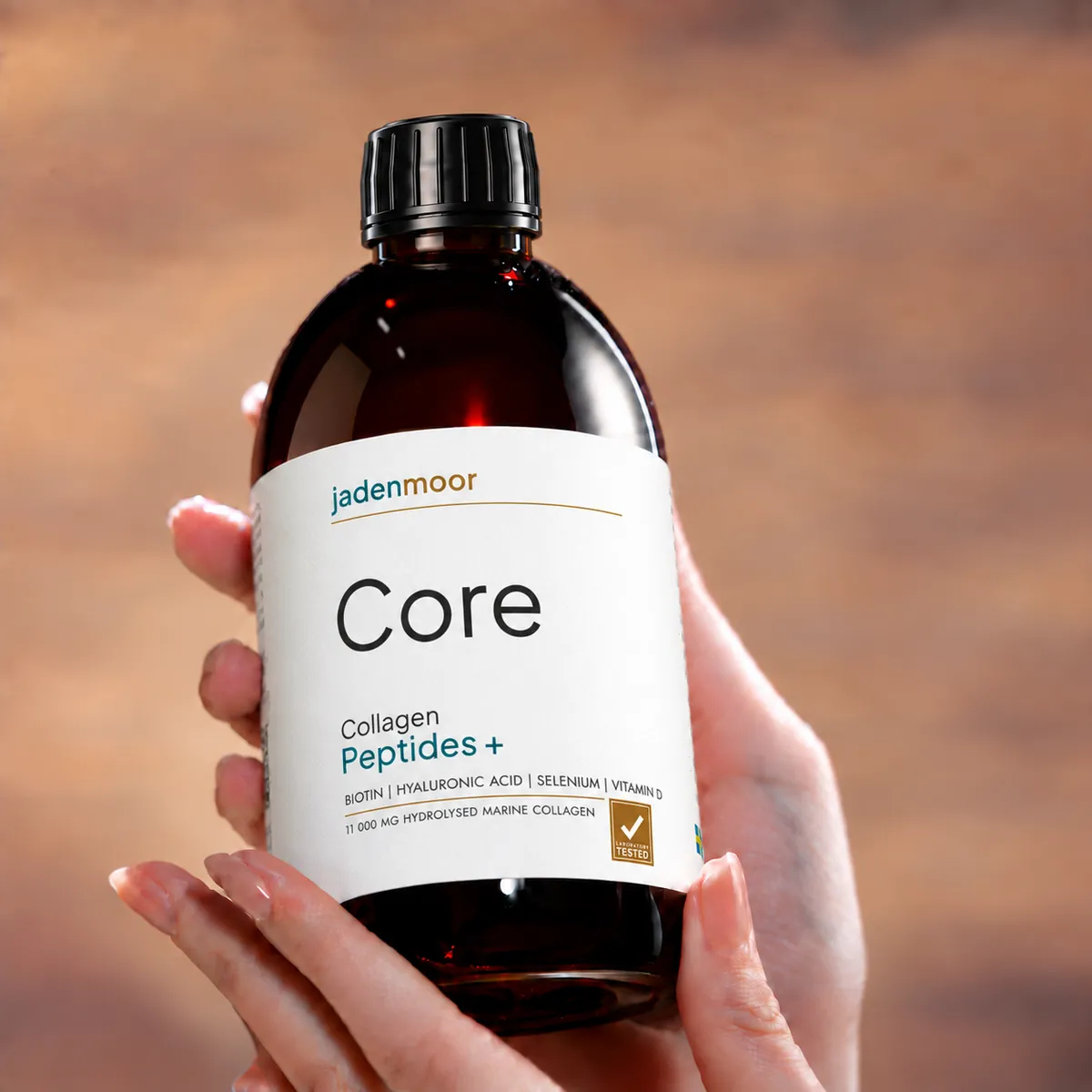
The EU list of permitted health claims gives one wording on this subject, and it gives it nutrient by nutrient. In Core™, the vitamins that carry it are vitamin C, biotin, vitamin B6 and vitamin B12.
- The wording, as authorised. Vitamin B6 contributes to normal functioning of the nervous system. The same sentence is authorised for vitamin B12, biotin and vitamin C.
- All of them in one portion. Vitamin C 120 mg, biotin 5,000 µg, vitamin B6 1.7 mg and vitamin B12 24 µg.
- A second line for the same vitamins. Vitamin B12 contributes to normal psychological function, and the list gives biotin, vitamin B6 and vitamin C that sentence too.
of 106 women said our liquid marine collagen was easy to include in their daily routine, in a user trial that ran for 8 weeks.
- 95%felt the appearance of their skin improved
- 89%reported more moisture and glow
- 86%reported healthier hair
Vitamin C, biotin, vitamin B6 and vitamin B12: which vitamins contribute to normal functioning of the nervous system?
Vitamin C, biotin, vitamin B6 and vitamin B12 are the nutrients in Core™ that hold the nervous system wording in Regulation (EU) No 432/2012. That regulation is the EU list of permitted health claims made on foods, and each claim on it is an authorised wording tied to a nutrient the list names.1 For the nervous system, the nutrients in Core™ that have the wording are these:
- Vitamin C. 120 mg in every portion.
- Biotin. 5,000 µg in every portion.
- Vitamin B6. 1.7 mg in every portion.
- Vitamin B12. 24 µg in every portion.
The amounts are from the Core™ product specification.2 The sentence itself never changes, only the name at the front of it, which is why you will see it written out once per vitamin in the next section.
We keep to that single line of the list from here on. You get the wording first, then a short portrait of each vitamin drawn from its reference fact sheet, then the label amounts set beside the EU reference intakes.
What does the EU list say, word for word?
The EU list gives vitamin C, biotin, vitamin B6 and vitamin B12 the same line, one vitamin at a time: each contributes to normal functioning of the nervous system. The table gives the line for every one of them, with the amount per portion from the Core™ label.
The nervous system wording, vitamin by vitamin
The authorised sentence for each nutrient, the amount in one portion of Core™, and the EU reference intake used for labelling.
| Nutrient | Wording on the EU list | Amount per portion | EU reference intake |
|---|---|---|---|
| Vitamin C | Vitamin C contributes to normal functioning of the nervous system. | 120 mg (150% NRV). | 80 mg. |
| Biotin | Biotin contributes to normal functioning of the nervous system. | 5,000 µg. | 50 µg. |
| Vitamin B6 | Vitamin B6 contributes to normal functioning of the nervous system. | 1.7 mg (121% NRV). | 1.4 mg. |
| Vitamin B12 | Vitamin B12 contributes to normal functioning of the nervous system. | 24 µg (960% NRV). | 2.5 µg. |
Run your eye down the second column. The nutrient changes from row to row and everything after it stays put. "Normal" belongs to the wording, and so does "functioning", so both stay in wherever we print it.
A claim on the list belongs to the nutrient it names, so we use it here vitamin by vitamin, in the list's own words.
These vitamins have other lines on the same list, and each of those has an article of its own. The wording on tiredness and fatigue is set out in vitamins for tiredness and energy, and the one on energy-yielding metabolism in B vitamins and metabolism.

assets/img/blog/nv-garden.webpWhat is each of these vitamins?
Vitamin B6 is a coenzyme in more than 100 enzyme reactions, vitamin B12 a cofactor for two enzymes, biotin the cofactor for five carboxylase enzymes, and vitamin C a vitamin humans cannot make that is required for the biosynthesis of collagen. They share a sentence on the EU list, and that is where the likeness ends. Each card below gives what a reference fact sheet says the vitamin is and does in the body, followed by its amount in a portion.
Busy in more than 100 enzyme reactions
Vitamin B6 dissolves in water. Its active coenzyme forms take part in more than 100 enzyme reactions, and most of those reactions are concerned with protein metabolism.4
1.7 mg per portion · 121% NRV · reference intake 1.4 mg
A cofactor with a short client list
Vitamin B12 is water-soluble too. It works as a cofactor for two enzymes, named methionine synthase and L-methylmalonyl-CoA mutase, and the body requires it for healthy red blood cell formation and for DNA synthesis.5
24 µg per portion · 960% NRV · reference intake 2.5 µg
The B vitamin also called B7
Biotin is an essential nutrient and a water-soluble B vitamin. Five carboxylase enzymes use it as their cofactor, and between them they catalyse critical steps in the metabolism of fatty acids, glucose and amino acids.6
5,000 µg per portion · reference intake 50 µg
The one you cannot make yourself
Most animals make their own vitamin C. Humans cannot, so yours has to come from what you eat and drink. It is required for the biosynthesis of collagen, and collagen is an essential component of connective tissue.7
120 mg per portion · 150% NRV · reference intake 80 mg
Amounts per portion from the Core™ product specification. Reference intakes from the EU food information regulation, Annex XIII.
Vitamin B6, vitamin B12 and biotin come from one family, the B vitamins, a group of eight water-soluble vitamins.8 In a scientific review of the group, the author reported that B vitamins serve as coenzymes in a large share of the enzymatic processes of the body, and that this includes the reactions your cells use to produce energy.8 A coenzyme is a helper molecule that works alongside an enzyme.
What about psychological function?
Vitamin C, biotin, vitamin B6 and vitamin B12 share a second line on the EU list, normal psychological function, and the list gives it to each of them separately.1 Written out for the first of them, it reads: vitamin C contributes to normal psychological function.
The phrase is the list's own, so we print it exactly as authorised and add no description of our own to it.
One further B vitamin in the portion has a line that belongs in this article. Pantothenic acid (vitamin B5) contributes to normal synthesis and metabolism of steroid hormones, vitamin D and some neurotransmitters.1 Core™ has 5 mg of vitamin B5 per portion, which is 83% NRV.2 Its wording on mental performance has a page to itself: vitamins and the EU wording on mental performance.
"Vitamins for stress": what words does the EU list use?
For the vitamins on this page, the EU list uses two fixed wordings, normal functioning of the nervous system and normal psychological function, in place of the phrase people type into a search box.
- Normal functioning of the nervous system. The wording in the table, authorised for vitamin C, biotin, vitamin B6 and vitamin B12.
- Normal psychological function. Authorised for the same vitamins, nutrient by nutrient.
Those are the terms the list gives these nutrients, so they are the terms on this page. They also show you how to read any label: find the nutrient, find its sentence on the list, and see that the two say the same thing.1
What is in one Core™ portion?
Collagen comes first, and each portion of Core™ delivers 11,000 mg of hydrolysed marine collagen of types I and III, with 9.9 g of protein.2 The vitamins from this article arrive in the same portion. Each is listed here with its label amount and the EU reference intake behind the percentage.3
- Vitamin C: 120 mg, which is 150% NRV. The reference intake is 80 mg.
- Vitamin B6: 1.7 mg, which is 121% NRV. The reference intake is 1.4 mg.
- Vitamin B12: 24 µg, which is 960% NRV. The reference intake is 2.5 µg.
- Biotin: 5,000 µg. The reference intake is 50 µg.
A reference intake is a figure used for labelling.
The rest of the label is short. Per portion, Core™ also has 50 mg of hyaluronic acid, 50 mg of silica, 60 µg of vitamin D and 27.5 µg of selenium, which is 50% NRV.2 It tastes of berries, with a natural flavour, and it is free of sugar and fat.
The routine takes seconds. Give the pack a shake, pour one portion into the cap and drink it straight, or stir it into water or a smoothie. The pack goes in the fridge after opening. The full label is on the Core™ product page.
What did women in our trial report?
Women in our trial reported on the whole drink: 99% found it easy to include in their daily routine, 95% felt the appearance of their skin improved and 89% reported more moisture and glow. In that user trial, 106 women took our liquid marine collagen every day for 8 weeks and then said what they had noticed.2 Their answers on the daily routine, skin and hair are below.
found it easy to include in their daily routine.
felt the appearance of their skin improved.
reported more moisture and glow.
Women in that trial reported visible results in as little as 4 weeks, with further improvement by week 8.2 Participants also reported more energy and better joint flexibility.2 Some 86% reported healthier hair.


Participants in the 8-week user trial of our liquid marine collagen, photographed before and after.
“The taste is amazing and it is sugar free! Love what it does to my hair, nails and skin.”
★★★★★
Suzanne H.Verified purchase · Amazon, United Kingdom · 26 August 2024
“I can really see the visible changes in my skin and nails.”
★★★★★
Check4YouVerified purchase · Amazon, Germany · 27 December 2023
“And truthfully? My skin looks better than ever.”
She calls herself a sceptic. After two months of marine collagen every day, she found her skin plumper, healthier and noticeably more radiant.
Shannon LawlorBeauty editor, writing in Marie Claire UK9
Verified buyer reviews of our liquid marine collagen, as sold under our manufacturer's own label, and an independent first-person account of marine collagen published by the outlet named.
Questions about vitamins and the nervous system
Vitamin C, biotin, vitamin B6 or vitamin B12: which contribute to normal functioning of the nervous system?
Among the nutrients in Core™, vitamin C, biotin, vitamin B6 and vitamin B12 each contribute to normal functioning of the nervous system, in the fixed wording of the EU list of permitted health claims. The table on this page has the sentence for each one.
Are there vitamins for stress?
The EU list of permitted health claims uses its own fixed wordings rather than that search phrase: for vitamin C, biotin, vitamin B6 and vitamin B12 they are "normal functioning of the nervous system" and "normal psychological function", each authorised nutrient by nutrient. The table has the nervous system sentence for each vitamin.
Is biotin a B vitamin?
Yes, biotin is a water-soluble B vitamin, also known as vitamin B7, and an essential nutrient. It is the cofactor for five carboxylase enzymes.
Can your body make vitamin C?
No, humans, unlike most animals, cannot make vitamin C in the body, so it has to come from the diet. A Core™ portion has 120 mg, which is 150% NRV.
How much vitamin B6 and vitamin B12 does a Core™ portion have?
A Core™ portion has 1.7 mg of vitamin B6, which is 121% NRV, and 24 µg of vitamin B12, which is 960% NRV. The EU reference intakes used for those percentages are 1.4 mg and 2.5 µg.