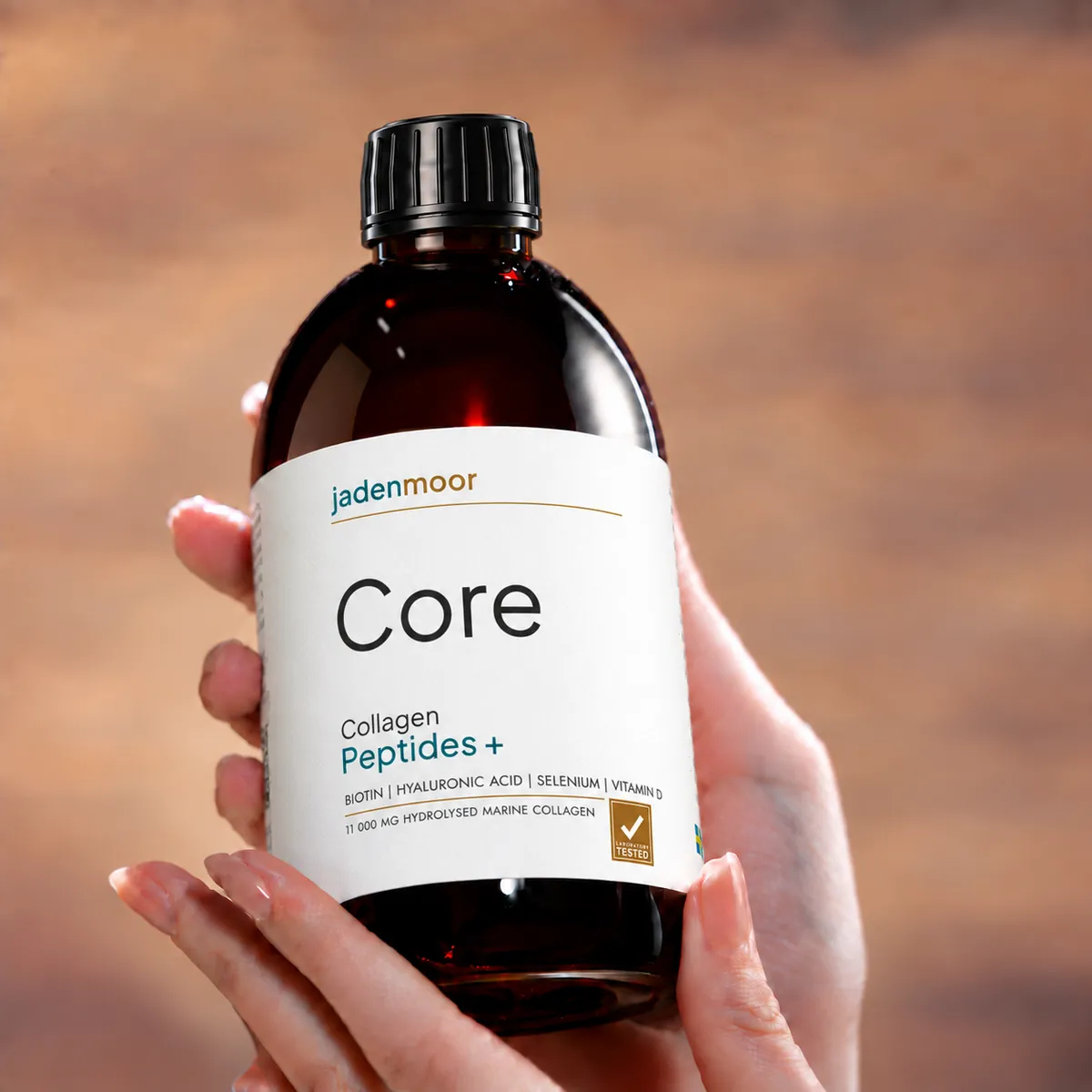
Choose a liquid collagen by its label. Six lines do the work: hydrolysed collagen, the amount per daily serving, the type and source, vitamin C, the testing behind it, and where it is made.
- Start with the collagen line. It should say hydrolysed, name the source and type, and give the amount in one daily serving.
- Then find vitamin C. Vitamin C contributes to normal collagen formation for the normal function of skin.
- Finish with the testing and the making. A named study with its length and number of participants, and the standards the drink is made to.
of 106 women found our liquid marine collagen easy to include in their daily routine during an 8-week user trial.
- 95%felt the appearance of their skin improved
- 89%reported more moisture and glow
- 81%reported firmer skin
How do you choose a liquid collagen?
Check six things on the label and product page: whether the collagen is hydrolysed, the amount per daily serving, the collagen type and source, vitamin C, the testing behind it, and where it is made. Together they tell you what the collagen is, how much you get each day, what comes with it, who has taken it in a study, and where it was made.
Each check below works the same way. It starts with the question to put to the label and gives the reason the question is worth asking, with the published source where there is one. It ends with a one-line answer for Core™, our liquid marine collagen, so you can see how one product answers it.
The back of the pack is all you need to follow along.

assets/img/blog/ch-label.webpIs the collagen hydrolysed?
Look for the word "hydrolysed", or "collagen peptides", in the ingredients. It tells you the collagen has been cut down to size. Native collagen is a large molecule of roughly 285 to 300 kDa. A peer-reviewed review describes hydrolysis as the step that cuts it into collagen peptides of about 3 to 6 kDa.1
For a drink, the same review adds that hydrolysed collagen is highly soluble in water, and the authors describe that higher solubility as a main advantage over native collagen.1 That solubility is what allows it to be formulated as a ready-to-drink liquid.
Some labels also print the molecular weight of the peptides. We compare the two formats side by side in liquid collagen or powder.
In Core™: hydrolysed marine collagen, taken down to a low molecular weight of about 1,500 daltons.2
How much collagen is in a daily serving?
Find the collagen figure for one day's serving, in milligrams or grams. This is the number that lets you compare one product with another. In the 26 trials pooled in a 2023 meta-analysis, the listed collagen amounts ranged from 372 mg to 12 g, and most of those trials used between 2.5 g and 10 g.3
With a spread that wide, the amount per serving is the practical variable to compare across products, whatever the format.3 Check two things together on the label, the collagen in a serving and how many servings make a day.
Our guide to how much collagen to take per day has the detail on amounts.
In Core™: 11,000 mg of hydrolysed marine collagen in one portion, and one portion is the day's serving.2
Does the label state the type and the source?
Look for both on the label: the collagen type by numeral and where the collagen comes from. The type tells you which collagen you are drinking. In skin, type I collagen makes up 80% to 90% of the collagen.4
The source tells you what the collagen was made from. A peer-reviewed review of fish collagen states that fish skin typically contains type I collagen with a high degree of purity.5
You are looking for two plain statements: "marine", "fish" or another named source, and the type or types. The numerals themselves are explained in our guide to the types of collagen.
In Core™: the marine collagen in Core™ is types I and III, and it is hydrolysed marine collagen by name.2
Is vitamin C in the recipe?
Look for vitamin C in the nutrition table, with its amount and its share of the reference intake. Among the nutrients in Core™, it is the one whose authorised claim names collagen. Vitamin C contributes to normal collagen formation for the normal function of skin.6
That wording has a scientific opinion behind it. EFSA's NDA Panel, in an opinion adopted on 2 July 2009, concluded that a cause and effect relationship has been established between the dietary intake of vitamin C and normal collagen formation, with the general population as the target population.7 To carry the claim, a food must be at least a "source of" vitamin C.7
The amount therefore matters as much as the name, and a label that prints vitamin C in milligrams, next to a percentage of the reference intake, lets you see it at a glance.
In Core™: 120 mg of vitamin C in every portion, which is 150% of the reference intake (NRV).2
What testing is behind it?
Ask three things of any study a brand mentions: who took part, for how long, and what was recorded. With those three answers you can weigh a study up for yourself.
Described that way, ours are two studies of our liquid marine collagen formula, commissioned by our manufacturer.2 In the user trial, 106 women took it daily for 8 weeks and reported what they noticed. In the clinical study, 10 women took it daily for 8 weeks and had their skin analysed with imaging before and after.
The clinical study showed a visible reduction in eye wrinkles, forehead wrinkles, spots, pigmentation and redness, and improved skin texture.2 The user-trial results are set out further down this page.
In Core™: the studies behind it are of our liquid marine collagen: an 8-week user trial of 106 women and an 8-week clinical study of 10 women with skin imaging.
Where and how is it made?
Look for a country of manufacture and the standards the drink is made to, written out by name. It is the shortest line on the checklist and the quickest to find. When both are there, you know where your daily portion is made and the standards it is made to.
In Core™: made in Sweden to GMP, HACCP and ISO 22000 standards.2
What does the checklist look like at a glance?
The checklist is six lines: hydrolysed collagen, the amount per daily serving, the collagen type and source, vitamin C, the testing behind it, and where it is made. The table puts all six in one place with Core's answer to each, ready to hold up against any pack.
The liquid collagen checklist
What to read on the label, why it is worth reading, and Core's answer.
| What to check | Why it is worth checking | Core™ |
|---|---|---|
| Hydrolysed collagen | Hydrolysis cuts native collagen of roughly 285 to 300 kDa into peptides a review places at about 3 to 6 kDa, and hydrolysed collagen is highly soluble in water.1 | Hydrolysed to about 1,500 daltons |
| Amount per daily serving | Across 26 pooled trials the listed amounts ranged from 372 mg to 12 g, so the amount per serving is the practical variable to compare.3 | 11,000 mg in one portion |
| Type and source | Type I makes up 80% to 90% of the collagen in skin.4 A review states that fish skin typically contains type I collagen with a high degree of purity.5 | Marine collagen, types I and III |
| Vitamin C | Vitamin C contributes to normal collagen formation for the normal function of skin.6 | 120 mg per portion (150% NRV) |
| Testing | A study you can describe: who took part, for how long, what was recorded. | Studies of our liquid marine collagen: an 8-week user trial of 106 women and an 8-week clinical study of 10 women2 |
| How it is made | A named country of manufacture and named standards. | Made in Sweden to GMP, HACCP and ISO 22000 standards |
One more thing belongs beside the list, although no label prints it, and that is whether you will take it every day. With Core™ the routine is one portion a day. Shake, pour into the cap, then drink it straight or stir it into water or a smoothie. Keep the pack in the fridge once opened.2
What did women report on our liquid marine collagen?
In our 8-week user trial, 99% of 106 women found our liquid marine collagen easy to include in their daily routine, and 95% felt that the appearance of their skin improved.2 Women reported visible results in as little as 4 weeks, with further improvement by week 8. These are the shares who reported each change.
felt that the appearance of their skin improved.
noticed a reduction in fine lines and wrinkles.
reported healthier hair.


Participants in the 8-week user trial of our liquid marine collagen, photographed before and after. This is what it looked like for women in our studies.
Two accounts in women's own words sit alongside those figures: one from a journalist who took marine collagen for around six months, and one from a buyer of our liquid marine collagen.
“To my surprise, these worked.”
After around six months on 10,000 mg of marine collagen a day she reported glowier, more even skin that held on to hydration for longer, and nails that were less brittle.
Charlotte BitmeadWriting in Stylist8
“I can really see the visible changes in my skin and nails.”
★★★★★
Check4YouVerified purchase · Amazon, Germany · 27 December 2023
An independent first-person account of marine collagen published by the outlet named, and a verified buyer review of our liquid marine collagen as sold under our manufacturer's own label.
Questions about choosing a liquid collagen
What should I look for in a liquid collagen?
Six things on the label: hydrolysed collagen, the amount per daily serving, the collagen type and source, vitamin C, the testing behind it, and where it is made. Core's answer to each of the six is set out above.
What does hydrolysed mean on a collagen label?
It means the collagen has been cut into smaller peptides. A peer-reviewed review puts native collagen at roughly 285 to 300 kDa and collagen peptides at about 3 to 6 kDa. The collagen in Core™ is hydrolysed to about 1,500 daltons.
Which number on the label should I compare?
The collagen in one daily serving. A 2023 meta-analysis of 26 trials listed amounts from 372 mg to 12 g, with most trials between 2.5 g and 10 g, which makes the amount per serving the practical figure to compare. Core™ has 11,000 mg in one portion.
Why do collagen drinks include vitamin C?
Vitamin C has an authorised claim that names collagen. Vitamin C contributes to normal collagen formation for the normal function of skin. Core™ has 120 mg per portion, which is 150% of the reference intake.
How can I tell if a liquid collagen has been studied?
Look for a study described in full: who took part, for how long and what was recorded. The studies of our liquid marine collagen are an 8-week user trial of 106 women and an 8-week clinical study of 10 women with skin imaging. In the user trial, 95% felt the appearance of their skin improved.
Is a liquid collagen easy to take every day?
Yes, in our user trial 99% of 106 women found our liquid marine collagen easy to include in their daily routine over 8 weeks. The routine with Core™ is one portion a day, straight from the cap or stirred into water or a smoothie.