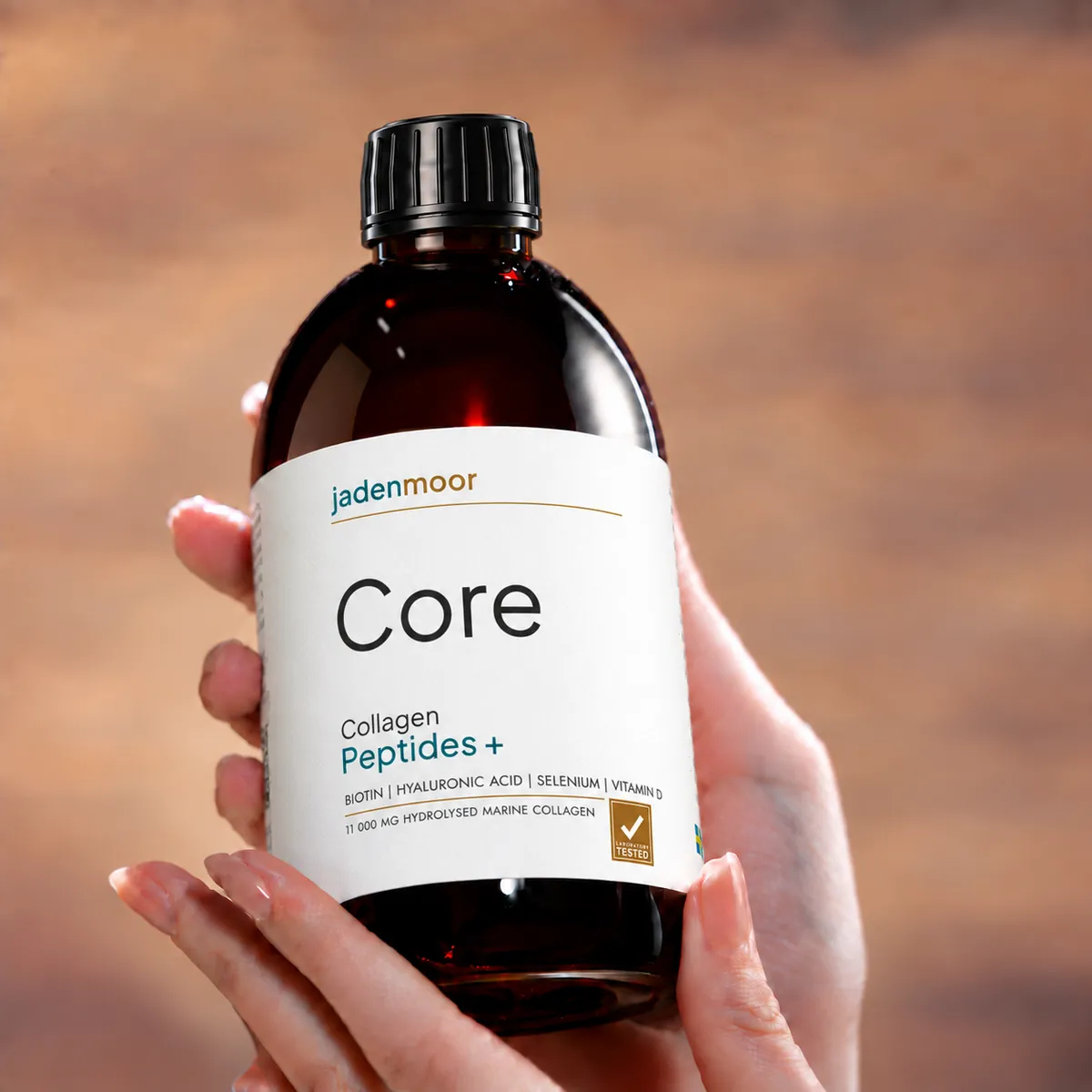
The clinical trials used between 1 g and 10 g of collagen peptides a day. One portion of Core™ provides 11,000 mg, just above that range.
- 1,000 mg a day of fish collagen peptide: skin hydration significantly higher than placebo at 6 weeks and at 12 weeks, in a trial of 64 women aged 40 to 60.
- 2.5 g a day of collagen peptides: eye-wrinkle volume about 20% lower than placebo after 8 weeks, in a trial of 114 women aged 45 to 65.
- 10 g a day of hydrolysed fish collagen: wrinkle score down 35% from baseline on the right side of the face after 12 weeks, in women aged 45 to 60.
of 106 women found our liquid marine collagen easy to include in their daily routine over 8 weeks.
- 95%said their skin looked better
- 87%noticed fewer fine lines and wrinkles
- 89%reported more moisture and glow
How much collagen should you take a day?
The clinical trials in the table below used between 1 g and 10 g of collagen peptides a day, so the answer is a range. Every one of them gave that amount daily, for weeks or months.
The pooled research looks at the same outcomes. A 2023 meta-analysis of 26 randomised controlled trials with 1,721 participants found that oral collagen significantly improved skin hydration and elasticity compared with placebo.2
For comparison, one portion of Core™ provides 11,000 mg of hydrolysed marine collagen, types I and III.1
What doses did the trials use?
The trials used 1,000 mg, 2.5 g, 5 g, 8 g or 10 g of collagen a day, with 2.5 g the most common dose. The table lists them smallest dose first, and each row is one study, with the collagen it used, what it recorded and who took part.
Daily collagen doses in the clinical trials
The amount taken each day, the result the study recorded, and the people and length of that study.
| Dose | What the study recorded | Study |
|---|---|---|
| 1,000 mg a day of low-molecular-weight fish collagen peptide | Skin hydration significantly higher than placebo at 6 weeks and at 12 weeks. Crow's-feet wrinkling and skin elasticity significantly better than placebo at 12 weeks.3 | 64 women aged 40 to 60. 12 weeks, randomised, double-blind, placebo-controlled. |
| 2.5 g a day of collagen peptides | Eye-wrinkle volume significantly lower than placebo after 4 weeks, and about 20% lower after 8 weeks.4 | 114 women aged 45 to 65. 8 weeks, randomised, double-blind, placebo-controlled. |
| 2.5 g a day of collagen peptides | Hair thickness up 1.93 micrometres on average with collagen, against a slight dip of 0.99 micrometres with placebo.5 | 44 healthy women aged 39 to 75. 16 weeks, randomised, placebo-controlled. |
| 2.5 g a day of collagen peptides | Nail growth rate up 12% and the frequency of broken nails down 42%.6 | 25 participants. 24 weeks, an open-label study with no placebo group. |
| 2.5 g a day of bovine collagen peptides, in a drink with acerola extract, vitamin C, zinc, vitamin E and biotin | Changes from baseline in the collagen group at 12 weeks: skin hydration +28.0% (placebo +9.0%), wrinkle depth −26.8% (placebo −6.4%), skin density +24.8% (placebo +6.8%).7 | 72 women aged 35 and over, 36 per group. 12 weeks, randomised, placebo-controlled. |
| 5 g a day of marine collagen hydrolysate | Cheek skin elasticity improved compared with placebo, and the difference was still there four weeks after stopping.8 | 36 postmenopausal women. 4 weeks, randomised, double-blind, placebo-controlled. |
| 5 g a day of collagen from freshwater fish skin | Skin elasticity up 12.23% from baseline in the collagen group of 20 women, significantly more than placebo.9 | Menopausal women aged 45 to 60. 6 months, randomised, placebo-controlled. |
| 8 g a day of hydrolysed collagen, in a marine collagen drink with vitamin C | In the collagen group at 12 weeks, the authors reported skin hydration +13.8% and elasticity +22.7%.10 | Adults aged 40 to 60, about 90% of them women. 12 weeks, randomised, double-blind, placebo-controlled. Daily-dose groups: 48 on collagen, 52 on placebo. |
| 10 g a day of hydrolysed fish collagen | Wrinkle score down 35% from baseline on the right side of the face, a 24% greater reduction than placebo.11 | Women aged 45 to 60. 12 weeks, randomised, triple-blind, placebo-controlled. |
How to read the table
Read each row as its own study, showing what that amount was studied for. The table does not rank the doses, because every row has different people, a different measurement and a different number of weeks.
- 2.5 g appears most often. It is the dose behind the eye-wrinkle trial, the hair-thickness trial, the open-label nail study and the bovine collagen drink.
- 5 g is the dose in two trials that measured skin elasticity. One used marine collagen hydrolysate in postmenopausal women, and the other used collagen from freshwater fish skin in menopausal women aged 45 to 60.
- 8 g and 10 g are the largest doses in the table. Both were 12-week trials, one of a marine collagen drink and one of hydrolysed fish collagen.
For the detail behind a single row, our guide to collagen for wrinkles goes through the wrinkle trials, and collagen for nails covers the nail study.

assets/img/blog/ds-shot.webpIs 11,000 mg of collagen a lot?
Core's 11,000 mg sits just above the largest daily dose used in these clinical trials, which is 10 g, or 10,000 mg, and it arrives in one portion of liquid.1 You have no scoops to level and no row of capsules to count, only one portion a day.
On the label, that portion reads as 9.9 g of protein. It is sugar free and fat free, with a natural berry flavour.1
That 10,000 mg comes from a 12-week trial in women aged 45 to 60 that used 10 g of hydrolysed fish collagen a day and recorded a wrinkle score 35% lower than baseline on the right side of the face.11
What form is the collagen in?
The collagen in Core™ is hydrolysed to a low molecular weight of about 1,500 daltons. Native collagen is about 300,000 daltons, roughly 200 times larger.1 The 1,000 mg trial in the first row also used a low-molecular-weight fish collagen peptide.3
Researchers have followed hydrolysed collagen into the blood after it is swallowed. When volunteers drank hydrolysed collagen, collagen peptides appeared in their blood and peaked within one to two hours.12 That study used gelatin hydrolysate and measured blood only.
What else is in the portion?
Alongside the collagen, Core™ adds vitamin C, hyaluronic acid, silica and biotin to every portion. Vitamin C contributes to normal collagen formation for the normal function of skin.13 Each portion of Core™ has 120 mg of it, which is 150% of the daily reference value, alongside 50 mg of hyaluronic acid, 50 mg of silica and 5,000 µg of biotin.1 Two of the drinks in the table paired their collagen with vitamin C too.710
“To my surprise, these worked.”
Her daily amount was 10,000 mg of marine collagen. Around six months in, she described skin that was glowier and more even and kept its hydration for longer, plus nails that were less brittle.
Charlotte BitmeadWriting in Stylist14
“The taste is amazing and it is sugar free! Love what it does to my hair, nails and skin.”
★★★★★
Suzanne H.Verified purchase · Amazon, United Kingdom · 26 August 2024
An independent first-person account of marine collagen published by the outlet named, and a verified buyer review of our liquid marine collagen as sold under our manufacturer's own label.
mg or grams: how do you read a collagen label?
Studies talk in grams and labels in milligrams, but the scale is the same, and 1,000 mg is 1 g.
- Convert first. 10 g in a study is 10,000 mg on a label. Core's 11,000 mg is 11 g.
- Find the serving. A figure only means something per day. Core's 11,000 mg is per portion, and you take one portion a day.
- Check the collagen itself. Look for the word hydrolysed and for the source. Core™ uses hydrolysed marine collagen, types I and III.
How do you take it?
Take it daily, at the moment you are least likely to skip. Every dose in the table was taken each day, and so was ours.
With Core™ you shake the pack, pour into the cap and drink it straight. If you prefer, stir it into water or a smoothie. Keep the pack in the fridge once opened.1
In our user trial, 106 women took our liquid marine collagen daily for 8 weeks, and 99% found it easy to include in their daily routine.1
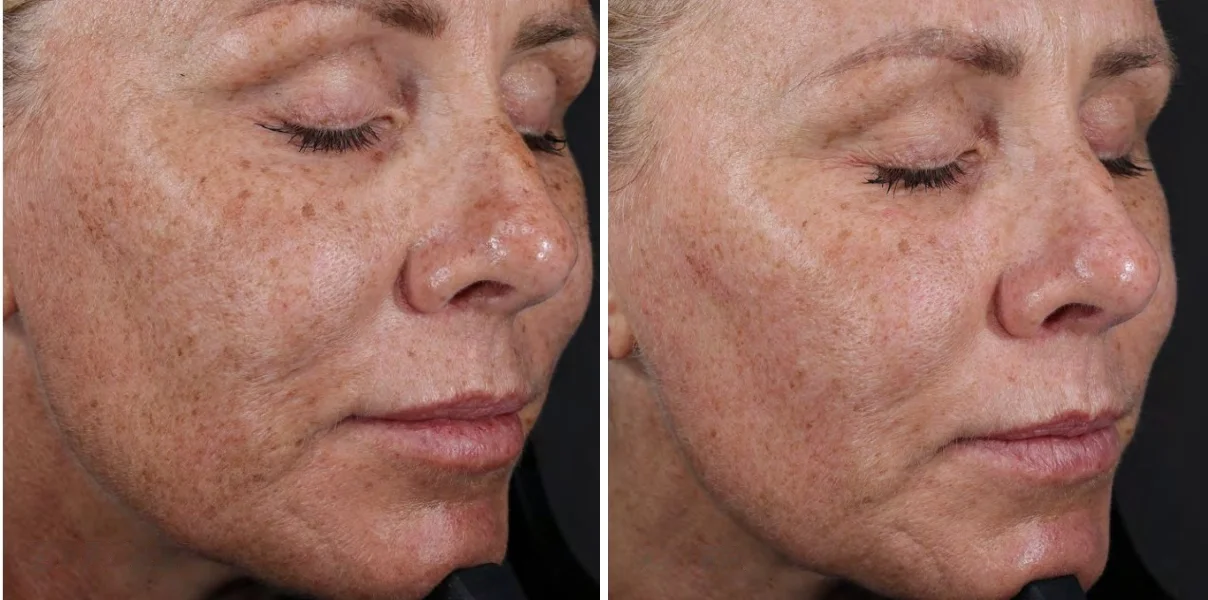
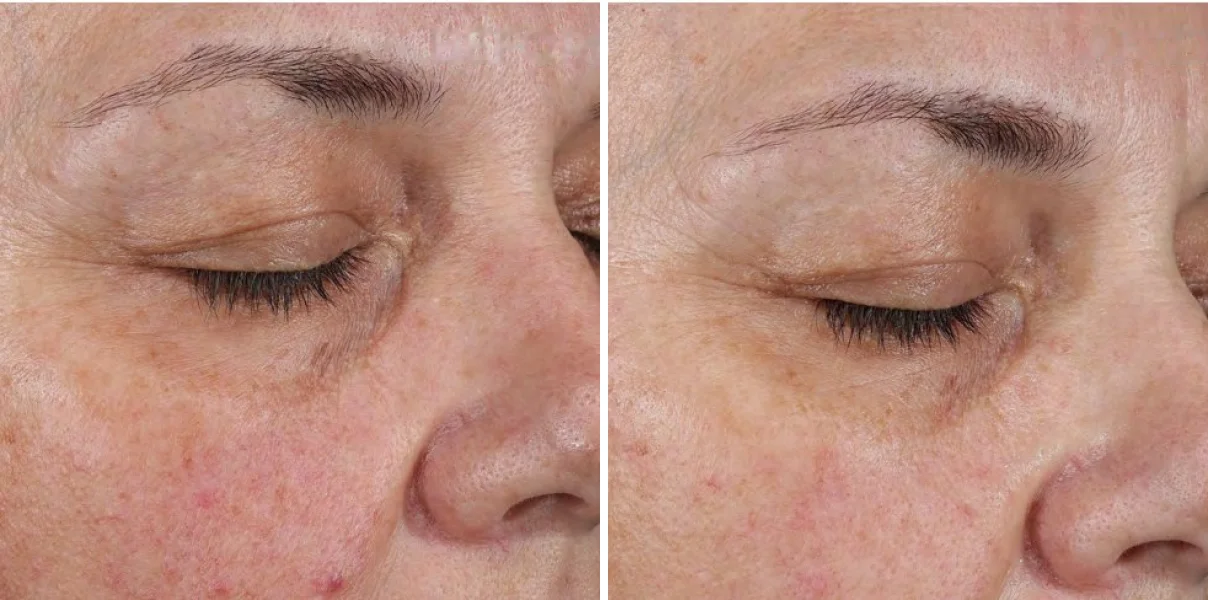
Participants in the 8-week user trial of our liquid marine collagen, photographed before and after. Figures are the shares of the 106 women who reported each change.
How long should you keep taking it?
Keep taking it for weeks and months, as the clinical trials did, which ran from 4 weeks to 6 months.
In the 2023 meta-analysis of 26 trials, the effect on skin hydration was larger when collagen was taken for more than 8 weeks.2 The same authors described fish as the optimal source of collagen for improving skin hydration.2
Our own user trial ran for 8 weeks of daily portions.1 For what showed up at which reading, see how long collagen takes to work.
Questions about collagen dosage
How much collagen should I take a day?
The clinical trials on this page used between 1 g and 10 g of collagen peptides a day, always as a daily dose. One portion of Core™ provides 11,000 mg of hydrolysed marine collagen, so one portion a day covers it.
Has 10,000 mg of collagen a day been studied?
10,000 mg is 10 g, the daily dose used in a 12-week trial of hydrolysed fish collagen in women aged 45 to 60. In that trial the wrinkle score fell 35% from baseline on the right side of the face.
Is 2.5 g of collagen a day enough?
2.5 g a day is the most common dose in the trials on this page: in a trial of 114 women aged 45 to 65 it was the amount behind eye-wrinkle volume about 20% lower than placebo after 8 weeks.
How many mg of collagen are in one portion of Core™?
11,000 mg of hydrolysed marine collagen, types I and III, in every portion. The same portion has 120 mg of vitamin C and gives 9.9 g of protein.
Should you take collagen every day?
Yes, daily is how collagen was studied: every trial on this page used a daily dose, and so did our own. In our user trial of 106 women, 99% found our liquid marine collagen easy to include in their daily routine over 8 weeks.
How long should I take collagen for?
The trials ran from 4 weeks to 6 months, and a meta-analysis of 26 trials found the skin-hydration effect was larger when collagen was taken for more than 8 weeks.