Collagen is the main structural protein of your skin. Hyaluronic acid is the molecule a skin review ties to the water your skin holds. Each has its own placebo-controlled trials by mouth.
- Collagen is structure. It accounts for about 75% of the dry weight of skin.
- Hyaluronic acid is linked to water. Reviews place about half of your body's total in the skin.
- The trial amounts differ. Collagen trials below used 1,000 mg to 5 g a day. Hyaluronic acid trials below used 120 mg a day.
of 106 women reported more moisture and glow after 8 weeks on our liquid marine collagen. This is a result for the whole drink.
- 95%felt their skin looked better
- 81%reported firmer skin
- 87%noticed fewer fine lines and wrinkles
What is the difference between collagen and hyaluronic acid?
Collagen is your skin's structural protein, while hyaluronic acid is a separate molecule tied to the water your skin holds.
Collagen is a protein, and it is the frame. A review of how the dermis ages puts collagen at about 75% of the skin's dry weight.1 An anatomy reference describes the deeper part of the dermis as dense connective tissue, built from bundles of collagen fibre.2
Hyaluronic acid is tied to water. A review of hyaluronic acid in skin describes skin hydration as depending on the water bound to hyaluronic acid, in the dermis and in the living layers of the epidermis.3 Skin is also your body's largest store of it.3
The frame and the water are two different molecules, and each has its own trials below.
Both descriptions are about the collagen and hyaluronic acid your body makes for itself. What happens when you swallow either one is a different question, and it belongs to the trials further down.
Collagen and hyaluronic acid side by side
The table asks the same six questions of each. Every cell comes from a published source or from the Core™ label.
Collagen and hyaluronic acid, question by question
The body's own supply in the first rows, then studies by mouth, then the Core™ label.
| Question | Collagen | Hyaluronic acid |
|---|---|---|
| What it is | The main structural protein of skin.1 | A molecule found in your skin. A review describes skin hydration as depending on the water bound to it.3 |
| Where it sits in skin | In the dermis. Its deeper part is dense connective tissue made of collagen fibre bundles.2 | In the dermis and in the living layers of the epidermis.3 |
| What the body holds | About 75% of the dry weight of skin is collagen. Type I makes up 80 to 90% of skin collagen.1 | An estimated 15 g or so in a 70 kg person, with about 5 g broken down and replaced every day.4 Reviews put about half of the total in the skin.3 |
| What trials of it by mouth measured | Skin hydration, eye-wrinkle volume and skin elasticity, each against placebo.567 | Water content of the facial stratum corneum, facial transepidermal water loss and wrinkle volume ratio in people with crow's-feet wrinkles, each against placebo at 120 mg a day.89 |
| Daily amounts in those trials | From 1,000 mg to 5 g of collagen peptides, depending on the trial.51067 | 120 mg in the two trials.89 120 mg or 240 mg in the studies gathered by a 2014 review.11 |
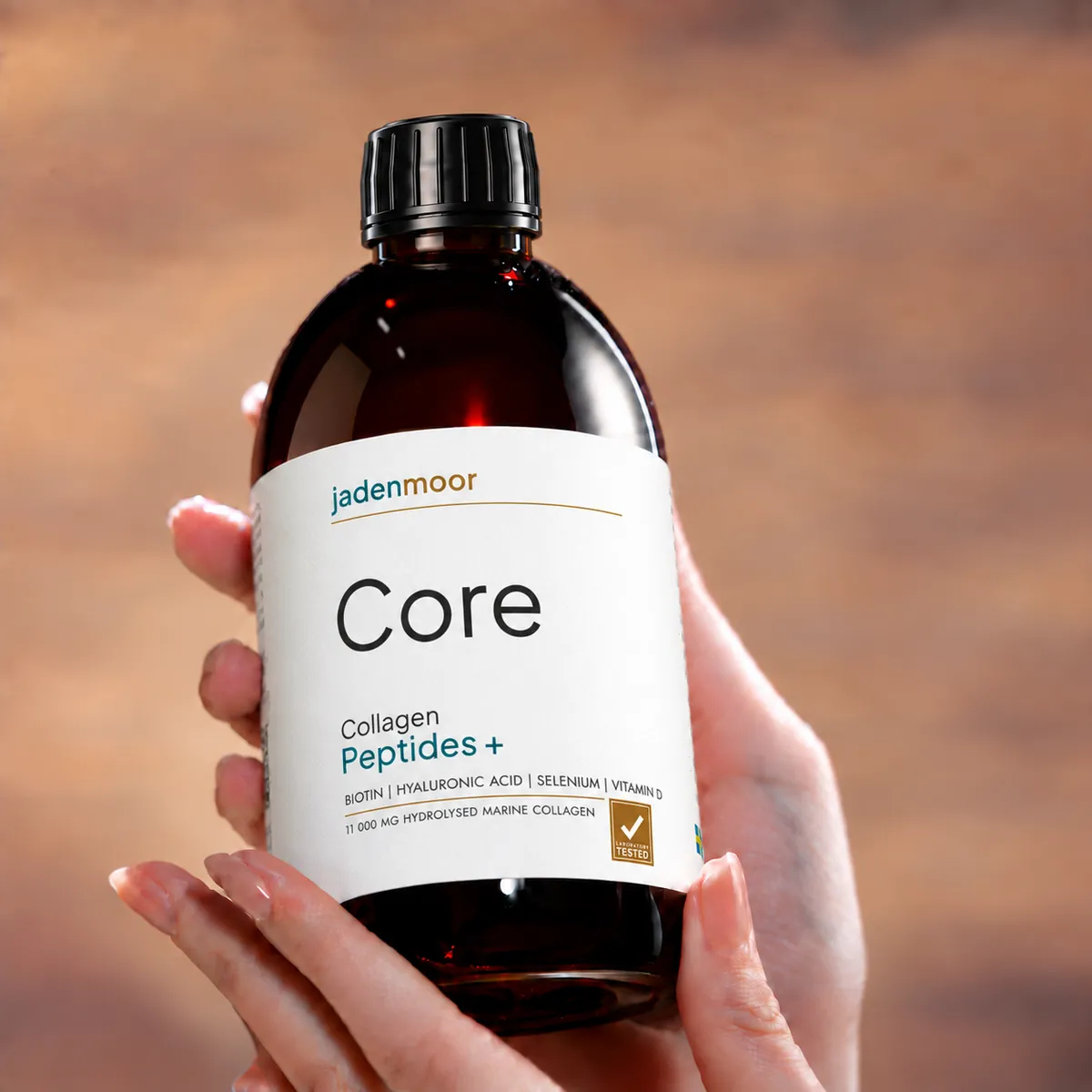
| Amount in Core™ | 11,000 mg of hydrolysed marine collagen, types I and III, per portion.12 | 50 mg per portion.12 |
A note on the "holds" row. The hyaluronic acid figure is an estimate from a review article, and the collagen figure is a share of skin's dry weight. They are different kinds of number, so read them down each column, not across.
What have trials of collagen by mouth measured?
Trials of collagen by mouth have mainly measured three things: skin hydration, wrinkles and elasticity. Each has one placebo-controlled trial or two below, with its own dose and volunteers.
Skin hydration significantly higher than placebo at 6 and 12 weeks
The volunteers took 1,000 mg of low-molecular-weight fish collagen peptide daily for 12 weeks. Hydration readings were significantly higher than in the placebo group at the 6-week check and again at the end.5
64 women aged 40 to 60 · randomised, double-blind, placebo-controlled
More water in the stratum corneum and epidermis
Over 12 weeks, taking 1 g or 5 g of collagen peptides daily increased water content in the stratum corneum and epidermis, lowered transepidermal water loss, and raised natural moisturising factor in the stratum corneum.10
99 healthy Japanese women aged 35 to 50 · randomised, double-blind, placebo-controlled
Eye-wrinkle volume about 20% lower than placebo after 8 weeks
On 2.5 g of collagen peptides daily, eye-wrinkle volume was significantly lower than placebo at 4 weeks and at 8 weeks, where the gap stood at about 20%.6
114 women aged 45 to 65 · randomised, double-blind, placebo-controlled
Skin elasticity significantly better than placebo in both collagen groups
Women took 2.5 g or 5 g of collagen hydrolysate, or a placebo, once daily for 8 weeks. Elasticity improved significantly in each collagen group compared with placebo.7
69 women aged 35 to 55 · double-blind, placebo-controlled
In these four trials, collagen was tested against placebo for skin hydration, eye-wrinkle volume and skin elasticity. The water studies are laid out in full in collagen for skin hydration.
Each result above stays with the amount and the kind of collagen its trial used.

assets/img/blog/vs-pair.webpWhat have trials of hyaluronic acid by mouth measured?
Trials of hyaluronic acid by mouth have mostly measured water in the skin and, in one trial, crow's-feet wrinkles. Every result comes with its dose, which was 120 mg a day in the two trials, and 120 mg or 240 mg a day in the review.
Two terms will help you read the cards. A corneometer estimates hydration at the skin surface from electrical capacitance.13 Transepidermal water loss is the water that passes outward through the stratum corneum over time, so a lower number means less is escaping.14
Higher water content and lower water loss than placebo at 12 weeks
After 12 weeks on 120 mg of hyaluronic acid daily, the corneometer showed more water in the facial stratum corneum than it did for the placebo group. Facial transepidermal water loss was lower as well.8
40 adults aged 35 to 64 · randomised, double-blind, placebo-controlled
Lower wrinkle volume ratio than placebo at 8 weeks
Everyone enrolled had crow's-feet wrinkles. Those given 120 mg daily of hyaluronic acid with a molecular weight of 300 kDa had a lower wrinkle volume ratio than placebo at week 8 of the 12-week trial.9
60 Japanese men and women aged 22 to 59 · randomised, double-blind, placebo-controlled
Improved skin moisture versus placebo in people with dry skin
A 2014 review looked back over earlier randomised, double-blind, placebo-controlled studies. The authors reported improved skin moisture versus placebo in people with dry skin, at 120 mg or 240 mg daily for 2 to 6 weeks.11
Review of studies of hyaluronic acid taken by mouth
For more on the molecule and these studies, see our page on hyaluronic acid supplements.
Do you have to choose?
No, you do not have to choose between collagen and hyaluronic acid: they are two different ingredients, and one label can list both, as Core's does.
- Marine collagen: 11,000 mg. Hydrolysed, types I and III, in each portion.12
- Hyaluronic acid: 50 mg. In the same portion.12
Those are the label amounts. The hyaluronic acid studies on this page used 120 mg or 240 mg a day, and Core™ has 50 mg of hyaluronic acid per portion. The collagen trials used 1,000 mg to 5 g a day, and Core™ has 11,000 mg of hydrolysed marine collagen per portion.
Having both in one pack keeps the routine to one portion a day, shaken, poured into the cap, taken straight or stirred into water. The full ingredient list is on the Core™ product page.
What did women report on our liquid marine collagen?
In a user trial of our liquid marine collagen, 89% of women reported more moisture and glow and 81% reported firmer skin. The 106 women took it daily for 8 weeks and then answered questions about what they saw, a different kind of study from the trials above.12 Their answers describe the whole drink.
reported more moisture and glow.
reported firmer skin.
felt that the appearance of their skin improved.
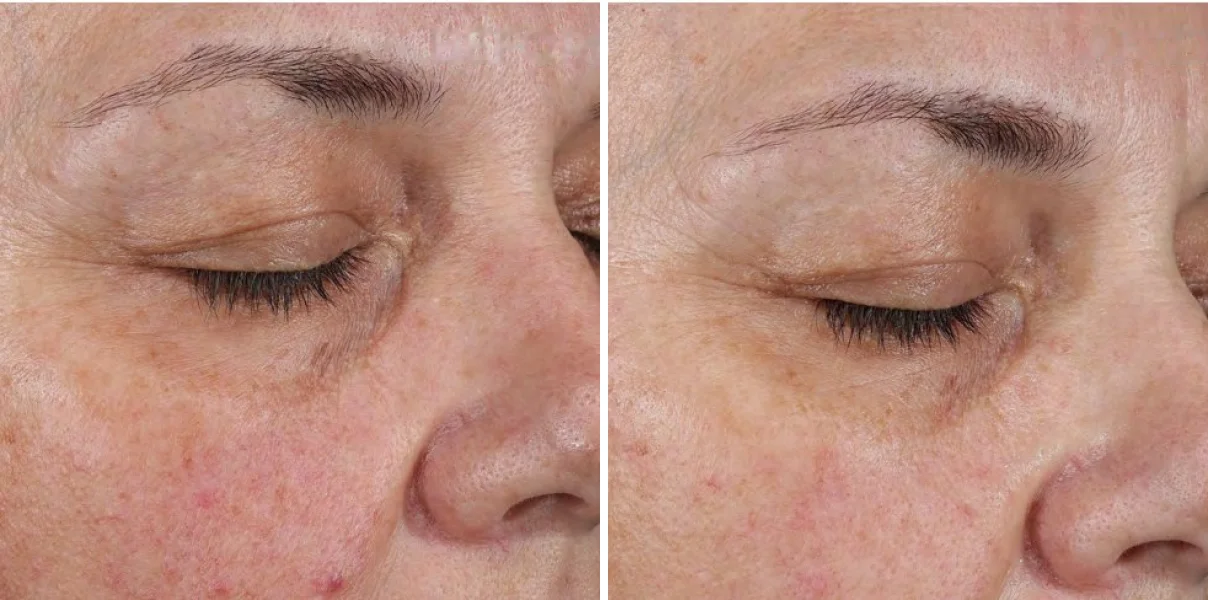
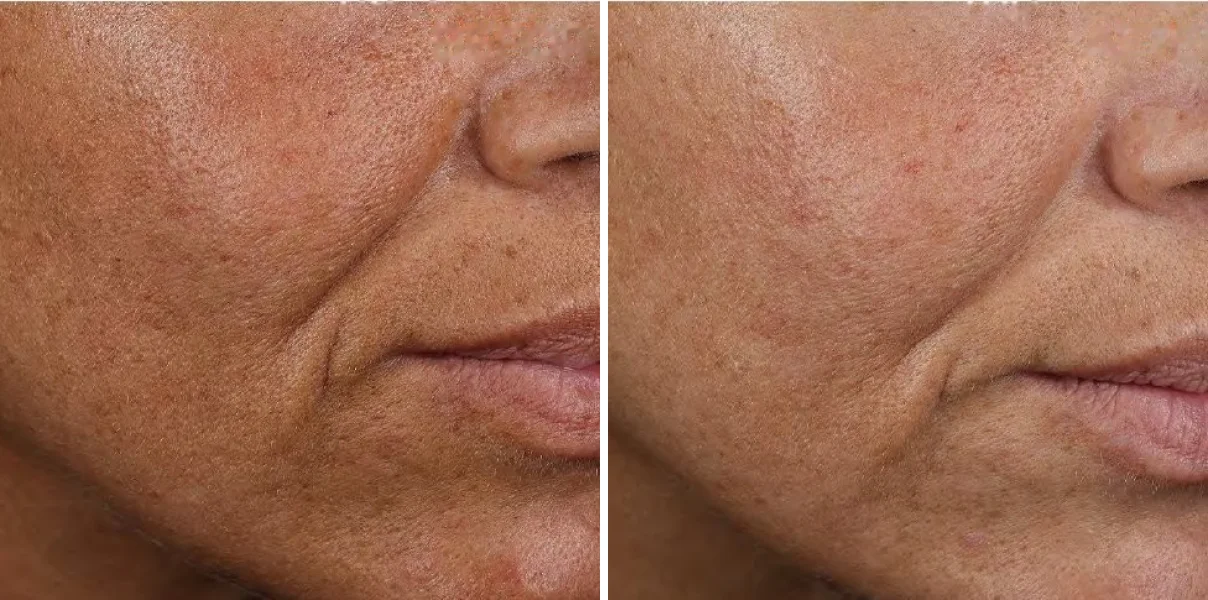
Participants in the 8-week user trial of our liquid marine collagen, photographed before and after. This is what it looked like for women in our studies.
The women in that trial reported visible results in as little as 4 weeks, with further improvement by week 8.12
“I can really see the visible changes in my skin and nails.”
★★★★★
Check4YouVerified purchase · Amazon, Germany · 27 December 2023
“The taste is amazing and it is sugar free! Love what it does to my hair, nails and skin.”
★★★★★
Suzanne H.Verified purchase · Amazon, United Kingdom · 26 August 2024
“My skin looks great, with no fine lines. I'm 45 and will definitely keep using it.”
★★★★★
FrédériqueVerified purchase · Amazon, France · 18 May 2024
Verified buyer reviews of our liquid marine collagen, as sold under our manufacturer's own label.
For the other ingredients on the Core™ label, see Collagen, vitamin C and hyaluronic acid.
Questions about collagen and hyaluronic acid
What is the difference between collagen and hyaluronic acid?
Collagen is the main structural protein of skin, at about 75% of its dry weight. Hyaluronic acid is a separate molecule: a review describes skin hydration as depending on the water bound to it. One is the layer's frame, the other is linked to its water.
Is collagen or hyaluronic acid better for skin?
The studies do not rank them, because each was studied for its own readings. The collagen trials on this page measured skin hydration, eye-wrinkle volume and skin elasticity against placebo, at 1,000 mg to 5 g a day. The hyaluronic acid trials measured facial stratum corneum water content, facial transepidermal water loss and wrinkle volume ratio against placebo, at 120 mg a day.
Can you take collagen and hyaluronic acid together?
Yes, and Core™ lists both. Each portion has 11,000 mg of hydrolysed marine collagen and 50 mg of hyaluronic acid, and you take one portion a day.
How much hyaluronic acid did the trials use?
The two 12-week trials described here used 120 mg a day. The studies gathered by a 2014 review used 120 mg or 240 mg a day for 2 to 6 weeks, in people with dry skin.
How much collagen did the trials use?
The collagen trials described here used from 1,000 mg to 5 g a day, for 8 or 12 weeks. Each of them compared collagen with a placebo.
Does your skin already contain both?
Yes, your skin contains both: the deeper part of the dermis is dense connective tissue made of collagen fibre bundles, and reviews put about half of the body's hyaluronic acid in the skin. Those facts describe what your body makes for itself.