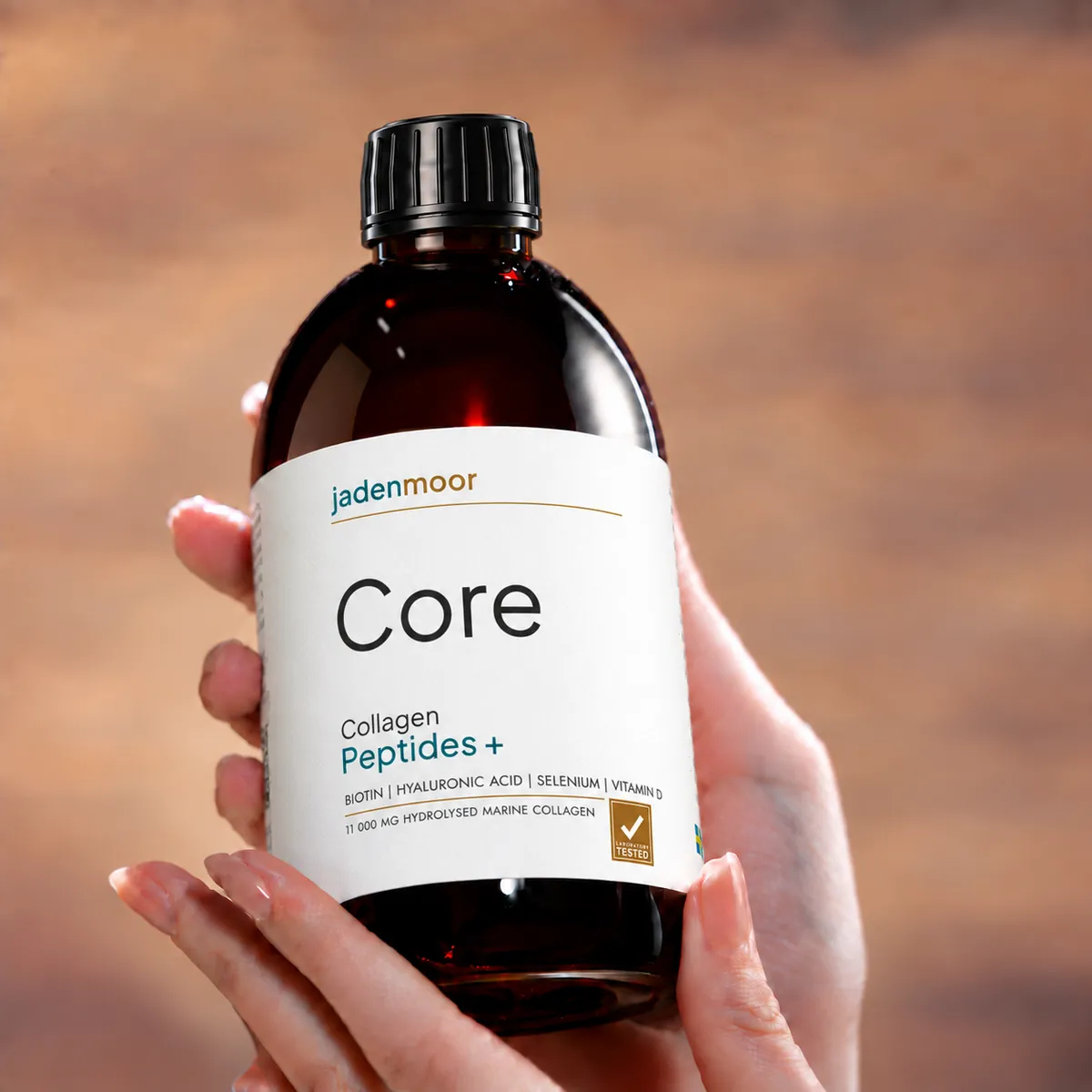
Two placebo-controlled trials described below tested collagen and vitamin C in the same daily drink, and Core™ lists collagen, vitamin C and hyaluronic acid in one portion.
- Collagen comes with trial findings. Eye-wrinkle volume was about 20% lower than placebo after 8 weeks in a trial of 114 women aged 45 to 65, at 2.5 g of collagen peptides a day.
- Vitamin C comes with an authorised claim. Vitamin C contributes to normal collagen formation for the normal function of skin.
- Hyaluronic acid is already in your skin. Two trials of it by mouth described below used 120 mg a day. Core™ has 50 mg.
of 106 women reported more moisture and glow after 8 weeks on our liquid marine collagen. This is a result for the whole drink.
- 95%felt their skin looked better
- 87%noticed fewer fine lines and wrinkles
- 81%reported firmer skin
Can you take collagen, vitamin C and hyaluronic acid together?
Yes, and researchers have already poured two of them into one glass. A 12-week randomised, double-blind, placebo-controlled trial tested a daily marine collagen drink made with 8 g of hydrolysed collagen plus vitamin C.1 Core's label names all three: 11,000 mg of hydrolysed marine collagen, 120 mg of vitamin C and 50 mg of hyaluronic acid in every portion.2
All three can share a portion, and in Core™ they do.
We wrote the recipe that way for a practical reason. Each of the three arrives with its own kind of evidence: trial findings for collagen, an authorised claim for vitamin C, and for hyaluronic acid a well-described place in your skin plus studies at a stated dose. A single measured portion lets you take all of them as one daily habit. Each one's evidence has its own section below.
What does each one bring?
Collagen: findings from placebo-controlled trials
Each brings a different kind of evidence: collagen has findings from placebo-controlled trials, vitamin C an authorised claim, and hyaluronic acid a well-described place in your skin plus studies at a stated dose. Collagen's case rests on studies, and the three below each have their own dose, volunteers and reading.
Eye-wrinkle volume about 20% lower than placebo
The daily amount was 2.5 g of collagen peptides. Eye-wrinkle volume in the collagen group was significantly lower than in the placebo group after 4 weeks and again after 8 weeks, by about 20%. Skin samples from the collagen group held 65% more procollagen type I and 18% more elastin than placebo after 8 weeks.3
114 women aged 45 to 65 · randomised, double-blind, placebo-controlled
Wrinkle score 35% lower than baseline on the right side of the face
Volunteers took 10 g of hydrolysed fish collagen each day. When the 12 weeks were up, their wrinkle score on the right side of the face had come down 35% from baseline, a 24% greater reduction than placebo.4
Women aged 45 to 60 · randomised, triple-blind, placebo-controlled
Cheek elasticity better than placebo
The shortest of the three gave 5 g of marine collagen hydrolysate a day for 4 weeks. Cheek skin elasticity improved compared with placebo, and the gap was still measurable four weeks after the final dose.5
36 postmenopausal women · randomised, double-blind, placebo-controlled
The collagen in Core™ is marine, types I and III, and hydrolysed to a low molecular weight of about 1,500 daltons.2
Vitamin C: an authorised claim and a role in collagen formation
Vitamin C stands on different ground. Unlike most animals, humans cannot make vitamin C in the body, so yours has to be eaten or drunk. The US National Institutes of Health fact sheet that records this also lists vitamin C as required for the biosynthesis of collagen, an essential component of connective tissue.6
The European Food Safety Authority describes the step in question. Vitamin C serves as a coenzyme for the prolyl and lysyl hydroxylases, enzymes that attach hydroxyl groups to proline and lysine within the collagen molecule, and that hydroxylation stabilises the triple helix. EFSA's panel concluded that a cause and effect relationship has been established between the dietary intake of vitamin C and normal collagen formation.7
The EU list of permitted health claims carries this wording: vitamin C contributes to normal collagen formation for the normal function of skin.8 The wording is reserved for foods that are at least a source of vitamin C, and it speaks about vitamin C alone. One portion of Core™ supplies 120 mg, which is 150% NRV.2 The enzyme story is told in full in vitamin C and collagen.
assets/img/blog/st-shot.webpHyaluronic acid: a molecule your skin holds, studied by mouth at 120 mg a day
Your body makes its own hyaluronic acid. Skin is its largest store, and reviews put roughly half of the body's total, 50% or more, there.9 One of those reviews links the skin's hydration to the water that hyaluronic acid binds, in the living layers of the epidermis and in the dermis beneath.9
Hyaluronic acid taken by mouth has studies of its own, and the dose is part of every result:
- 120 mg a day, water readings. A 12-week randomised, double-blind, placebo-controlled trial followed 40 adults aged 35 to 64. At week 12 the hyaluronic acid group showed more water in the facial stratum corneum and less facial transepidermal water loss than the placebo group.10
- 120 mg a day, crow's feet. In a 12-week randomised, double-blind, placebo-controlled trial of 60 Japanese men and women aged 22 to 59 with crow's-feet wrinkles, hyaluronic acid with a molecular weight of 300 kDa produced a lower wrinkle volume ratio than placebo at 8 weeks.11
- 120 mg or 240 mg a day, dry skin. The authors of a 2014 review reported that randomised, double-blind, placebo-controlled studies at these amounts, run for 2 to 6 weeks in people with dry skin, found improved skin moisture versus placebo.12
Core™ has 50 mg of hyaluronic acid per portion.2 The 120 mg and 240 mg above are different amounts, so those results stay with their doses. The studies are covered one by one in our page on hyaluronic acid supplements.
Which trials tested a combination?
Two placebo-controlled trials used a study drink that held collagen and vitamin C side by side. Every figure in them belongs to the entire drink.
Marine collagen plus vitamin C. The first is the 12-week trial from the opening section. Its volunteers were adults aged 40 to 60, about 90% of them women, and the figures come from the daily-dose groups: 48 on collagen and 52 on placebo. For the collagen group at 12 weeks, the authors reported skin hydration +13.8%, elasticity +22.7% and a wrinkle index of −19.6%.1
Bovine peptides with vitamin C and other nutrients. A 12-week randomised, placebo-controlled trial of 72 women aged 35 and over, 36 per group, used a drink of 2.5 g of bovine collagen peptides plus acerola extract, vitamin C, zinc, vitamin E and biotin.13 The chart sets the collagen group's changes from baseline next to the placebo group's.
One combination drink over 12 weeks: change from baseline
Collagen group beside placebo group, 36 women in each, all aged 35 and over.
View as a table
| Measure, change from baseline | Collagen drink | Placebo |
|---|---|---|
| Skin hydration | +28.0% | +9.0% |
| Wrinkle depth | −26.8% | −6.4% |
| Skin density | +24.8% | +6.8% |
Skin elasticity also improved significantly in that trial, and four weeks after the drink was stopped the collagen group's results were still above baseline.13
Each of these drinks had its own recipe, and their numbers stay with them. For more hydration readings from collagen trials, see collagen for skin hydration and glow.
What is in one Core™ portion?
One portion of Core™ holds 11,000 mg of hydrolysed marine collagen, 120 mg of vitamin C and 50 mg of hyaluronic acid, alongside further vitamins and selenium. The table gives the product specification for that portion, with the kind of evidence or authorised wording that goes with each line.2 For every vitamin and for selenium the table quotes one authorised claim from the EU list.8
One portion of Core™
Each listed ingredient with its amount, and what stands behind it.
| Ingredient | Per portion | What stands behind it |
|---|---|---|
| Hydrolysed marine collagen, types I and III | 11,000 mg | Trial findings for collagen, described above. Those trials used 2.5 g, 5 g and 10 g a day. |
| Vitamin C | 120 mg (150% NRV) | Vitamin C contributes to normal collagen formation for the normal function of skin. |
| Hyaluronic acid | 50 mg | A stated amount on the label. The studies above used 120 mg or 240 mg a day. |
| Silica | 50 mg | A stated amount on the label. |
| Biotin | 5,000 µg | Biotin contributes to the maintenance of normal skin. |
| Vitamin D | 60 µg | Vitamin D contributes to the maintenance of normal bones. |
| Vitamin B5 | 5 mg (83% NRV) | Pantothenic acid (vitamin B5) contributes to normal energy-yielding metabolism. |
| Vitamin B6 | 1.7 mg (121% NRV) | Vitamin B6 contributes to the regulation of hormonal activity. |
| Vitamin B12 | 24 µg (960% NRV) | Vitamin B12 contributes to normal red blood cell formation. |
| Selenium | 27.5 µg (50% NRV) | Selenium contributes to the maintenance of normal hair. |
The table shows the logic of the recipe, with collagen first, vitamin C beside its authorised wording and hyaluronic acid listed with its quantity.
Taking it is one step a day: shake the pack, pour into the cap, and drink it straight or stir it into water or a smoothie. The flavour is natural berry, sugar free and fat free.2 You can see it on the Core™ product page.
What did women report on our liquid marine collagen?
Women in the user trial of our liquid marine collagen reported more moisture and glow (89%) and firmer skin (81%). For 8 weeks, 106 women took it daily and then reported what they had noticed.2 Their answers describe the formula as a whole.
reported more moisture and glow.
felt that the appearance of their skin improved.
reported firmer skin.
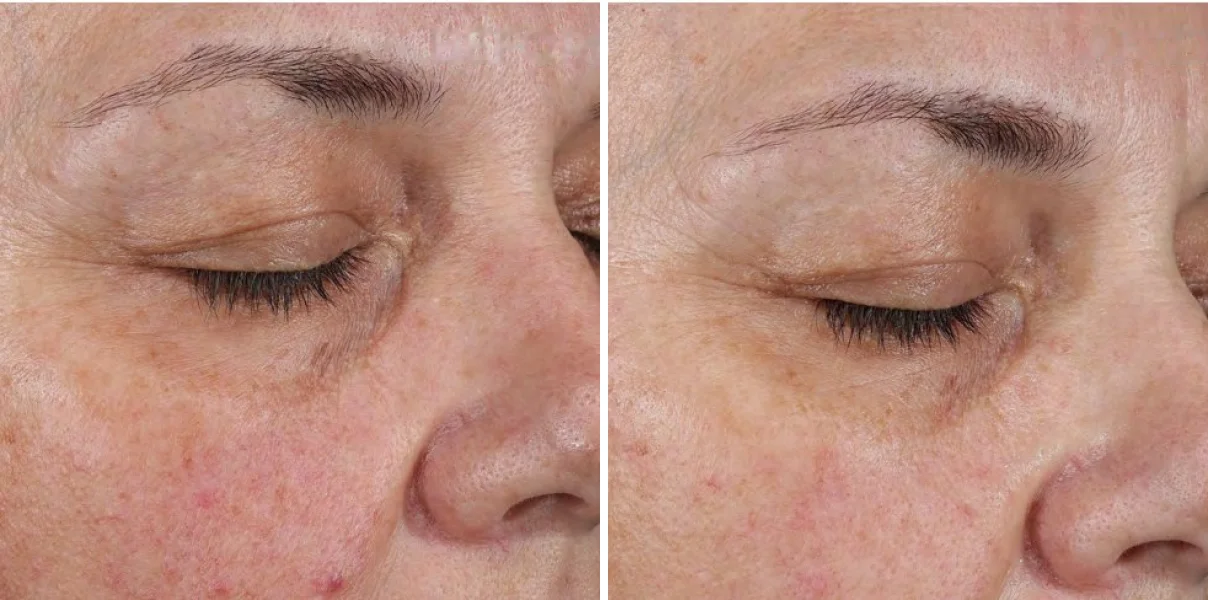
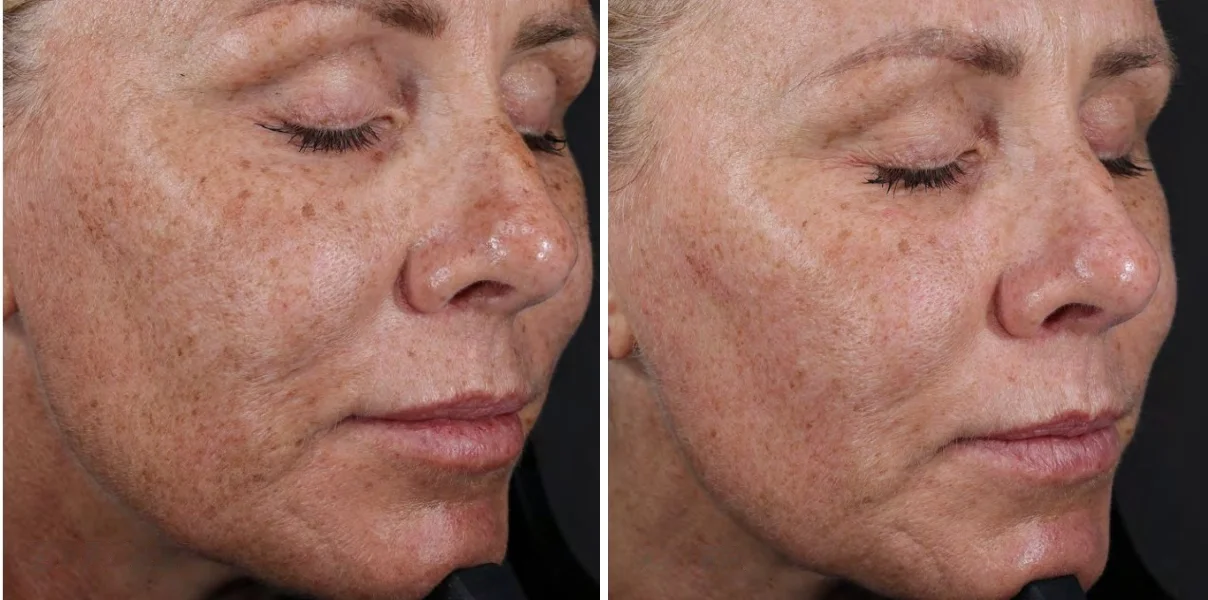
Participants in the 8-week user trial of our liquid marine collagen, photographed before and after.
The same women reported visible results in as little as 4 weeks, with further improvement by week 8.2
Questions about collagen, vitamin C and hyaluronic acid
Can you take collagen and hyaluronic acid together?
Yes, and Core™ lists both in the same portion: 11,000 mg of hydrolysed marine collagen and 50 mg of hyaluronic acid. You take them in one pour, once a day.
Should you take vitamin C with collagen?
Vitamin C is a natural partner for collagen, because the body requires it for the biosynthesis of collagen, and two placebo-controlled trials on this page tested the two in one drink, including a 12-week placebo-controlled trial of a daily marine collagen drink with 8 g of hydrolysed collagen plus vitamin C. Separately, vitamin C contributes to normal collagen formation for the normal function of skin. Core™ has 120 mg of vitamin C per portion.
Why does Core™ put all three in one portion?
Core™ puts all three in one portion so that one measured portion is a single daily step for you. Each ingredient has its own evidence, described on this page.
How much hyaluronic acid is in Core™, and how much did the studies use?
Core™ has 50 mg per portion. The studies of hyaluronic acid by mouth described here used 120 mg or 240 mg a day, so their results belong to those amounts.
How do you take Core™?
Take one portion a day. Shake the pack, pour into the cap, then drink it straight or stir it into water or a smoothie, and keep the pack in the fridge once opened.