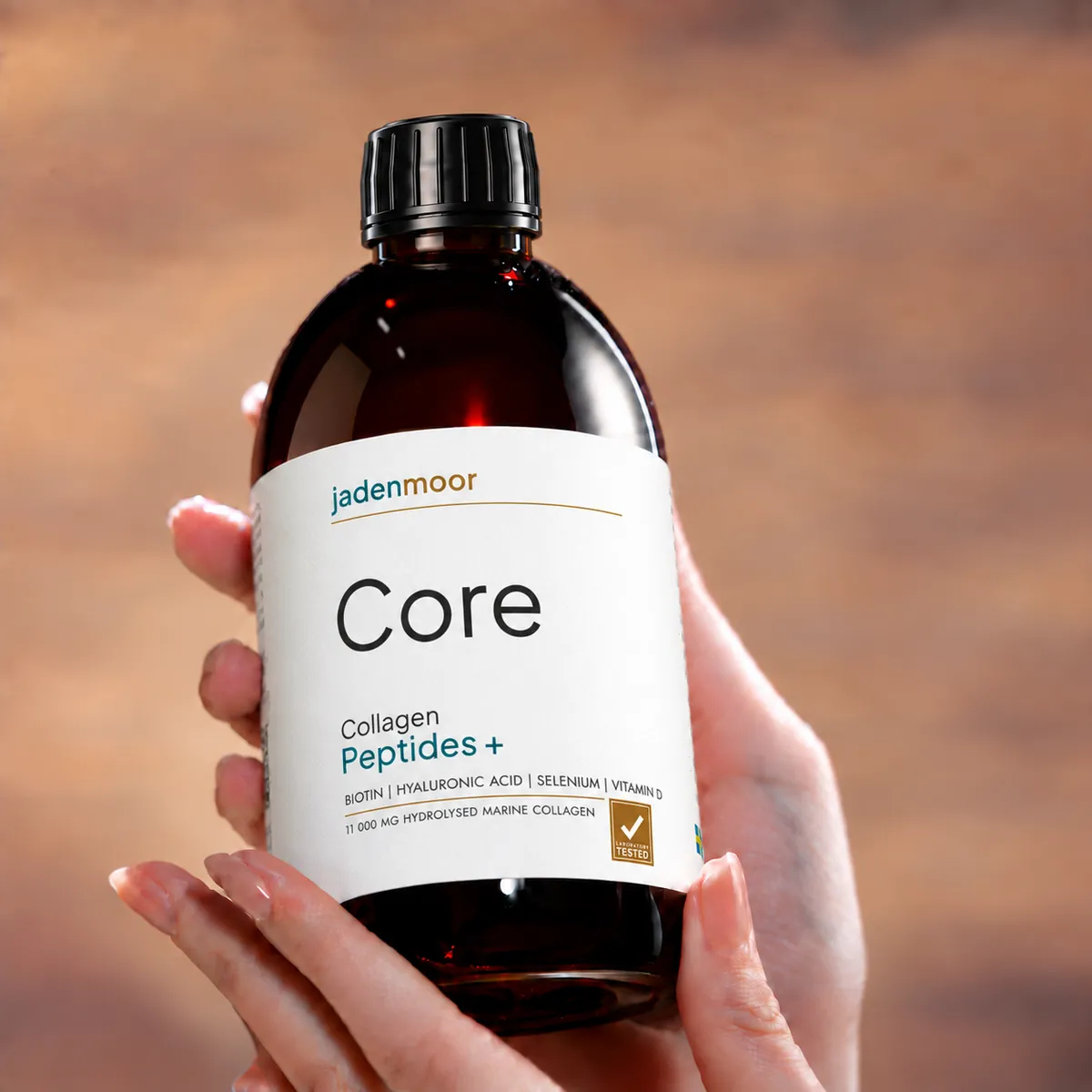
Core™ has 60 µg of vitamin D in every portion. The EU list of permitted health claims gives vitamin D authorised wording for bones, muscle function, teeth, calcium and the immune system.
- Bones and muscle. Vitamin D contributes to the maintenance of normal bones, and vitamin D contributes to the maintenance of normal muscle function.
- Calcium. According to the NIH fact sheet, vitamin D promotes calcium absorption in the gut.
- Skin and hair. In Core™ the authorised skin and hair wording belongs to biotin, selenium and vitamin C.
of 106 women found our liquid marine collagen easy to include in their daily routine during an 8-week trial.
- 95%felt the appearance of their skin improved
- 86%reported healthier hair
- 76%reported stronger nails
Why is there vitamin D in a collagen portion?
Vitamin D is in a collagen portion because it brings a different job description from the collagen, with authorised wording about bones, muscle function and teeth rather than your face. Core™ lists 60 µg of vitamin D per portion, next to 11,000 mg of hydrolysed marine collagen.1
It is there for breadth, because the EU list of permitted health claims gives vitamin D wording for bones, muscle function and teeth.2 Core™ includes it.
The rest of this guide takes the vitamin D line on the label and reads it slowly, using only what the law allows the vitamin to say and what the published opinions behind that wording concluded.
What is vitamin D?
Vitamin D is a fat-soluble vitamin, and one the body produces for itself. The NIH fact sheet on vitamin D describes it being made when ultraviolet rays from sunlight strike the skin.3
From there it goes to work elsewhere in the body. The same fact sheet says vitamin D promotes calcium absorption in the gut and helps keep blood calcium and phosphate at adequate concentrations.3
The fact sheet adds that vitamin D is needed for bone growth and bone remodelling, and for the normal development and growth of muscle fibres.3

assets/img/blog/vd-shot.webpWhat is vitamin D authorised to say?
Vitamin D is authorised to speak about bones, muscle function, teeth, calcium and phosphorus, blood calcium and the immune system, in wording taken from the EU list of permitted health claims, the only wording a food may use to describe a vitamin's benefit.2 The phrases are fixed, and a careful brand prints them unchanged. The table gives six of them for vitamin D, one line per row.
Six authorised vitamin D claims, word for word
The wording EU law allows for vitamin D, grouped by the part of the body it names.
| Area | Authorised wording | What sits behind it |
|---|---|---|
| Bones | Vitamin D contributes to the maintenance of normal bones. | EFSA opinion of 2009 on bone and teeth.4 |
| Muscle | Vitamin D contributes to the maintenance of normal muscle function. | EFSA opinion of 2010 on muscle function.5 |
| Teeth | Vitamin D contributes to the maintenance of normal teeth. | EFSA opinion of 2009 on bone and teeth.4 |
| Calcium and phosphorus | Vitamin D contributes to normal absorption/utilisation of calcium and phosphorus. | EU list of permitted health claims.2 |
| Blood calcium | Vitamin D contributes to normal blood calcium levels. | EU list of permitted health claims.2 |
| Immune system | Vitamin D contributes to the normal function of the immune system. | EU list of permitted health claims.2 |
Read down the first column and you get a map of the vitamin. Three rows name structures you can point to: skeleton, muscle, teeth. The calcium and phosphorus rows name two minerals, and the last row is the body's defences, which we cover with the other immune nutrients in Core™ in our article on vitamins and the immune system.
What did EFSA conclude?
EFSA, the European Food Safety Authority, concluded that dietary vitamin D intake has an established cause and effect relationship with normal bone and teeth and, in a later opinion, with normal muscle function. Each authorised phrase traces back to a scientific opinion like these, from a panel that weighs the evidence before a claim reaches the list.
Bone and teeth: cause and effect established
The panel concluded that a cause and effect relationship has been established between dietary vitamin D intake and the maintenance of normal bone and teeth.4
EFSA Journal 2009;7(9):1227
Muscle function: cause and effect established
A later opinion reached the same verdict for muscle: a cause and effect relationship has been established between dietary vitamin D intake and the maintenance of normal muscle function.5
EFSA Journal 2010;8(2):1468
For bone, the opinion also gives its reasoning. Vitamin D is required for efficient calcium absorption and for maintaining normal blood calcium and phosphate, which are needed for the normal mineralisation of bone and teeth.4
That reasoning ties the table together. The calcium rows describe the route, and the bones and teeth rows describe where it leads. The panel reached its cause and effect conclusion for bone and teeth in 2009 and for muscle function in 2010.
If bones and muscle are your main interest, our article on bones and muscles after menopause looks at both vitamins involved from that reader's side.
How much vitamin D is in Core™?
Each portion of Core™ has 60 µg of vitamin D.1 The label states it as an amount, in micrograms, and that is the figure to go by.
- One portion a day. Shake the pack, pour a portion into the cap and drink it straight, or stir it into water or a smoothie.
- Nothing extra to remember. The vitamin D is already in the liquid with the collagen.
- Fridge once opened. Core™ comes in a 500 ml pack. Keep it in the fridge once opened.
There is one more vitamin D connection on the label. Pantothenic acid (vitamin B5) contributes to normal synthesis and metabolism of steroid hormones, vitamin D and some neurotransmitters.2 Core™ has 5 mg of it per portion.1
How does vitamin D sit beside vitamin C?
Vitamin D and vitamin C meet at bones and teeth: vitamin D's wording is about maintaining them, while vitamin C's wording is about normal collagen formation for their normal function. That shared ground is where the collagen comes back in. The same portion of Core™ has 120 mg of vitamin C.1
- Vitamin C contributes to normal collagen formation for the normal function of bones.2
- Vitamin C contributes to normal collagen formation for the normal function of cartilage.2
- Vitamin C contributes to normal collagen formation for the normal function of teeth.2
Set those beside the vitamin D table and bones and teeth each appear under both vitamins, from different directions. Cartilage appears under vitamin C only.
A peer-reviewed review states that type I collagen is the most common type in skin, bone, teeth and tendon, while type II is present in cartilage.6 That describes the collagen your own body makes and where it sits.
Each vitamin keeps to its own wording. For the vitamin C half, see how vitamin C and collagen work together.
Does vitamin D do anything for skin and hair?
The EU list gives vitamin D wording for bones, muscle function, teeth, calcium and phosphorus, blood calcium and the immune system, and none for skin or hair.2
Those lines are held by other nutrients in the same pack, and each keeps its own wording:
- Hair. Biotin contributes to the maintenance of normal hair. Selenium contributes to the maintenance of normal hair.2
- Skin. Biotin contributes to the maintenance of normal skin. Vitamin C contributes to normal collagen formation for the normal function of skin.2
A formula with several nutrients divides the work this way, with each one there for the job it is authorised to name. You can read the biotin side in full in our biotin article.
What did women in our trial report?
In our user trial, 99% of women found our liquid marine collagen easy to include in their daily routine, 95% felt the appearance of their skin improved and 86% reported healthier hair. The 106 women took the whole drink every day for 8 weeks and reported what they noticed.1 These figures describe the complete formula as the women experienced it. They are not readings for any single vitamin.
found it easy to include in their daily routine.
felt that the appearance of their skin improved.
reported healthier hair.
We chose the first tile because nearly every woman in the trial found the habit easy to keep. Participants also reported more energy and better joint flexibility.1
The women in that trial reported visible results in as little as 4 weeks, with further improvement by week 8.1
“The taste is amazing and it is sugar free! Love what it does to my hair, nails and skin.”
★★★★★
Suzanne H.Verified purchase · Amazon, United Kingdom · 26 August 2024
“I can really see the visible changes in my skin and nails.”
★★★★★
Check4YouVerified purchase · Amazon, Germany · 27 December 2023
Verified buyer reviews of our liquid marine collagen as sold under our manufacturer's own label. They are buyers' own words about the whole drink, separate from the trial.
Questions about vitamin D and collagen
Can you take collagen with vitamin D?
Yes, collagen and vitamin D can be taken together, as Core™ is made that way: every portion holds 60 µg of vitamin D next to its hydrolysed marine collagen. The two arrive in one drink, once a day.
Why add vitamin D to a collagen drink?
Vitamin D is added to a collagen drink because it brings authorised wording of its own, for bones and muscle function. Vitamin D contributes to the maintenance of normal bones. Vitamin D contributes to the maintenance of normal muscle function.
Is vitamin D good for skin and hair?
Vitamin D has no authorised EU wording for skin or hair; its own lines cover bones, muscle function, teeth, calcium and phosphorus, blood calcium and the immune system. In Core™, the authorised hair wording belongs to biotin and selenium, and the skin wording to vitamin C and biotin.
What does vitamin D have to do with teeth?
EFSA concluded in 2009 that a cause and effect relationship has been established between dietary vitamin D intake and the maintenance of normal bone and teeth. The authorised line reads: vitamin D contributes to the maintenance of normal teeth.
Is vitamin D fat-soluble or water-soluble?
Vitamin D is fat-soluble. The NIH fact sheet describes it as a fat-soluble vitamin that the body also makes itself when ultraviolet rays from sunlight strike the skin.
Does vitamin D help the body form collagen?
The authorised wording on collagen formation belongs to vitamin C, not vitamin D: vitamin C contributes to normal collagen formation for the normal function of bones. Vitamin D's own lines are about maintaining bones, muscle function and teeth, and about calcium.