Collagen sits in animal foods with connective tissue. Your body also builds its own from amino acids, in a process that needs vitamin C and zinc, according to Harvard's Nutrition Source.
- Foods with collagen in them: tougher cuts of meat, plus the bones and skin of fresh and saltwater fish.
- Foods with the building blocks: protein foods such as fish, poultry, meat, eggs, dairy, legumes and soy supply amino acids including glycine and proline.
- The vitamin in the process: vitamin C contributes to normal collagen formation for the normal function of skin.
of 106 women found our liquid marine collagen easy to include in their daily routine during an 8-week user trial.
- 95%felt the appearance of their skin improved
- 89%reported more moisture and glow
- 81%reported firmer skin
Which foods contain collagen?
Harvard's Nutrition Source names the foods that naturally contain collagen: animal foods with connective tissue, such as tougher cuts of meat, and the bones and skin of fresh and saltwater fish.1
That list is specific, down to the connective tissue in tougher cuts of meat and the bones and skin of fish, and it describes where collagen is found in food.
Fish earns a second mention. A scientific review of fish gelatin states that the skin, bones, fins, heads and scales of fish can be used as a valuable source of gelatin.2 Harvard describes gelatin as a collagen derivative made by boiling animal bones, cartilage and skin.1 How gelatin, broth and collagen peptides relate is a topic of its own, covered in collagen, gelatin and bone broth compared.
What does your body build collagen from?
Your body builds its own collagen from amino acids including glycine and proline, and the process also needs vitamin C and zinc, as Harvard's Nutrition Source sets out.1
The amino acids come from protein foods. Harvard's examples are fish, poultry, meat, eggs, dairy, legumes and soy.1 Legumes and soy stand on that wide list beside fish and eggs, so the building blocks are open to very different ways of eating. If your plate is plant-based, our article on vegan collagen looks at that side in detail.
Collagen in food, and the materials your body works from
What each source in this article says, row by row.
| What | Where the source places it | Source |
|---|---|---|
| Collagen itself | Animal foods with connective tissue, such as tougher cuts of meat, and the bones and skin of fresh and saltwater fish. | Harvard's Nutrition Source1 |
| Gelatin | The skin, bones, fins, heads and scales of fish can be used as a valuable source of it. | Review of fish gelatin2 |
| Glycine and proline | Amino acids supplied by protein foods such as fish, poultry, meat, eggs, dairy, legumes and soy. | Harvard's Nutrition Source1 |
| Vitamin C | Needed in the process. It has to come from the diet. | Harvard's Nutrition Source1 and the NIH fact sheet3 |
| Zinc | Named by the source as needed in the process. | Harvard's Nutrition Source1 |

assets/img/blog/fd-table.webpWhy is vitamin C part of the picture?
Your body needs vitamin C to make collagen and cannot supply it from within. Humans, unlike most animals, cannot make vitamin C, so every milligram arrives with what you eat and drink. The US National Institutes of Health states the link to collagen directly: vitamin C is required for the biosynthesis of collagen.3
Proline, one of the amino acids Harvard names, appears in the biochemistry too. A medical reference text describes vitamin C as a required cofactor for the enzymes that hydroxylate proline and lysine in collagen.4 The European Food Safety Authority adds what that step is for: the hydroxylation stabilises the triple helix, the three-stranded shape of the collagen molecule.5
EU food law carries the conclusion in a single authorised sentence. Vitamin C contributes to normal collagen formation for the normal function of skin.6 The same form of words is authorised for bones, cartilage, gums, teeth and blood vessels, and a food may use it only when it is at least a source of vitamin C.6
Behind that sentence is a scientific opinion. EFSA's panel adopted it on 2 July 2009, finding an established cause and effect relationship between vitamin C in the diet and normal collagen formation, for the general population.5 The claim belongs to vitamin C. Our longer read on vitamin C and collagen follows the chemistry further.
Food or supplement: how do they compare?
Food and a supplement sit side by side rather than compete: protein foods supply the amino acids,1 and your diet is where vitamin C has to come from.3
Harvard describes bone broth as made by simmering animal bones in water, and says the amino acids it provides vary from batch to batch, depending on the bones used, cooking time and processing.1
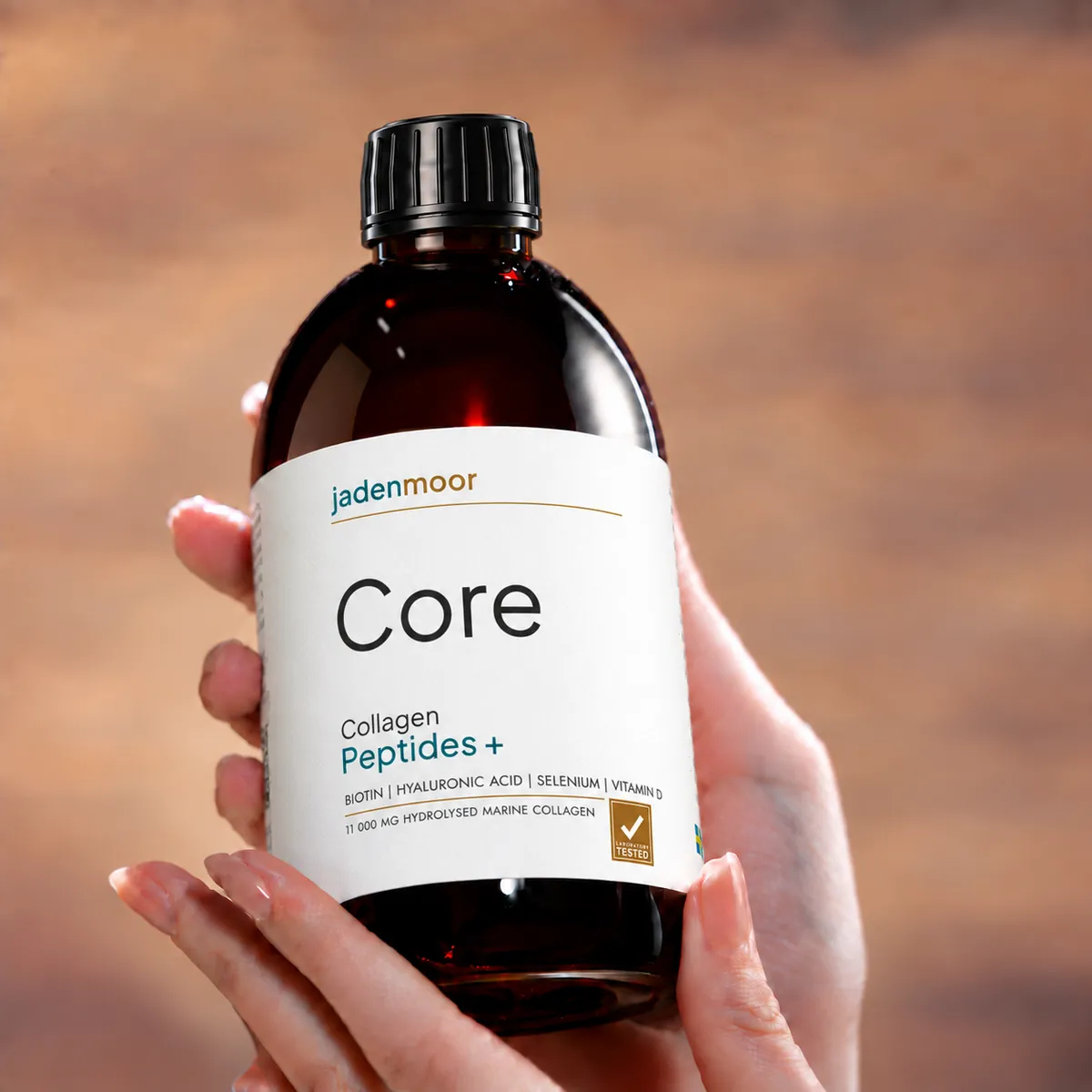
Core's label states an amount per portion.7
- On your plate: collagen in animal foods with connective tissue, such as tougher cuts of meat and the bones and skin of fish.
- Also on your plate: the protein foods that supply glycine and proline, from fish and eggs to legumes and soy.
- On Core's label: a stated amount of each ingredient in every portion.
Neither replaces the other. A portion is one measured item in a day of eating, and the meals around it stay yours to choose.
What is in one Core™ portion?
One portion of Core™, our liquid marine collagen, contains 11,000 mg of hydrolysed marine collagen, types I and III, with natural berry flavour. It is sugar free and fat free.7
Collagen is a protein,4 and the label lists 9.9 g of protein per portion.7 The portion also carries 120 mg of vitamin C, which is 150% NRV.7 The EU's adult daily reference intake for vitamin C is 80 mg, set in Annex XIII of Regulation (EU) No 1169/2011.8
One portion of Core™, as the label states it
Amounts per portion. NRV is the EU nutrient reference value used on labels.
| Ingredient | Amount per portion | NRV |
|---|---|---|
| Hydrolysed marine collagen, types I and III | 11,000 mg | |
| Vitamin C | 120 mg | 150% |
| Hyaluronic acid | 50 mg | |
| Silica | 50 mg | |
| Biotin | 5,000 µg | |
| Vitamin D | 60 µg | |
| Vitamin B5 | 5 mg | 83% |
| Vitamin B6 | 1.7 mg | 121% |
| Vitamin B12 | 24 µg | 960% |
| Selenium | 27.5 µg | 50% |
Collagen you eat, whether from fish or a daily portion, is a food protein.4 Research on collagen drinks starts from the idea that it supplies the kind of building blocks collagen is made of. The vitamin C in the same portion has its own authorised wording: vitamin C contributes to normal collagen formation for the normal function of skin.6
Using it takes a few seconds. Shake the pack, pour a portion into the cap, and drink it straight or stir it into water or a smoothie. Keep the pack in the fridge once opened.7 You can see the full label on the Core™ product page.
What did women report on our liquid marine collagen?
Of the 106 women who took our liquid marine collagen daily for 8 weeks in our user trial, 95% felt that the appearance of their skin improved and 99% found it easy to include in their daily routine.7
Women in the trial also described what they saw, reporting visible results in as little as 4 weeks, with further improvement by week 8.7 The figures below are shares of those 106 women, for the whole drink.
felt that the appearance of their skin improved.
reported more moisture and glow.
reported firmer skin.


Participants in the 8-week user trial of our liquid marine collagen, photographed before and after. This is what it looked like for women in our studies.
Buyers describe the same drink in their own words.
“The taste is amazing and it is sugar free! Love what it does to my hair, nails and skin.”
★★★★★
Suzanne H.Verified purchase · Amazon, United Kingdom · 26 August 2024
“I can really see the visible changes in my skin and nails.”
★★★★★
Check4YouVerified purchase · Amazon, Germany · 27 December 2023
“My skin looks great, with no fine lines. I'm 45 and will definitely keep using it.”
★★★★★
FrédériqueVerified purchase · Amazon, France · 18 May 2024
Verified buyer reviews of our liquid marine collagen, as sold under our manufacturer's own label.
Questions about foods and collagen
Which foods are rich in collagen?
Harvard's Nutrition Source points to animal foods with connective tissue. Its examples are tougher cuts of meat, and the bones and skin of fresh and saltwater fish.
Can foods boost collagen naturally?
Food supports your body's collagen in two ways, according to the sources here: some animal foods contain collagen, and protein foods provide amino acids including glycine and proline, which the body uses to build its own. Harvard adds that the process also needs vitamin C and zinc.
Does fish skin contain collagen?
Yes, Harvard lists the bones and skin of fresh and saltwater fish among the foods that naturally contain collagen. A review of fish gelatin also states that fish skin, bones, fins, heads and scales can be used as a valuable source of gelatin.
Which foods give your body the building blocks for collagen?
Protein foods do: Harvard names fish, poultry, meat, eggs, dairy, legumes and soy as suppliers of amino acids including glycine and proline. That covers animal and plant foods alike.
Do you need vitamin C to make collagen?
The NIH fact sheet says vitamin C is required for the biosynthesis of collagen, and that humans cannot make the vitamin, so it comes from the diet. In EU law the authorised wording is that vitamin C contributes to normal collagen formation for the normal function of skin.
How much collagen and vitamin C is in one Core™ portion?
One portion of Core™ has 11,000 mg of hydrolysed marine collagen and 120 mg of vitamin C, which is 150% NRV. Both amounts are stated on the label, so each daily portion gives you the same measure.