Gelatin is made from collagen, and hydrolysed collagen is made by taking gelatin a step further. Bone broth is made by simmering animal bones in water.
- Gelatin. A collagen derivative, produced from collagen by partial hydrolysis.
- Hydrolysed collagen. Also sold as collagen peptides. A review describes it as highly soluble in water, and the European gelatine industry association says it cannot form a gel.
- Bone broth. Its amino acids vary from batch to batch with the bones used, the cooking time and the processing.
of the 106 women in our 8-week user trial felt the look of their skin had improved on our liquid marine collagen.
- 99%found it easy to include in their daily routine
- 89%reported more moisture and glow
- 81%reported firmer skin
Is gelatin the same as collagen?
Not quite: gelatin is collagen's closest relative, made from it by partial hydrolysis. According to a review of fish gelatin, gelatin is produced from collagen by partial hydrolysis, which incompletely breaks the cross-links of the collagen molecule.1 Harvard's Nutrition Source calls it a collagen derivative, made by boiling animal bones, cartilage and skin.2
The two words name a parent and a child: collagen is the starting protein, and gelatin is what you have once that protein has been partly taken apart.
The line continues for one more generation. Collagen hydrolysate, the ingredient a label calls hydrolysed collagen, is made by enzymatically hydrolysing gelatin further.3 The European gelatine industry association describes collagen peptides as made from the same raw materials as gelatine, by enzymatic hydrolysis.4
On the family tree, collagen comes first, gelatin second and hydrolysed collagen third. Bone broth sits on a side branch, with its own section below.
How is each one made?
Partial hydrolysis turns collagen into gelatin, and enzymes cut the gelatin again to make hydrolysed collagen, while bone broth is made by simmering animal bones in water. Follow the collagen from the animal to the pack and you pass each form in turn, and every step is hydrolysis, which means cutting a large molecule into shorter pieces.
- Collagen
The starting protein
Collagen is a protein of animal connective tissue. Harvard's Nutrition Source lists the bones and skin of fresh and saltwater fish among the places it is found.2 A review gives native collagen a size of about 285 to 300 kDa.5
- Gelatin
Partly hydrolysed
Partial hydrolysis turns collagen into gelatin.1 Gelatin keeps a high molecular weight, which one study gives as about 100,000 Da.3
- Hydrolysed collagen
Hydrolysed further
Enzymes cut the gelatin again.3 A review describes hydrolysed collagen as small peptides of low molecular weight, 3 to 6 kDa.5
The sources switch between two units. A dalton, Da, is the unit for the weight of one molecule, and a kilodalton, kDa, is 1,000 of them. Each figure above is the one its own source prints, so read them as a sense of scale.
Fish belong in this story as much as cattle do. The gelatin review concludes that the skin, bones, fins, heads and scales of fish can be used as a valuable source of gelatin.1
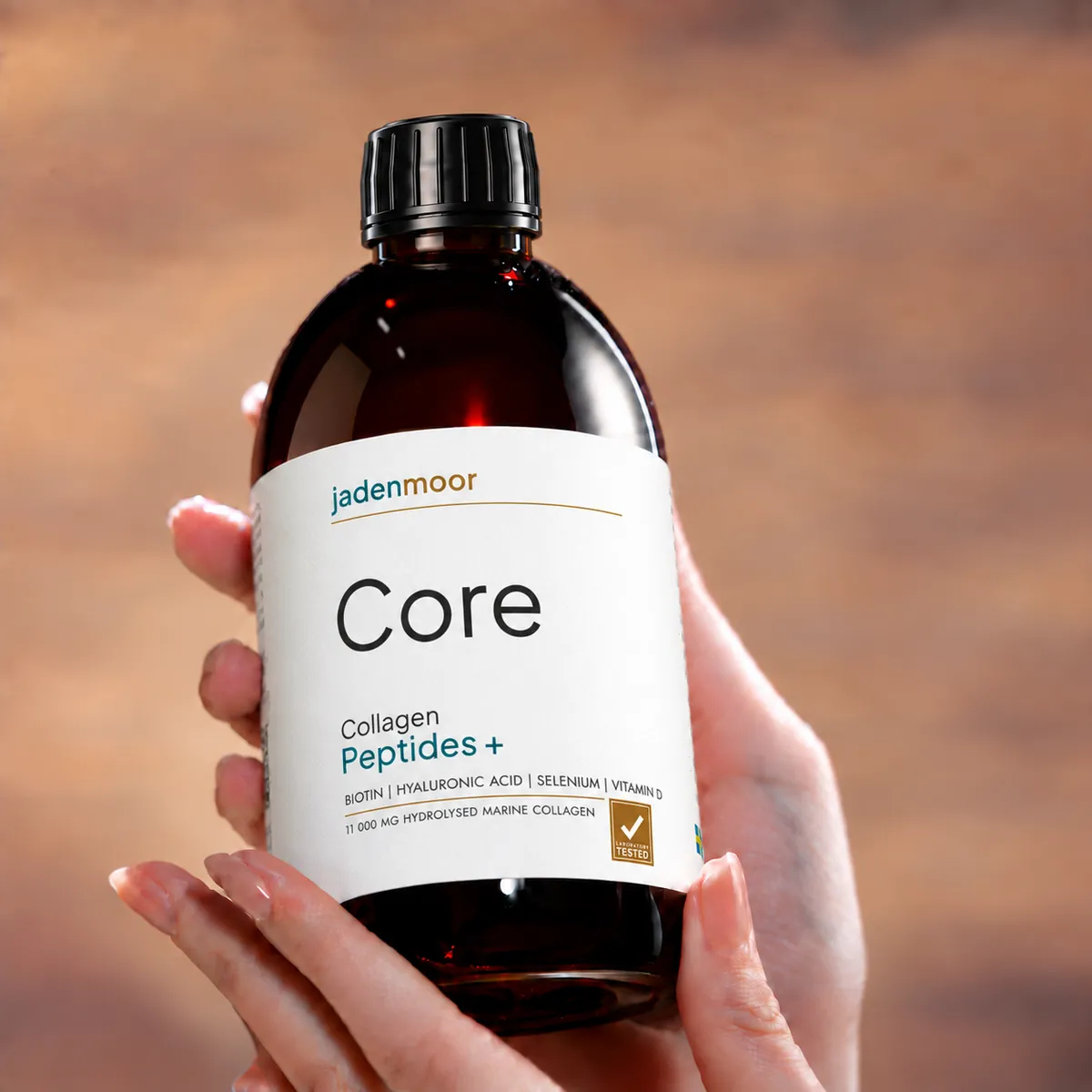
Core™ sits at the far end of the line. Its marine collagen is hydrolysed to a low molecular weight of about 1,500 daltons, a figure taken from the product specification.6 The 3 to 6 kDa range belongs to the review and describes the category in general. For the vocabulary itself, our glossary of hydrolysed, peptides and daltons goes word by word.
How do they behave in a drink?
Gelatin gels and collagen peptides dissolve, a difference you can see. The European gelatine industry association describes gelatine as a foodstuff that binds, gels and stabilises. Of collagen peptides it says that, unlike gelatine, they cannot form a gel, because of their low molecular weight and shorter peptide chains.4
The peer-reviewed review adds the other half, describing hydrolysed collagen as highly soluble in water and naming that higher solubility as a main advantage over native collagen.5 Solubility is the property that lets hydrolysed collagen be made as a ready-to-drink liquid.
Gelling and dissolving are properties of texture and formulation.
Core™ is a ready-to-drink liquid, so the routine is short: shake, pour into the cap, and drink it straight or stir it into water or a smoothie.6

assets/img/blog/gb-three.webpWhat about bone broth?
Bone broth is a kitchen food made by simmering animal bones in water, as Harvard's Nutrition Source describes it, which puts it on a side branch of the family.2
Every pot turns out differently. The same Harvard page notes that the amount of amino acids a broth provides varies from batch to batch, depending on the bones used, the cooking time and the processing.2
One laboratory team has measured this. A 2019 study analysed bone broths and found that the amino acid content of those made to non-standardised recipes varied widely. It also found that broths made to a standardised recipe held lower levels of several collagen-related amino acids than a 20 g dose of the reference collagen supplements used in research.7 The study's comparison was broths against 20 g research doses.
Broth is a food with a recipe, while a supplement is an ingredient with a stated amount. Our piece on foods and collagen covers the plate in more detail.
The three side by side
The table puts the family on one page, and each cell keeps to what its source says.
Gelatin, hydrolysed collagen and bone broth compared
What each one is, how it is made, how it behaves in water and how the amount is known.
| Gelatin | Hydrolysed collagen | Bone broth | |
|---|---|---|---|
| What it is | A collagen derivative.2 | Collagen peptides: small peptides of low molecular weight.5 | A broth of animal bones and water.2 |
| How it is made | From collagen, by partial hydrolysis.1 | By enzymatically hydrolysing gelatin further.3 | By simmering the bones in water.2 |
| How it behaves in water | Forms a gel.4 | Highly soluble in water.5 Cannot form a gel.4 | Made in water: the bones are simmered in it.2 |
| How the amount is known | Not covered in these sources. | From the label, which states a measured amount per serving. Core™: 11,000 mg in a portion.6 | It varies from batch to batch with the bones, cooking time and processing.2 |
Which form did the skin trials use?
The skin trials in our evidence used the hydrolysed form: 2.5 g of collagen peptides a day in one placebo-controlled trial and 10 g of hydrolysed fish collagen a day in another. The blood studies worked with gelatin hydrolysate. In one blood study, volunteers drank a gelatin hydrolysate, and collagen peptides appeared in their blood and peaked within one to two hours.8 In another, after people ingested gelatin hydrolysate, nine hydroxyproline-containing di- and tripeptides were quantified in blood plasma.9
The material was gelatin, hydrolysed, so both teams were handling the third generation of the family, and both were reading blood. Skin is a separate measurement. Our article on whether collagen is absorbed sets the blood studies out in full.
The skin trials in our evidence also name their ingredient. These two are placebo-controlled trials in women, and each card states the form its authors gave.
Eye-wrinkle volume about 20% lower than placebo at 8 weeks
The collagen group took 2.5 g of collagen peptides a day. Their eye-wrinkle volume was significantly lower than the placebo group's after 4 weeks and after 8 weeks, by about 20%. Skin samples at 8 weeks showed 65% more procollagen type I than placebo.10
114 women aged 45 to 65 · randomised, double-blind, placebo-controlled
Wrinkle score down 35% from baseline on the right side of the face
Here the daily amount was 10 g of hydrolysed fish collagen, taken for 12 weeks. The wrinkle score on the right side of the face fell 35% from baseline, which was a 24% greater reduction than placebo recorded.11
Women aged 45 to 60 · randomised, triple-blind, placebo-controlled
A pooled analysis used the same word. The authors of a meta-analysis of 19 randomised double-blind trials, with 1,125 participants aged 20 to 70 and about 95% of them women, concluded that 90 days of hydrolysed collagen reduced wrinkles and improved skin elasticity and hydration.12
These papers tell you what was in the cup for those studies. They describe a design, and they are a reason to know which word is on your own label.
What women reported on our liquid marine collagen
Women in a user trial of our liquid marine collagen reported that the appearance of their skin improved (95%) and that fine lines and wrinkles were reduced (87%). That trial is our own evidence: 106 women took it daily for 8 weeks and reported what they noticed.6
felt that the appearance of their skin improved.
noticed a reduction in fine lines and wrinkles.
found it easy to include in their daily routine.
Shares of the 106 women in the 8-week user trial of our liquid marine collagen.
What is in one Core™ portion?
One portion of Core™ holds 11,000 mg of hydrolysed marine collagen, types I and III, the hydrolysed marine form in a pack. These lines come from the label and specification for one portion of Core™.6
- The form. Hydrolysed marine collagen, types I and III, at a low molecular weight of about 1,500 daltons.
- The amount. 11,000 mg in one portion. The cap is the measure.
- The taste. Natural berry flavour, sugar free and fat free.
- The routine. One portion a day. Keep the pack in the fridge once it is open.
Each portion also carries 120 mg of vitamin C. Vitamin C contributes to normal collagen formation for the normal function of skin.13
That is the practical meaning of "a measured 11,000 mg". With a supplement the amount is printed, and the cap measures it out each morning.
Questions about collagen, gelatin and bone broth
Is gelatin the same as collagen?
No, gelatin is made from collagen. A review describes it as produced by partial hydrolysis, which incompletely breaks the cross-links of the collagen molecule. Harvard's Nutrition Source calls it a collagen derivative.
Is hydrolysed collagen the same as collagen peptides?
On a label, yes. Hydrolysed names the process and peptides names what the process leaves. The European gelatine industry association describes collagen peptides as made by enzymatic hydrolysis from the same raw materials as gelatine.
Does hydrolysed collagen set like gelatin?
No, hydrolysed collagen does not set like gelatin, according to the European gelatine industry association. It says collagen peptides cannot form a gel, unlike gelatine, because of their low molecular weight. A peer-reviewed review describes hydrolysed collagen as highly soluble in water.
Is bone broth the same as a collagen supplement?
No, they are different forms. Bone broth is made by simmering animal bones in water, and Harvard's Nutrition Source notes that its amino acids vary from batch to batch. A supplement label states a measured amount per serving.
Which form was used in collagen skin trials?
The skin trials used collagen peptides or hydrolysed fish collagen, and each names its own form. In our evidence, a trial of 114 women gave 2.5 g of collagen peptides a day, and a trial in women aged 45 to 60 gave 10 g of hydrolysed fish collagen a day. Both were placebo-controlled.
Which form of collagen is in Core™?
Core™ contains hydrolysed marine collagen, types I and III. One portion holds 11,000 mg, and the product specification gives its molecular weight as about 1,500 daltons.