The published collagen trials in the table below were all placebo-controlled, and between them they enrolled women from 35, 40 and 45 upwards.
- From 35. One trial took 99 healthy Japanese women aged 35 to 50. Another took 69 women aged 35 to 55.
- From 40. In a trial of 64 women aged 40 to 60, skin hydration was significantly higher than placebo at 6 weeks and at 12 weeks, with 1,000 mg a day of low-molecular-weight fish collagen peptide.
- Why the question comes early. One paper reports that as much as 30% of skin collagen is lost in the first five years after menopause.
of 106 women reported firmer skin after 8 weeks on our liquid marine collagen.
- 95%felt their skin's appearance improved
- 89%reported more moisture and glow
- 99%found it easy to include in their routine
Should you take collagen in perimenopause?
Perimenopause falls within the ages the collagen research covers: the published trials gathered below enrolled women from 35 and 40 upwards.123
If you are somewhere in your forties, you can look up your own age in the table further down and see which studies enrolled women of that age.
A headline may urge you to start early, and the plain reply from the research is that the trials enrolled women from 35 and 40 upwards. The rest fills in who they were, what they took each day and what the researchers measured.
What changes in skin around menopause?
Skin collagen declines: from early adulthood the skin makes about 1.0% to 1.5% less collagen each year, and as much as 30% of skin collagen is lost in the first five years after menopause. Two papers describe the skin itself, each over a different stretch of life.
The first takes in all of adult life and reports that from early adulthood the skin makes about 1.0% to 1.5% less collagen each year.4 That small yearly figure is at work long before anyone uses the word menopause.
The second looks at what comes afterwards. As much as 30% of skin collagen is lost in the first five years after menopause.5 Total skin collagen then declines by an average of 2.1% per postmenopausal year over 15 years.5
Neither paper is about supplements, but together they explain why women ask about collagen well ahead of menopause. If you are already past that point, the trials run in menopausal and postmenopausal women have their own page, collagen and menopause.

assets/img/blog/pm-garden.webpWhich collagen trials enrolled women in their forties?
Six placebo-controlled collagen trials had an age range that includes the forties, enrolling ages 35 to 50, 35 to 55, 40 to 60 and 45 to 60. The table below lists each study by the ages it accepted, lowest first. Look for every row whose range includes your age, because the ranges overlap.
Collagen trials whose age range includes the forties
One row per study: the ages enrolled, who took part and the daily amount, and what that study recorded.
| Ages enrolled | Who took part and what they took | What the study recorded |
|---|---|---|
| 35 to 50 | 99 healthy Japanese women. 1 g or 5 g of collagen peptides daily for 12 weeks. Randomised, double-blind, placebo-controlled.1 | Water content in the stratum corneum and epidermis increased, transepidermal water loss was lower and natural moisturising factor in the stratum corneum was higher. |
| 35 to 55 | 69 women. 2.5 g or 5.0 g of collagen hydrolysate, or placebo, once daily for 8 weeks. Double-blind, placebo-controlled.2 | Skin elasticity improved significantly in both collagen groups compared with placebo. In older women elasticity was still higher 4 weeks after the last dose. |
| 40 to 60 | 64 women. 1,000 mg a day of low-molecular-weight fish collagen peptide for 12 weeks. Randomised, double-blind, placebo-controlled.3 | Skin hydration significantly higher than placebo at 6 weeks and at 12 weeks. Crow's-feet wrinkling and skin elasticity significantly better than placebo at 12 weeks. |
| 40 to 60 | Adults, about 90% of them women. A daily marine collagen drink with 8 g of hydrolysed collagen plus vitamin C for 12 weeks. Randomised, double-blind, placebo-controlled; daily-dose groups of 48 on collagen and 52 on placebo.6 | In the collagen group at 12 weeks, the authors reported hydration +13.8%, elasticity +22.7% and a skin-profile (wrinkle) index of −19.6%. |
| 45 to 60 | Women. 10 g a day of hydrolysed fish collagen for 12 weeks. Randomised, triple-blind, placebo-controlled.7 | Wrinkle score fell 35% from baseline on the right side of the face, a 24% greater reduction than placebo. |
| 45 to 60 | Menopausal women. 5 g a day of collagen from freshwater fish skin for 6 months. Randomised, placebo-controlled.8 | Skin elasticity improved by 12.23% from baseline in the collagen group of 20 women, significantly more than placebo. |
How to read the table at your age
- From 35. The top two rows start here. One recorded skin water content in 99 healthy Japanese women.1 The other recorded skin elasticity in 69 women.2
- From 40. Two more rows open up. The 64 women in the fish collagen peptide trial were aged 40 to 60,3 and so were the adults in the marine collagen drink trial, about 90% of them women.6
- From 45. The last two rows open up, and from 45 to 50 your age is inside every range listed. The last row names its group as menopausal women aged 45 to 60, and it ran the longest, at 6 months.8
As you read, remember that a result belongs to the collagen, the amount and the people in its own row. The 35% wrinkle-score figure, for example, comes from 10 g a day of hydrolysed fish collagen and from the right side of the face.7 It does not transfer to the row above or below it.
The trials differ in length too, from 8 weeks in one study to 6 months in another, with 12 weeks the most common. If you would like the same kind of table stretched across every age the research covers, see what age to start collagen.
What else is in a Core™ portion?
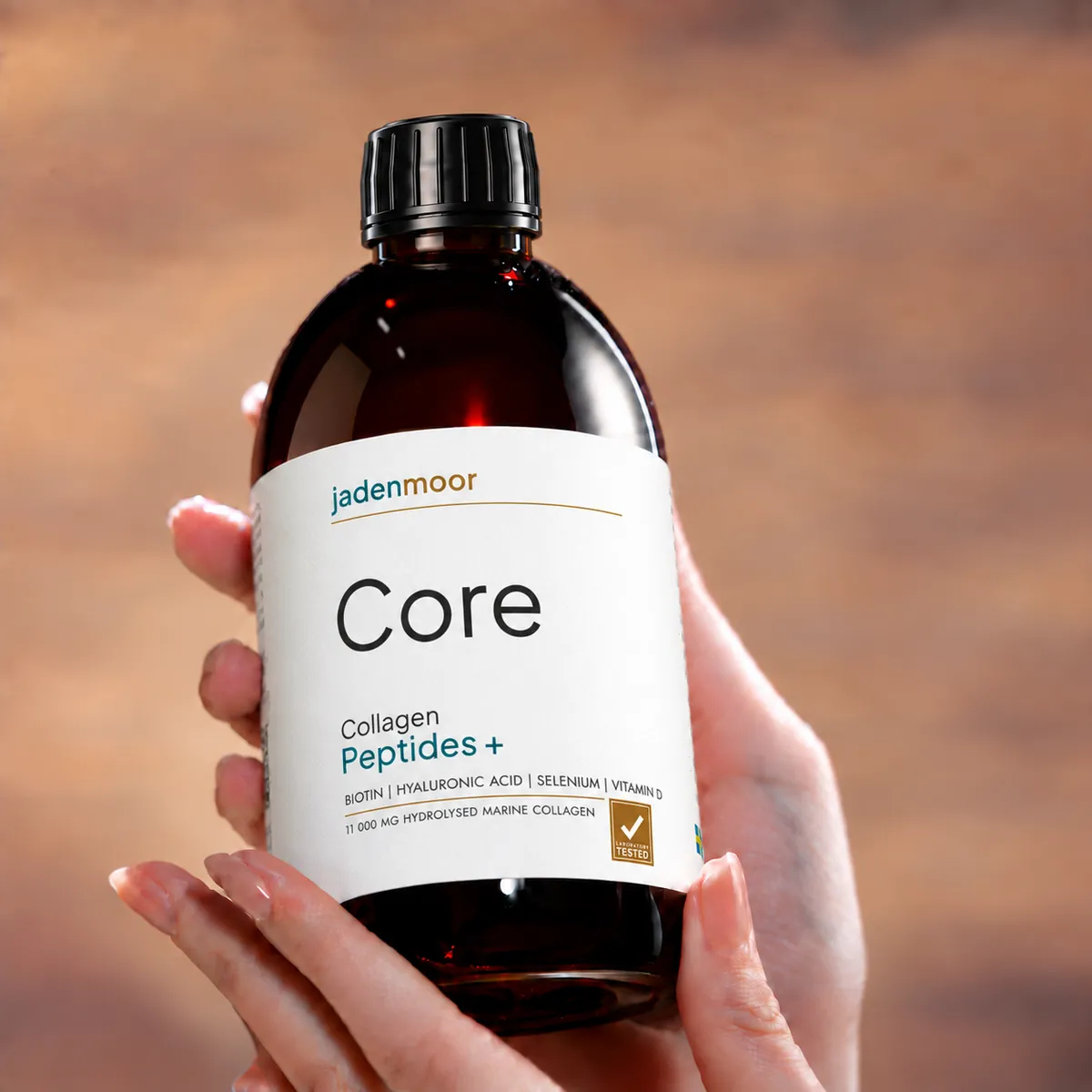
Besides 11,000 mg of hydrolysed marine collagen, types I and III, one portion of Core™ holds vitamin C, biotin, selenium, vitamin D, vitamins B5, B6 and B12, hyaluronic acid and silica, with 9.9 g of protein. The collagen is hydrolysed to a low molecular weight of about 1,500 daltons, and the drink is sugar free and fat free with a natural berry flavour.9
Alongside it sit vitamins and a mineral. Collagen has no authorised health claim of its own, which is why its part of this page rests on studies. These nutrients do have authorised wording, and it is quoted here exactly as the EU list of permitted health claims gives it.10 The lines are written for the general population, so they read the same at any age.
- Skin. Vitamin C contributes to normal collagen formation for the normal function of skin. Biotin contributes to the maintenance of normal skin. A portion has 120 mg of vitamin C (150% NRV) and 5,000 µg of biotin.
- Hair and nails. Biotin contributes to the maintenance of normal hair. Selenium contributes to the maintenance of normal hair. Selenium contributes to the maintenance of normal nails. A portion has 27.5 µg of selenium (50% NRV).
- Bones and muscle function. Vitamin D contributes to the maintenance of normal bones. Vitamin D contributes to the maintenance of normal muscle function. A portion has 60 µg of vitamin D.
- Energy-yielding metabolism. Vitamin B12 contributes to normal energy-yielding metabolism. Vitamin B6 contributes to normal energy-yielding metabolism. Pantothenic acid (vitamin B5) contributes to normal energy-yielding metabolism. A portion has 24 µg of vitamin B12 (960% NRV), 1.7 mg of vitamin B6 (121% NRV) and 5 mg of vitamin B5 (83% NRV).
NRV is the reference intake printed on EU labels. Each portion also has 50 mg of hyaluronic acid and 50 mg of silica.9
To take it, have one portion a day: shake, pour into the cap, then drink it straight or stir it into water or a smoothie. Keep the pack in the fridge once opened.9 Our guide on how to take liquid collagen has the practical details, and the full label is on the Core™ page.
What did women report on our liquid marine collagen?
In our 8-week user trial, 81% of 106 women reported firmer skin, 87% noticed a reduction in fine lines and wrinkles and 86% reported healthier hair. The table above describes other formulas; in ours, the women took our liquid marine collagen daily for 8 weeks and then answered questions about what they had noticed.9
reported firmer skin.
noticed a reduction in fine lines and wrinkles.
reported healthier hair.
Each tile is a share of the 106 women, counted from their own answers. In that trial, women reported visible results in as little as 4 weeks, with further improvement by week 8.9
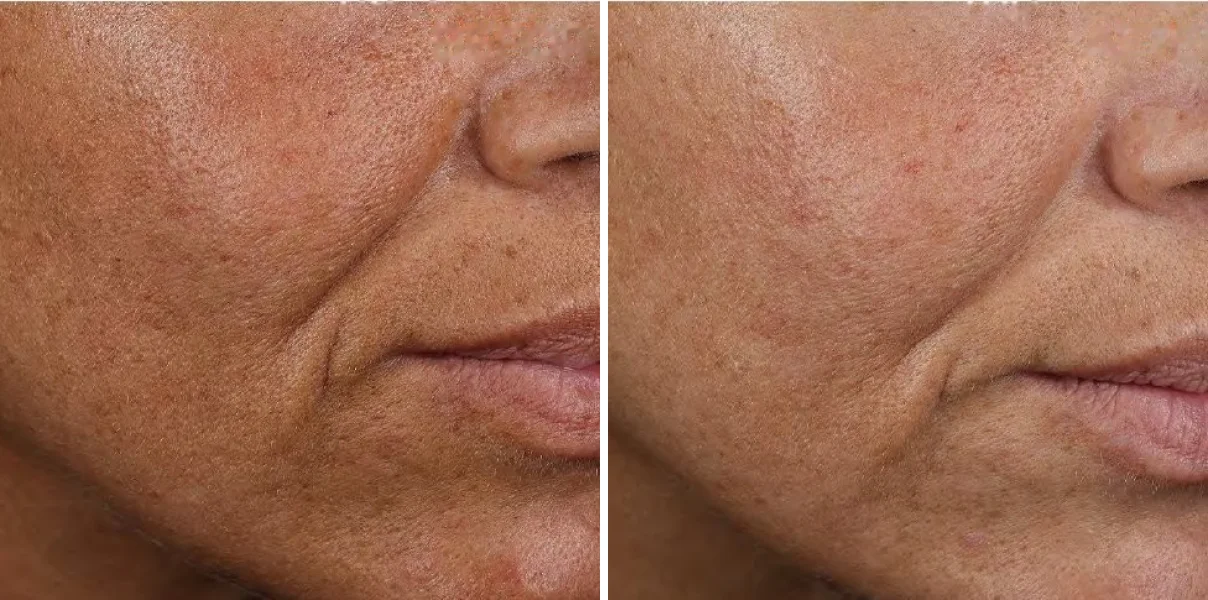
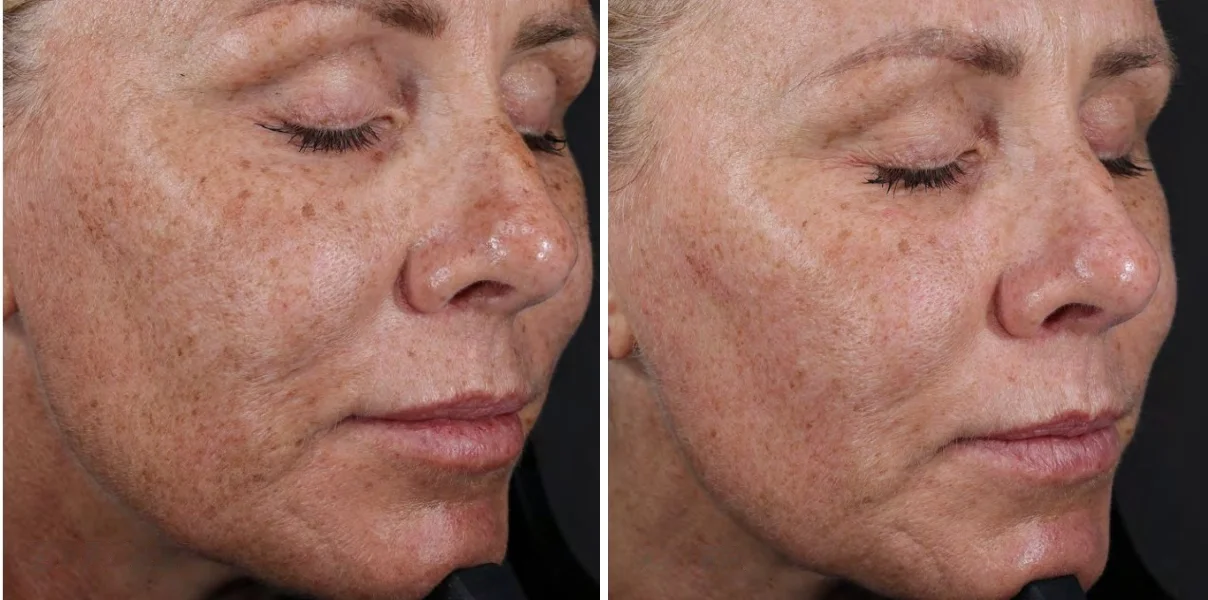
Participants in the 8-week user trial of our liquid marine collagen, photographed before and after. This is what it looked like for these women in our studies.
Three accounts, two of them with an age attached
One buyer below writes that she is 45, and one writer began after turning 40.
“My skin looks great, with no fine lines. I'm 45 and will definitely keep using it.”
★★★★★
FrédériqueVerified purchase · Amazon, France · 18 May 2024
“My nails were the best I had ever had in my whole life.”
She started marine collagen after turning 40. Her skin was more hydrated within the first month, and by month six her hair felt thicker and fuller.
Charlotte DormonWriting in Hip & Healthy11
“I can really see the visible changes in my skin and nails.”
★★★★★
Check4YouVerified purchase · Amazon, Germany · 27 December 2023
An independent first-person account of marine collagen published by the outlet named, and verified buyer reviews of our liquid marine collagen as sold under our manufacturer's own label.
Questions about collagen in perimenopause
Should I take collagen in perimenopause?
Perimenopause sits within the ages the collagen research covers: the placebo-controlled studies on this page enrolled women from 35, 40 and 45 upwards. Find the rows that include your age in the table and read what each study recorded.
What does starting collagen early mean on this page?
On this page, starting early refers to the ages the trials enrolled, which begin at 35 and 40. Those are the youngest ages with a study behind them here.
What is the youngest age in these collagen trials?
The youngest age enrolled in these collagen trials is 35. One trial enrolled 99 healthy Japanese women aged 35 to 50, and another enrolled 69 women aged 35 to 55. The next two ranges begin at 40.
How much skin collagen changes after menopause?
One paper reports that as much as 30% of skin collagen is lost in the first five years after menopause. It adds that total skin collagen then declines by an average of 2.1% per postmenopausal year over 15 years.
How long did the trials on this page last?
The trials on this page lasted between 8 weeks and 6 months. The trial of 69 women aged 35 to 55 lasted 8 weeks, and the trial in menopausal women aged 45 to 60 lasted 6 months. The others ran for 12 weeks.
How do you take Core™?
Take one portion of Core™ a day. Shake the pack, pour into the cap, and drink it straight or stirred into water or a smoothie. Keep the pack in the fridge once opened.