The research is not women-only. A blood study in five healthy men found collagen peptides in the blood after fish and porcine gelatin hydrolysates, and a 12-week trial of 60 men and women tested hyaluronic acid against placebo.
- Five healthy men, blood readings. Hydroxyproline-containing peptides appeared in their blood after each hydrolysate tested.
- 60 men and women, crow's-feet wrinkles. 120 mg a day of hyaluronic acid (molecular weight 300 kDa) gave a lower wrinkle volume ratio than placebo at 8 weeks.
- Men and women aged 35 to 60 with dry skin, 12 weeks. A skin moisture reading improved 7.33% on 1,000 mg a day of fish-scale collagen peptides, against 2.83% with placebo.
of the 106 women found our liquid marine collagen easy to include in their daily routine.
- 95%of the women felt the appearance of their skin improved
- 89%of the women reported more moisture and glow
- 81%of the women reported firmer skin
Can men take collagen?
Yes, men can take collagen: the marine collagen in Core™ is one formula for everyone, and six published studies have enrolled men, alone or alongside women. Collagen is the most abundant structural protein you have, and type I accounts for over 90% of the total.1 A peer-reviewed review maps the main types by tissue: type I is the most common in skin, bone, teeth and tendon, type II is present in cartilage, and type III is most commonly found in skin, muscle and blood vessels.2
Skin, bone, tendon and cartilage are on the list, and you have all of them.
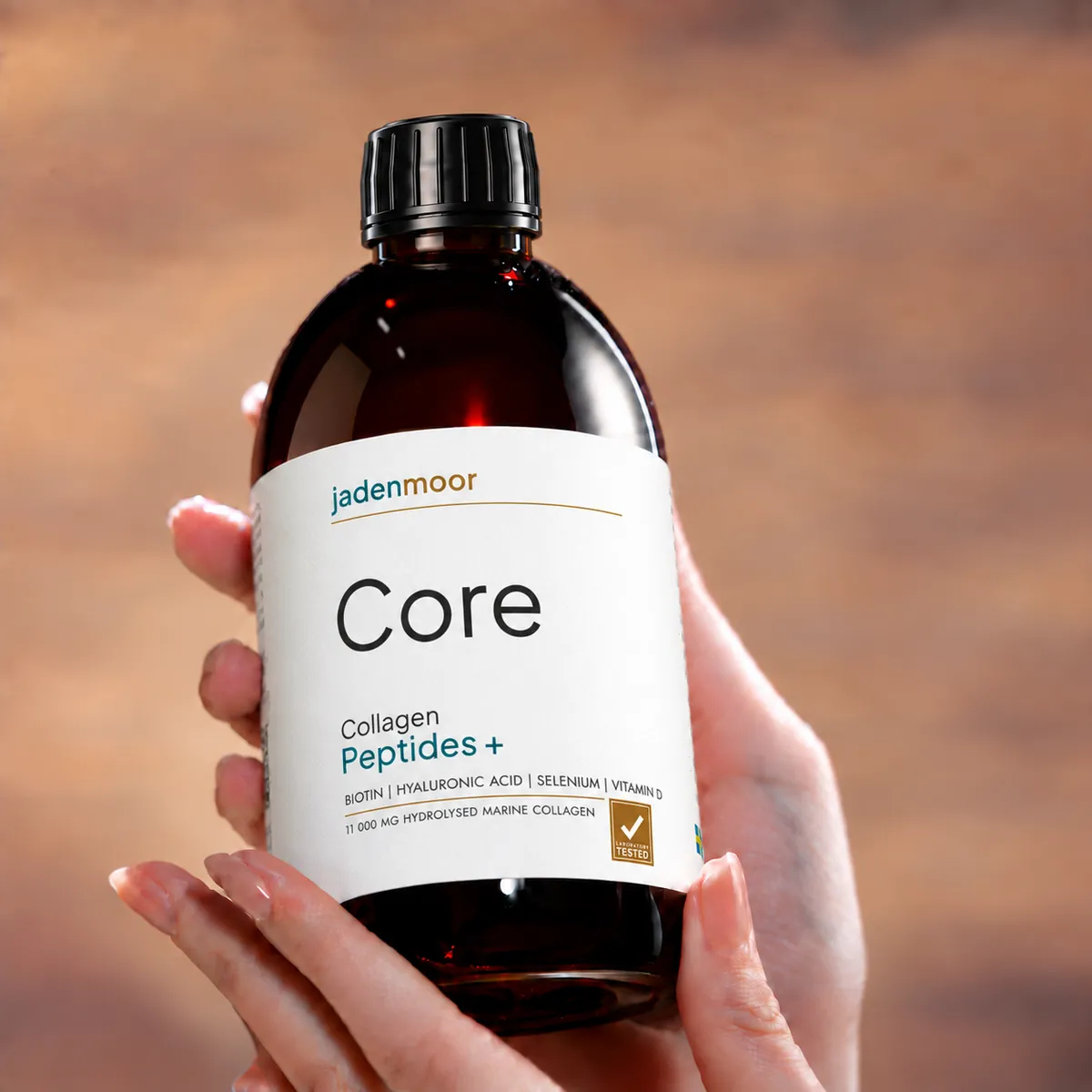
The marine collagen in Core™ is hydrolysed and made up of types I and III, 11,000 mg in a portion.3 There is no separate version for men: it is one pack and one pour.
What differs is the paperwork behind it. Our own 8-week trial enrolled 106 women; the published studies below each enrolled men, alone or alongside women. We keep the two apart all the way down this page, so you always know whose results you are reading.
Which collagen studies included men?
Six published studies enrolled men: two blood studies, in five healthy men and in six healthy adults, and four skin trials of 8 to 12 weeks with a placebo group, including a 12-week trial of 60 men and women with crow's-feet wrinkles. Each paper states that men took part, and each row says who was in it.
Blood studies: does collagen get in?
Yes: in a single-blind crossover study in five healthy men, hydroxyproline-containing peptides appeared in their blood after they drank type I gelatin hydrolysates from fish scale, fish skin and porcine skin. How much appeared, and in what structure, depended on the source.4
A 2024 randomised, double-blind crossover study in six healthy adults, men and women, adds to it. A single 10 g dose of collagen hydrolysate raised blood levels of free hydroxyproline and of collagen-derived peptides, including Pro-Hyp and Hyp-Gly, for all sources and molecular weights tested.5
Both are blood readings, taken after a single serving. They show collagen peptides in the blood, which is the thinking behind the skin research that follows. Our page on how collagen is absorbed goes through it in detail.
Skin trials in men and women
The skin trials below ran for 8 to 12 weeks with a placebo group. Read each row as that study's own result, for the people and the ingredient it tested.
Published studies that enrolled men, alone or alongside women
Who took part, what they took and what the study reported.
| Who took part | What they took | What the study reported |
|---|---|---|
| Five healthy men, single-blind crossover study | Type I gelatin hydrolysates from fish scale, fish skin and porcine skin | Hydroxyproline-containing peptides appeared in blood. Total exposure was significantly higher for fish scale than for porcine skin.4 |
| Six healthy adults, men and women, randomised, double-blind crossover study | A single 10 g dose of collagen hydrolysate | Higher blood levels of free hydroxyproline and of collagen-derived peptides including Pro-Hyp and Hyp-Gly.5 |
| Adults aged 40 to 60, about 90% of them women, 12 weeks, randomised, double-blind, placebo-controlled | A daily marine collagen drink: 8 g hydrolysed collagen plus vitamin C | In the collagen group, the authors reported skin hydration up 13.8% and elasticity up 22.7% at 12 weeks.6 |
| Men and women aged 35 to 60 with dry skin, 50 randomised and 44 completed, 12 weeks, randomised, double-blind, placebo-controlled | 1,000 mg a day of fish-scale collagen peptides | A skin moisture reading improved by 7.33% versus 2.83% with placebo. Natural moisturising factor in the stratum corneum ended higher than with placebo.7 |
| 22 healthy Japanese adults aged 31 to 48, most of them women, 8-week randomised, double-blind, placebo-controlled pilot trial | A daily 30 ml drink with 10 g of fish-derived collagen peptide plus 400 mg ornithine | Lower transepidermal water loss than placebo at 8 weeks. The result belongs to the drink as a whole.8 |
| 60 Japanese men and women aged 22 to 59 with crow's-feet wrinkles, 12 weeks, randomised, double-blind, placebo-controlled | 120 mg a day of hyaluronic acid, molecular weight 300 kDa | A lower wrinkle volume ratio than placebo at 8 weeks.9 |
Two rows deserve a second look. The hyaluronic acid trial enrolled 60 Japanese men and women, and its dose was 120 mg a day.9 The marine collagen drink trial enrolled adults aged 40 to 60, about 90% of them women, on 8 g of hydrolysed collagen plus vitamin C each day for 12 weeks.6
In a meta-analysis of 19 randomised double-blind trials with 1,125 participants aged 20 to 70, about 95% were women. Its authors concluded that 90 days of hydrolysed collagen reduced wrinkles and improved skin elasticity and hydration.10 The studies above are where men come into it.

assets/img/blog/mn-pour.webpWhat do the nutrients in Core™ do, for men and women alike?
The vitamins and the mineral beside the collagen in Core™ carry health claims authorised in the EU for men and women alike, covering collagen formation, skin, hair, nails, muscle, bones, spermatogenesis and tiredness. Each one is written for the nutrient.11 Some of them follow, word for word.
- Vitamin C, 120 mg. Vitamin C contributes to normal collagen formation for the normal function of skin. Vitamin C contributes to normal collagen formation for the normal function of cartilage.
- Biotin, 5,000 µg. Biotin contributes to the maintenance of normal hair. Biotin contributes to the maintenance of normal skin.
- Selenium, 27.5 µg. Selenium contributes to normal spermatogenesis. Selenium contributes to the maintenance of normal hair. Selenium contributes to the maintenance of normal nails.
- Vitamin D, 60 µg. Vitamin D contributes to the maintenance of normal muscle function. Vitamin D contributes to the maintenance of normal bones.
- B vitamins. Pantothenic acid (vitamin B5) contributes to the reduction of tiredness and fatigue. Vitamin B6 contributes to the reduction of tiredness and fatigue. Vitamin B12 contributes to the reduction of tiredness and fatigue.
The amounts are per portion.3 The 120 mg of vitamin C is 150% of the reference intake and the 27.5 µg of selenium is 50%. A portion also carries 5 mg of vitamin B5, 1.7 mg of vitamin B6 and 24 µg of vitamin B12.
Each claim belongs to its own nutrient. For the full list, nutrient by nutrient, see what the vitamins in a collagen portion are there for.
How do you take it?
Take one portion of Core™ a day, straight from the cap or stirred into water or a smoothie; the routine is the same for everyone in the house.
- One portion a day. Shake the pack, pour into the cap and drink it straight, or stir it into water or a smoothie.
- Keep it cold. Once opened, the pack lives in the fridge.
- Know what is in the glass. Each portion has 11,000 mg of hydrolysed marine collagen and 9.9 g of protein. It is sugar free and fat free, with a natural berry flavour.
- Give it a full course. The skin trials in the table ran for 8 to 12 weeks of daily use.
The collagen is hydrolysed to a low molecular weight of about 1,500 daltons.3 For serving ideas and timing, read how to take liquid collagen. You will find the full label and the pack options on the Core™ product page.
What did our trial of 106 women report?
In our 8-week user trial, 99% of 106 women found our liquid marine collagen easy to include in their daily routine, and 95% felt the appearance of their skin improved. Each took it every day and reported what they noticed.3 These are their answers, and they are answers from women. We show them so you can see how the drink was received by the people who took it daily for 8 weeks.
of the women found it easy to include in their daily routine.
of the women felt that the appearance of their skin improved.
of the women noticed a reduction in fine lines and wrinkles.
8-week user trial of our liquid marine collagen. All 106 participants were women.
The women in that trial reported visible results in as little as 4 weeks, with further improvement by week 8.3 Routine comes first among the tiles, with 99% of the women finding it easy to include in their daily routine.
Questions about collagen for men
Is collagen only for women?
No, the published research includes men: a blood study in five healthy men found hydroxyproline-containing peptides in the blood after gelatin hydrolysates, and a 12-week hyaluronic acid trial enrolled 60 men and women. We list six studies above that enrolled men, alone or alongside women.
Is marine collagen for men too?
Yes, marine collagen is for men too: Core™ has one formula, 11,000 mg of hydrolysed marine collagen, types I and III, in a portion. Anyone in the house can pour from the same pack.
Did your own trial include men?
No, our own trial enrolled 106 women, so every figure from it describes women. For men and mixed groups we point you to the published studies in the table above.
How much collagen did the studies in adults use?
The collagen skin trials in the table used 1,000 mg a day of fish-scale collagen peptides, 8 g of hydrolysed collagen in a daily marine collagen drink, and 10 g of fish-derived collagen peptide in a daily drink with ornithine. The 2024 blood study gave a single 10 g dose. One portion of Core™ holds 11,000 mg.
What does selenium in a collagen drink do?
Selenium contributes to normal spermatogenesis. Selenium contributes to the maintenance of normal hair. Selenium contributes to the maintenance of normal nails.
How long did the studies run?
The skin trials in adults listed here ran for 8 to 12 weeks of daily use, and the blood studies measured a single serving.