One trial has tested collagen peptides for cellulite. Among its normal-weight women, the collagen peptide group had a statistically significant lower cellulite score than placebo after 6 months.
- 105 women aged 24 to 50 with moderate cellulite took collagen peptides or a placebo for 6 months.
- 2.5 g a day of porcine-skin collagen peptides was the amount and the source tested.
- About 9% against placebo: the mean reduction on a pinch-test score in normal-weight women after 6 months.
of 106 women reported firmer skin after 8 weeks on our liquid marine collagen. Our user trial asked women about the firmness, appearance, moisture and glow of their skin.
- 95%felt the appearance of their skin improved
- 89%reported more moisture and glow
- 99%found it easy to include in their daily routine
Does collagen help cellulite?
In the one randomised, double-blind, placebo-controlled trial of oral collagen peptides for cellulite, normal-weight women in the collagen peptide group finished with a statistically significant lower cellulite score than placebo after 6 months.1 It enrolled 105 women aged 24 to 50 with moderate cellulite. Each day for 6 months they took either 2.5 g of a specific porcine-skin collagen peptide or a maltodextrin placebo.1
In that trial, among normal-weight women, the collagen peptide group finished with a statistically significant lower cellulite score than the placebo group after 6 months.1 The mean reduction was about 9% against placebo on a pinch-test score.1
When you read that collagen has been studied for cellulite, this is the study behind the sentence. Everything we say about cellulite comes from it, reported as its authors recorded it, for one collagen peptide at one daily amount with one 6-month reading.
What did the cellulite trial measure?
The cellulite trial measured a cellulite score from a pinch test, a clinician's grade made by eye and by touch, and the waviness of the skin on the thigh. In normal-weight women, the trial recorded a reduction in thigh skin waviness alongside the lower score (P < 0.05).1
A change in a score is a different kind of number from a share of people. "About 9%" here is the mean reduction in the pinch-test score in the collagen peptide group against placebo, among normal-weight women, graded after 6 months of daily intake.
Cellulite score: mean reduction of about 9% against placebo in normal-weight women after 6 months
Women took 2.5 g a day of a specific porcine-skin collagen peptide, or a maltodextrin placebo, for 6 months.1 In normal-weight women the collagen peptide group had a statistically significant lower cellulite score than placebo after 6 months: a mean reduction of about 9% against placebo on a pinch-test score, with a reduction in thigh skin waviness (P < 0.05).1
105 women aged 24 to 50 with moderate cellulite · randomised, double-blind, placebo-controlled
The cellulite trial at a glance
The design of the trial and its 6-month reading in normal-weight women.
| Question | What the trial did |
|---|---|
| Who took part? | 105 women aged 24 to 50 with moderate cellulite.1 |
| What did they take? | 2.5 g a day of a specific porcine-skin collagen peptide, or a maltodextrin placebo.1 |
| For how long? | 6 months.1 |
| How was it designed? | Randomised, double-blind and placebo-controlled.1 |
| What was scored? | A pinch-test cellulite score graded by a clinician, and thigh skin waviness.1 |
| What did it find in normal-weight women? | A statistically significant lower cellulite score than placebo after 6 months: a mean reduction of about 9% against placebo, with a reduction in thigh skin waviness (P < 0.05).1 |
How does that compare with Core™?
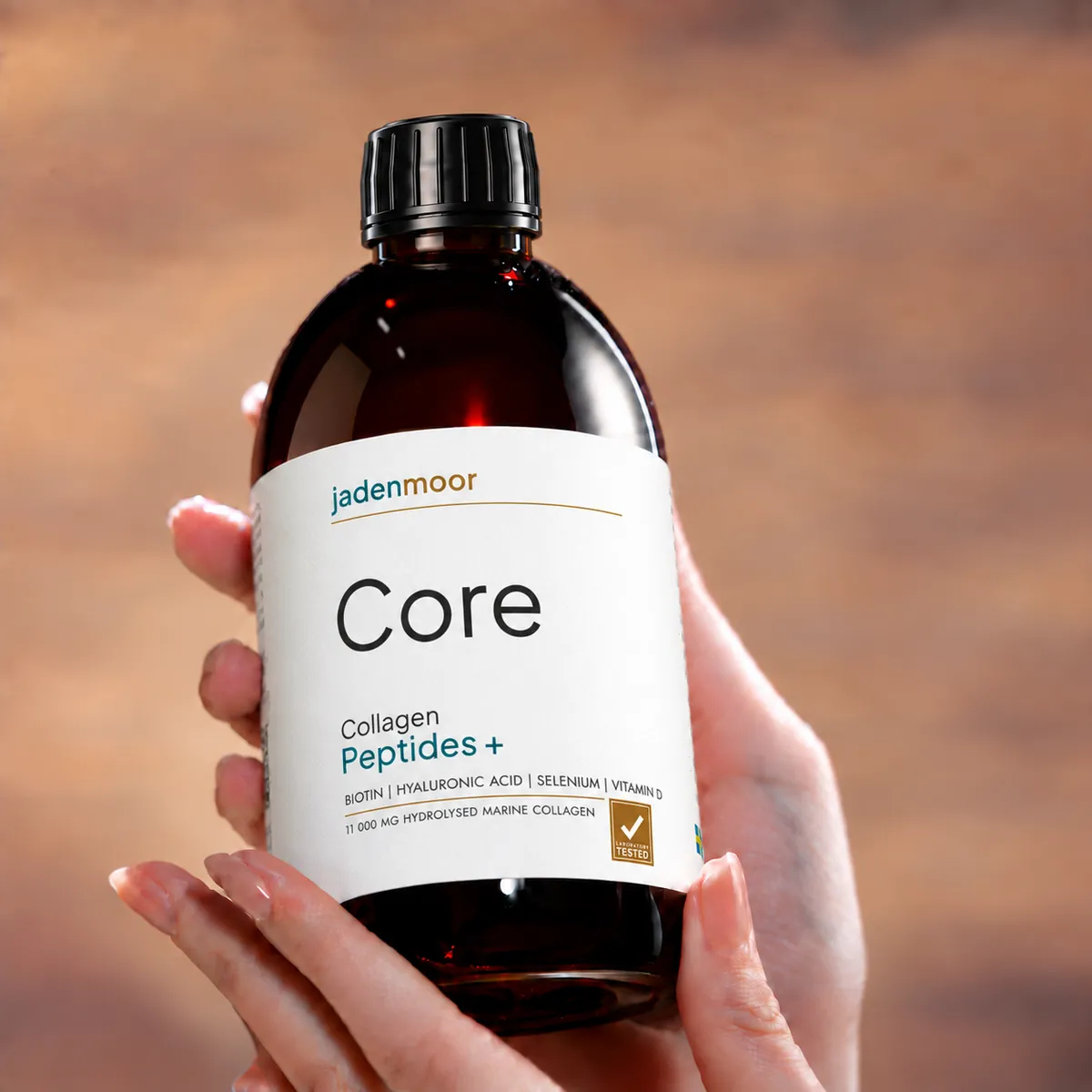
The trial used 2.5 g a day of porcine-skin collagen peptides, while Core™ holds 11,000 mg of hydrolysed marine collagen, types I and III, in one portion, so they are different collagens in different amounts.
- The trial: 2.5 g a day of collagen peptides from porcine skin, taken for 6 months.1
- Core™: 11,000 mg of hydrolysed marine collagen, types I and III, in one portion.2
The trial tested a porcine-skin collagen peptide at 2.5 g a day, and its 6-month reading belongs to that peptide at that amount. We list the two side by side so you know exactly what was tested and exactly what is in the pack. If the source of a collagen matters to you, our comparison of marine and bovine collagen explains how the sources are described in the research.
As for Core™ itself, its marine collagen is hydrolysed to a low molecular weight of about 1,500 daltons. It has a natural berry flavour and is sugar free and fat free.2 The full label is on the Core™ product page.

assets/img/blog/ce-notes.webpWhere does collagen sit in your skin?
In your skin, collagen sits beneath the outer layer, in the dermis, whose deeper part is dense connective tissue made of collagen fibre bundles. A pinch test grades skin from the outside, so it helps to know what lies underneath.3
Collagen is the main structural protein of skin and accounts for about 75% of its dry weight. Most of it is type I, which makes up 80 to 90% of skin collagen.4 Elastic fibres, built from elastin, are what give skin its stretch and recoil.5
These are facts about the collagen your own skin makes. They are background to the pinch test, and the trial result above stands on its own measurements.
One of Core's vitamins has an authorised role here. Vitamin C contributes to normal collagen formation for the normal function of skin. One portion of Core™ carries 120 mg of it. Biotin contributes to the maintenance of normal skin, and Core™ includes that too.2
What have collagen trials measured in skin elasticity?
Collagen trials have measured improved skin elasticity compared with placebo, at the cheek in postmenopausal women after 4 weeks and in women aged 35 to 55 after 8 weeks. Two of them, briefly:
- Marine collagen, 4 weeks. In a randomised, double-blind, placebo-controlled trial of 36 postmenopausal women, 5 g of marine collagen hydrolysate a day for 4 weeks improved cheek skin elasticity compared with placebo.6
- Collagen hydrolysate, 8 weeks. In a double-blind, placebo-controlled trial of 69 women aged 35 to 55, skin elasticity improved significantly compared with placebo in both collagen groups, one on 2.5 g and one on 5.0 g once daily.7
The first reading was taken at the cheek. These are elasticity studies, and each one reports its own elasticity measurement in its own participants. We go through them properly, with the instrument that takes the readings, in collagen for skin firmness. For a wider view of the published evidence across skin, hair and nails, see do collagen supplements work.
What did women report on our liquid marine collagen?
In the user trial of our liquid marine collagen, 81% of 106 women reported firmer skin after 8 weeks of daily use, 95% felt that the appearance of their skin improved and 89% reported more moisture and glow.2 The trial asked about the firmness, appearance, moisture and glow of their skin, and the figures below are the shares of women who reported each one.
reported firmer skin.
felt that the appearance of their skin improved.
reported more moisture and glow.
8-week user trial of our liquid marine collagen, 106 women. Self-reported results on skin firmness, appearance, moisture and glow.
Women in that trial reported visible results in as little as 4 weeks, with further improvement by week 8.2 In the same trial, 99% found it easy to include in their daily routine, which matters for any habit you plan to keep for months.2
To take Core™, shake the pack, pour one portion into the cap, and drink it straight or stir it into water or a smoothie. Keep the pack in the fridge once opened.2
Questions about collagen and cellulite
Does collagen help cellulite?
In the one trial of collagen for cellulite, normal-weight women in the collagen peptide group had a statistically significant lower cellulite score than placebo after 6 months, a mean reduction of about 9% against placebo on a pinch-test score. The trial used 2.5 g a day of porcine-skin collagen peptides.
Which collagen was used in the cellulite study?
The cellulite study used a specific collagen peptide made from porcine skin, at 2.5 g a day. The comparison group took a maltodextrin placebo.
How long did the collagen peptide cellulite study last?
The collagen peptide cellulite study ran for 6 months. The result reported on this page is the 6-month reading in normal-weight women.
Has marine collagen been tested for cellulite?
Marine collagen was not the collagen in the cellulite trial on this page, which used porcine-skin collagen peptides, so its result belongs to that collagen. Marine collagen has been studied for skin elasticity: in a trial of 36 postmenopausal women, 5 g of marine collagen hydrolysate a day for 4 weeks improved cheek skin elasticity compared with placebo.
How much collagen is in a portion of Core™?
One portion holds 11,000 mg of hydrolysed marine collagen, types I and III, and you take one portion a day.