The trials answer with the ages they enrolled. Placebo-controlled studies recruited women aged 45 to 65, postmenopausal women and, for hair, healthy women aged 39 to 75, and each measured a difference from placebo.
- Ages 45 to 65: eye-wrinkle volume about 20% lower than placebo after 8 weeks on 2.5 g of collagen peptides a day, in a trial of 114 women.
- Postmenopausal women: cheek skin elasticity improved compared with placebo after 4 weeks on 5 g of marine collagen hydrolysate a day, in a trial of 36 women, and the difference was still there four weeks after stopping.
- Ages 39 to 75: hair thickness rose by 1.93 micrometres on average in the collagen group over 16 weeks on 2.5 g of collagen peptides a day, in a placebo-controlled trial of 44 healthy women.
of 106 women reported firmer skin after 8 weeks on our liquid marine collagen.
- 95%felt their skin's appearance improved
- 87%noticed fewer fine lines and wrinkles
- 86%reported healthier hair
Does collagen still work after 50?
Yes, in trials that enrolled women past 50, the collagen group came out ahead of placebo on the measure taken. One enrolled 114 women aged 45 to 65.1 Another took only postmenopausal women.2 A hair trial accepted healthy women from 39 up to 75.3
If your worry is that you have left it too late, look at who was invited and then at the result. In each of those three trials, the collagen group came out ahead of placebo on the thing being measured.
Each study below tested one group of women, at one dose, for a set length of time. If you are nearer the start of this age range, the studies that begin there are laid out in collagen after 40.
Which trials enrolled women in their fifties and sixties?
Six collagen trials enrolled women in their fifties and sixties: 114 women aged 45 to 65, two groups of women aged 45 to 60, 36 postmenopausal women, 44 healthy women aged 39 to 75 and 69 women aged 35 to 55. Each row of the table below tells you who took part, how much collagen they had each day and which reading changed.
Collagen trials by the ages they enrolled
One row per study: the participants, the daily amount and what the study recorded.
| Study | Ages | Daily amount | What changed |
|---|---|---|---|
| Eye wrinkles, 8 weeks1 | 114 women aged 45 to 65 | 2.5 g of collagen peptides | Eye-wrinkle volume significantly lower than placebo after 4 weeks and after 8 weeks (about 20%). Randomised, double-blind, placebo-controlled. |
| Wrinkle score, 12 weeks4 | Women aged 45 to 60 | 10 g of hydrolysed fish collagen | Wrinkle score fell 35% from baseline on the right side of the face, a 24% greater reduction than placebo. Randomised, triple-blind, placebo-controlled. |
| Elasticity, 6 months5 | Menopausal women aged 45 to 60 | 5 g of collagen from freshwater fish skin | Skin elasticity improved by 12.23% from baseline in the collagen group of 20 women, significantly more than placebo. Randomised, placebo-controlled. |
| Elasticity, 4 weeks2 | 36 postmenopausal women | 5 g of marine collagen hydrolysate | Cheek skin elasticity improved compared with placebo. Randomised, double-blind, placebo-controlled. |
| Hair thickness, 16 weeks3 | 44 healthy women aged 39 to 75 | 2.5 g of collagen peptides | Hair thickness rose by 1.93 micrometres on average with collagen, against a slight dip of 0.99 micrometres with placebo. Randomised, placebo-controlled. |
| Elasticity, 8 weeks6 | 69 women aged 35 to 55 | 2.5 g or 5.0 g of collagen hydrolysate | Skin elasticity improved significantly in both collagen groups compared with placebo. Double-blind, placebo-controlled. |
The collagen in these rows came from more than one place: marine collagen hydrolysate, fish collagen and collagen peptides all appear, at daily amounts from 2.5 g to 10 g. Some teams measured lines, some measured the spring in the skin, and one measured the thickness of hair.
The trial of 114 women went a layer deeper, with skin samples as well as surface readings. After 8 weeks, the collagen group had 65% more procollagen type I and 18% more elastin in the skin than the placebo group.1

assets/img/blog/a5-walk.webpWhat changes in skin after 50?
Skin after 50 holds less collagen, because from early adulthood it makes about 1.0% to 1.5% less collagen each year.7 By your fifties those small yearly steps have had time to add up.
Menopause has its own figures. As much as 30% of skin collagen is lost in the first five years after menopause, and total skin collagen then declines by an average of 2.1% per postmenopausal year over 15 years.8 We cover that stage in full in collagen and menopause.
Do the results last?
In the four studies that measured again four weeks after the collagen stopped, the result was still there: eye-wrinkle volume, cheek elasticity and elasticity in older women stayed ahead of placebo, and the share with improved brittle nails rose from 64% to 88%. Each card below gives one of those later readings.
The eye-wrinkle effect was still there
Women took 2.5 g of collagen peptides a day for 8 weeks. Eye-wrinkle volume was significantly lower than placebo during the trial, and the effect remained at the reading taken four weeks after stopping.1
114 women aged 45 to 65 · randomised, double-blind, placebo-controlled
Cheek elasticity still ahead of placebo
This was a short course of 5 g of marine collagen hydrolysate a day for 4 weeks. Cheek skin elasticity improved compared with placebo, and the gap between the groups was still present four weeks after stopping.2
36 postmenopausal women · randomised, double-blind, placebo-controlled
Still higher in the older women
Women took 2.5 g or 5.0 g of collagen hydrolysate, or placebo, once daily for 8 weeks. Elasticity improved significantly in both collagen groups compared with placebo, and in older women it was still higher 4 weeks after the last dose.6
69 women aged 35 to 55 · double-blind, placebo-controlled
Brittle nails improved in 64%, then 88%
In an open-label study, participants took 2.5 g of collagen peptides daily for 24 weeks. A physician judged that 64% showed a clinical improvement in brittle nails. Four weeks after stopping, that share had risen to 88%.9
25 participants · open-label study, no placebo group
Each of these is a single extra reading, four weeks on, in the study named on the card. While the studies ran, the collagen was taken daily.
What else is in Core™ for this stage?
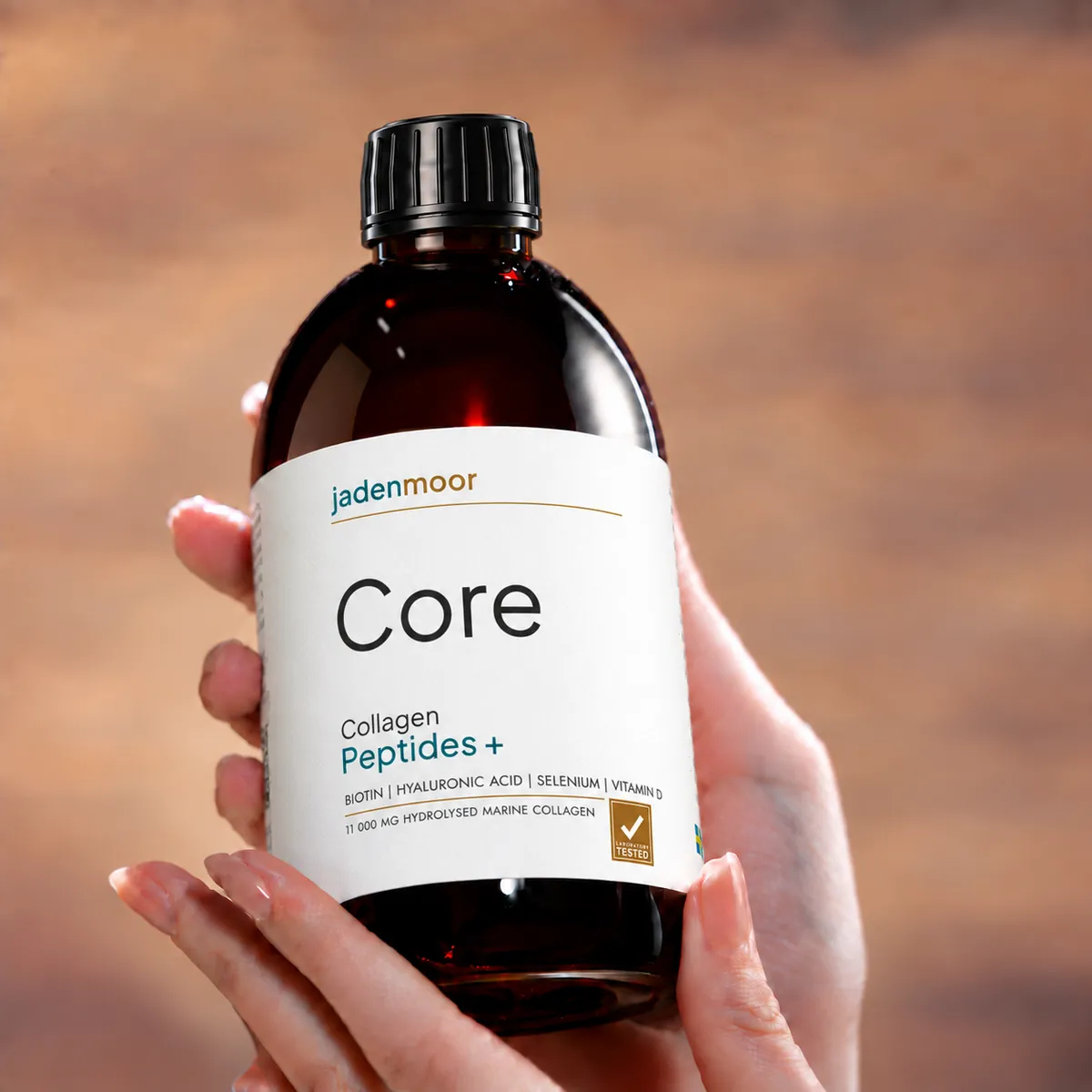
Alongside 11,000 mg of hydrolysed marine collagen, types I and III, each portion of Core™ carries vitamin D, vitamin C, selenium and vitamin B6, plus hyaluronic acid, silica, biotin, vitamin B5 and vitamin B12.10 The clinical trials we draw on used between 1 g and 10 g of collagen peptides a day.
The same portion carries vitamins and a mineral with health claims authorised in the EU.11 These four are in every portion:
- Vitamin D, 60 µg. Vitamin D contributes to the maintenance of normal bones. Vitamin D contributes to the maintenance of normal muscle function.
- Vitamin C, 120 mg. Vitamin C contributes to normal collagen formation for the normal function of skin. Vitamin C contributes to normal collagen formation for the normal function of bones. Vitamin C contributes to normal collagen formation for the normal function of cartilage.
- Selenium, 27.5 µg. Selenium contributes to the maintenance of normal hair. Selenium contributes to the maintenance of normal nails.
- Vitamin B6, 1.7 mg. Vitamin B6 contributes to the regulation of hormonal activity.
Bones and muscle have their own article, bones and muscles after menopause, where vitamin D gets the room it deserves. Core™ also contains hyaluronic acid and silica, 50 mg of each, with biotin, vitamin B5 and vitamin B12.10
To take it, shake the pack, pour one portion into the cap, and drink it straight or stir it into water or a smoothie. The full label is on the Core™ product page.
What did women report on our liquid marine collagen?
In a user trial of our liquid marine collagen, 106 women took it daily for 8 weeks, and 81% reported firmer skin, 95% felt the appearance of their skin improved and 87% noticed a reduction in fine lines and wrinkles.10
reported firmer skin.
felt the appearance of their skin improved.
noticed a reduction in fine lines and wrinkles.
Those figures are shares of the women who took part, drawn from what they reported. The same women reported visible results in as little as 4 weeks, with further improvement by week 8, and 99% found the portion easy to include in their daily routine.10
You can see how it looked for women in that trial in the before and after photos below.
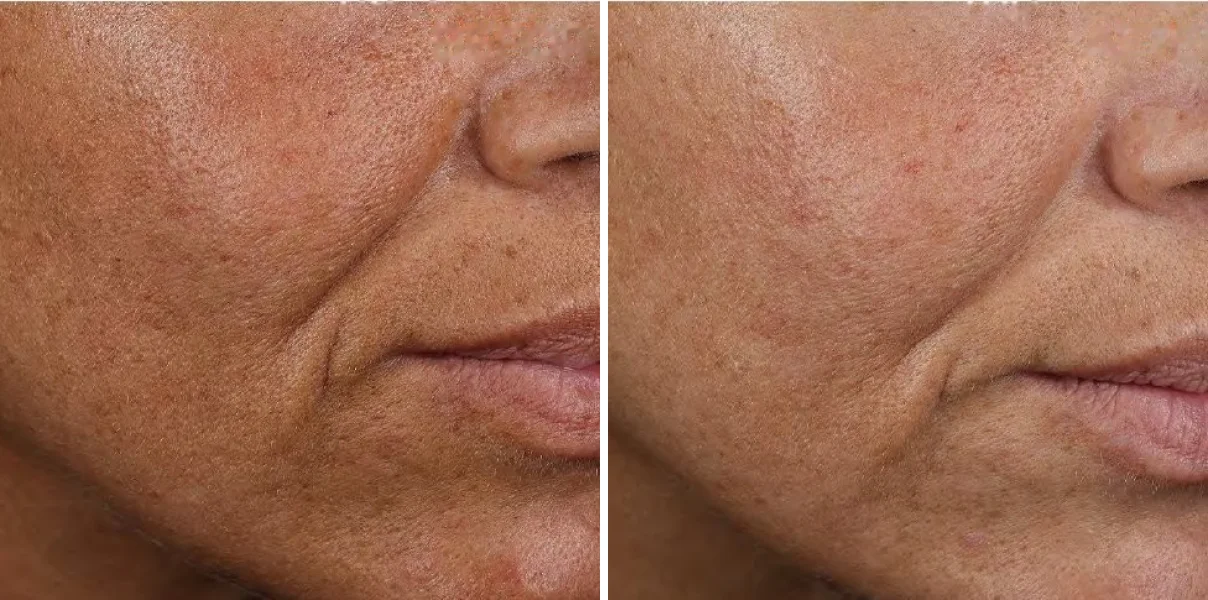
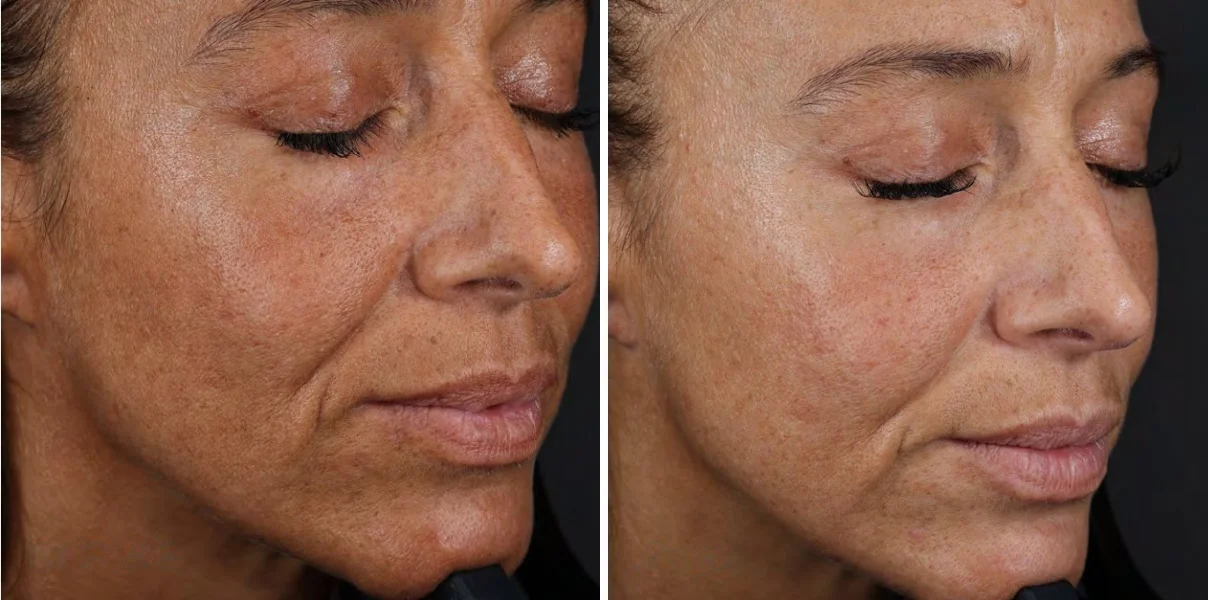
Participants in the 8-week user trial of our liquid marine collagen, photographed before and after.
What do women say in their own words?
In the accounts below, women describe glowier, plumper and more radiant skin, and nails that were less brittle, after months of daily marine collagen. Each account comes from one woman and is hers alone.
“To my surprise, these worked.”
She stayed with 10,000 mg of marine collagen a day for around six months. Her report: glowier, more even skin that held on to hydration for longer, and nails that were less brittle.
Charlotte BitmeadWriting in Stylist12
“And truthfully? My skin looks better than ever.”
A beauty editor and self-confessed sceptic, she gave marine collagen two months of daily use. She found her skin plumper, healthier and noticeably more radiant.
Shannon LawlorBeauty editor, writing in Marie Claire UK13
“My skin looks great, with no fine lines. I'm 45 and will definitely keep using it.”
★★★★★
This is one buyer's own account, with her age as she gives it.
FrédériqueVerified purchase · Amazon, France · 18 May 2024
Independent first-person accounts of marine collagen published by the outlets named, and a verified buyer review of our liquid marine collagen as sold under our manufacturer's own label.
Questions about collagen after 50
Is it too late to take collagen at 50?
It is not too late: the trials on this page enrolled women past 50, and each of them measured a difference from placebo. One recruited 114 women aged 45 to 65, others took women aged 45 to 60 and postmenopausal women, and a hair trial took healthy women aged 39 to 75.
What is the best collagen for women over 50?
The trials on this page gave women a daily marine collagen hydrolysate, fish collagen or collagen peptides, at 2.5 g to 10 g a day. One portion of Core™ gives you 11,000 mg of hydrolysed marine collagen.
Does collagen work after menopause?
Yes, in the two trials on this page that recruited menopausal or postmenopausal women, skin elasticity improved in the collagen group compared with placebo. In a randomised, double-blind, placebo-controlled trial of 36 postmenopausal women, 5 g of marine collagen hydrolysate a day for 4 weeks improved cheek skin elasticity compared with placebo. In menopausal women aged 45 to 60, 5 g a day of collagen from freshwater fish skin for 6 months improved skin elasticity by 12.23% from baseline in the collagen group of 20 women, significantly more than placebo.
What happens when you stop taking collagen?
The studies that checked found their result still measurable four weeks later. That was true for eye-wrinkle volume in the trial of 114 women aged 45 to 65 and for cheek elasticity in the trial of 36 postmenopausal women. Both trials gave the collagen daily while they ran.
Which vitamins go well with collagen after 50?
Vitamin D, vitamin C and selenium sit alongside collagen in every portion of Core™. Vitamin D contributes to the maintenance of normal bones. Vitamin C contributes to normal collagen formation for the normal function of cartilage, and selenium contributes to the maintenance of normal nails.