The skin trials in our evidence set different routines, and each kept to it daily. We found no human study that compared morning with evening intake of collagen peptides for skin.
- Morning, on an empty stomach. The routine set in a 6-week trial in 80 women, with 2.5 g of bovine collagen peptides once daily.
- Before bedtime. The routine set in an 8-week pilot trial in 22 healthy Japanese adults, with a 30 ml fish-derived collagen peptide drink that also held ornithine and vitamin C.
- Daily. The instruction shared by every trial in the table on this page.
of 106 women found our liquid marine collagen easy to include in their daily routine during an 8-week user trial.
- 95%felt the appearance of their skin improved
- 89%reported more moisture and glow
- 81%reported firmer skin
When is the best time to take collagen?
We found no study that names a best time: the trials in our evidence set different routines and each kept to it daily. Everything below is the working behind that answer.
While gathering research for this blog we looked for a head-to-head test of timing. We found no human study that compared morning with evening intake of collagen peptides for skin. We found none that set intake with food against intake on an empty stomach either. Each trial we hold set one routine.
So we open the method section of each trial and copy out the instruction the volunteers were given: in the morning, before bed, around a meal, at a time of their own choosing, or plain "once daily". Then we point to the single word those instructions share.
When did the skin trials give their collagen?
The skin trials gave their collagen at different times: in the morning on an empty stomach, before bedtime, before or together with a meal, at the participant's preferred timing, or simply once daily. The table lists them, one trial per row. Every row states its own participants and daily amount, and each trial tested its own product, named in the third column. Read the second column first, because that is where the clock lives.
The routine each skin trial set
The timing instruction written into each trial, the product and daily amount it used, and what that trial measured.
| Trial | When it was taken | Daily amount and product | What was measured |
|---|---|---|---|
| 6-week trial in 80 women1 | Once daily, in the morning, on an empty stomach, dissolved in liquid. | 2.5 g of bovine collagen peptides. | Hydration and crow's-feet wrinkles improved against placebo. |
| 8-week pilot trial in 22 healthy Japanese adults, 21 analysed2 | Once daily, before bedtime. | A 30 ml drink with 10 g of fish-derived collagen peptide plus 400 mg of ornithine and vitamin C. | The change in skin elasticity and water loss were better than placebo. The result belongs to the whole drink. |
| 12-week trial in 72 women aged 35 and over3 | Daily, before or together with a meal. No time of day specified. | A drinkable ampoule: 2.5 g of bovine collagen peptides with acerola, vitamin C, zinc, vitamin E and biotin. | Hydration, elasticity, roughness and density improved against placebo. The result belongs to the whole ampoule. |
| 3-month randomised trial4 | "At the participant's preferred timing." | 5 g a day of porcine collagen peptide. | Listed here for its timing instruction only. |
| 12-week trial in 64 women aged 40 to 605 | Once daily. No time of day stated. | 1,000 mg of low-molecular-weight fish collagen peptide, from sutchi catfish skin. | Hydration, wrinkling and elasticity measures improved against placebo. |
| 8-week trial in 120 women aged 35 to 60, 112 analysed6 | Once daily. No time of day stated. | 10 g of bovine type I and III hydrolysed collagen. | Elasticity, hydration and roughness were better than placebo at week 8. |
Morning or evening?
Either has been used: one trial set a morning routine and one a bedtime routine.
The morning routine. In a 6-week trial in 80 women, the product was 2.5 g of bovine collagen peptides, taken once daily in the morning. Hydration and crow's-feet wrinkles improved against placebo.1
The bedtime routine. Another trial chose the opposite end of the day. In an 8-week pilot trial in 22 healthy Japanese adults, a 30 ml drink was taken once daily before bedtime. It held 10 g of fish-derived collagen peptide plus 400 mg of ornithine and vitamin C. The change in skin elasticity and water loss were better than placebo, and that result belongs to the drink as a whole.2
For your question, what matters is that the morning trial used a morning routine and nothing else, and the bedtime trial a bedtime routine and nothing else. Neither team set its hour against another hour, so neither result tells you which end of the day to choose.
The two also used different products, different volunteers and different lengths, so we do not rank them. What you can fairly take from the pair is that a morning routine has been written into a published skin trial, and so has an evening one.

assets/img/blog/wt-day.webpWith food or without?
Both have been used: one trial asked for an empty stomach and another for before or together with a meal.
The morning trial asked for an empty stomach, with its 2.5 g of bovine collagen peptides dissolved in liquid.1 That was the routine it used, with no fed routine tested beside it.
A 12-week trial in 72 women aged 35 and over went the other way. Its drinkable ampoule was taken daily before or together with a meal, with no time of day specified. The ampoule held 2.5 g of bovine collagen peptides with acerola, vitamin C, zinc, vitamin E and biotin. Hydration, elasticity, roughness and density improved against placebo, a result for the whole ampoule.3
"Before or together with a meal" is already a choice handed to the participant. So we make no claim that collagen belongs with food, and no claim that it belongs apart from food.
And when the trial let people choose?
When one randomised trial let people choose, its participants took 5 g a day of porcine collagen peptide for 3 months, "at the participant's preferred timing".4 We read that as a note about their protocol: an amount and a daily rhythm, with the hour left to each person.
What do the trials have in common?
Every trial had its product taken daily. Read across each row of the table and the hour moves, while the daily rhythm stays.
Several well-known skin trials state only "once daily" and give no time of day at all. In one, 64 women aged 40 to 60 took part for 12 weeks, the product was 1,000 mg of low-molecular-weight fish collagen peptide once daily, and hydration, wrinkling and elasticity measures improved against placebo.5
A trial at a much larger amount did the same. In an 8-week trial in 120 women aged 35 to 60, the product was 10 g of bovine type I and III hydrolysed collagen once daily. Elasticity, hydration and roughness were better than placebo at week 8.6
Put the rows together and the shared design is easy to state:
- A fixed amount. Each trial named its product and kept the daily amount unchanged, from 1,000 mg in one row to 10 g in two others.
- One instruction. Morning, bedtime, mealtime, free choice or once daily, and each trial kept to whatever it had written down.
- Repeated daily. For 6 weeks, 8 weeks, 12 weeks or 3 months, depending on the trial.
It helps to think about your own portion the same way, since the trials in our table were built around repetition. For the dates at which studies recorded their changes, see how long collagen takes to work.
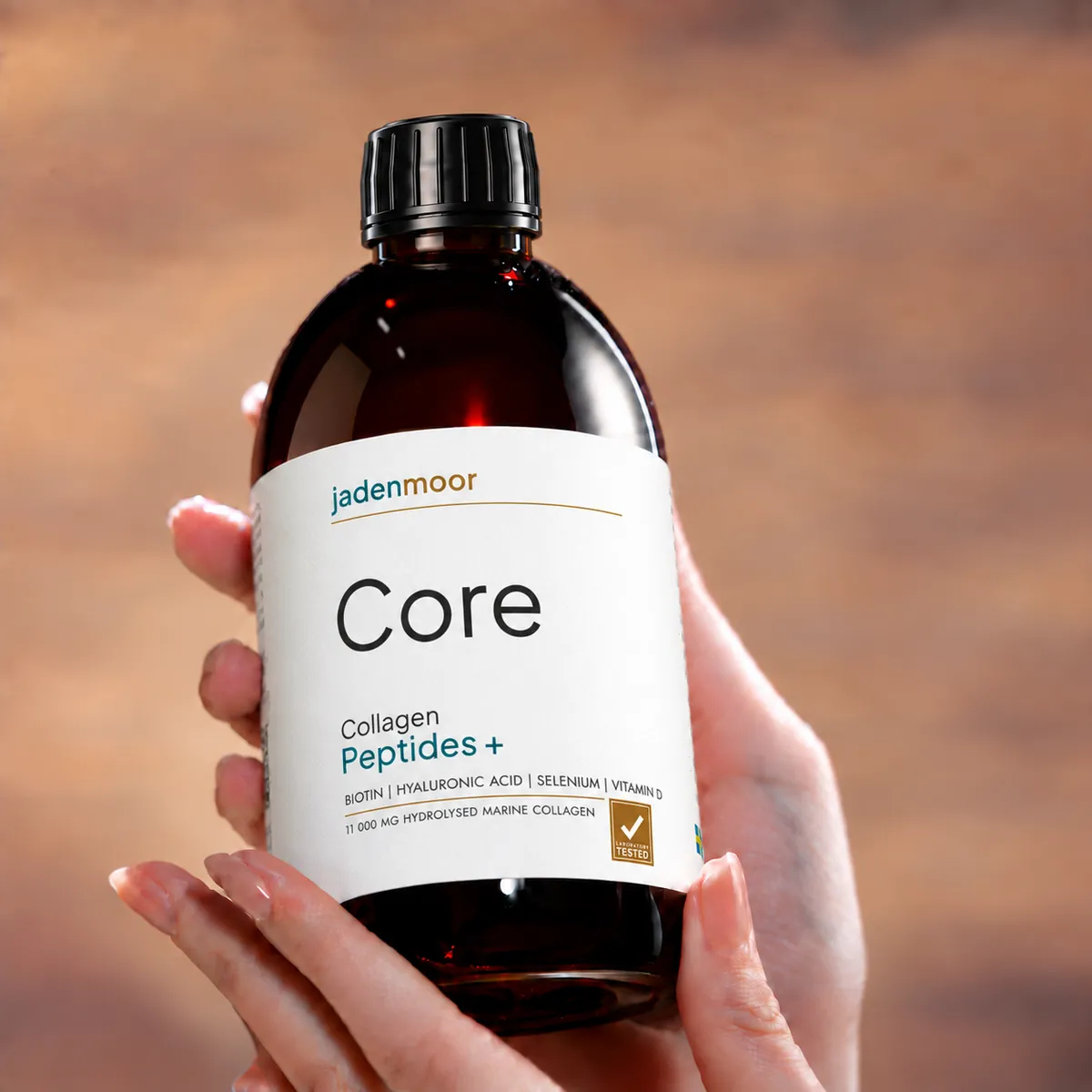
How do you take Core™?
Take one portion of Core™ a day, at an hour of your choosing, since its directions do not name one. Shake, pour into the cap, then drink it straight or stir it into water or a smoothie. Keep the pack in the fridge once opened.7 Our guide on how to take liquid collagen has more on the daily portion itself.
That leaves the moment in your hands, which is where one of the trials above left it too.
- One portion. The cap is the measure, and one cap is a serving of Core™.
- Once a day. That is the full schedule, with no second serving and no changing pattern through the week.
- Your moment. The directions name no hour, so the moment is yours.
- Back in the fridge. An opened pack lives there, so it is waiting in the same place next time.
If you would like a plan to follow, our 60-day collagen routine walks through it week by week.7
Was a daily portion easy to keep up?
Yes, for the women in our user trial: for 8 weeks, 106 of them took our liquid marine collagen daily, and afterwards 99% found it easy to include in their daily routine.7
found it easy to include in their daily routine.
felt that the appearance of their skin improved.
reported more moisture and glow.
Shares of the 106 women in the 8-week user trial of our liquid marine collagen.
Women in that trial reported visible results in as little as 4 weeks, with further improvement by week 8.7
Questions about when to take collagen
What is the best time of day to take collagen?
We found no study that names a best time of day, and the trials in our evidence set different routines and each kept to it daily. One set a morning routine, one a bedtime routine, and others stated only "once daily". We found no human study that compared morning with evening intake of collagen peptides for skin.
Should you take collagen on an empty stomach?
One 6-week trial in 80 women had collagen taken on an empty stomach: 2.5 g of bovine collagen peptides once daily, in the morning. That was the routine the trial used. We found no study that compared it with a with-food routine.
Can you take collagen before bed?
One trial had its collagen drink taken before bed. In an 8-week pilot trial in 22 healthy Japanese adults, a 30 ml drink with 10 g of fish-derived collagen peptide, 400 mg of ornithine and vitamin C was taken once daily before bedtime. The trial used that one routine throughout.
Can you take collagen with a meal?
A 12-week trial in 72 women aged 35 and over had its ampoule taken daily before or together with a meal. It held 2.5 g of bovine collagen peptides with acerola, vitamin C, zinc, vitamin E and biotin. Core's own directions say one portion a day, straight or stirred into water or a smoothie.
Do you have to take collagen at the same time every day?
Core's directions ask for one portion a day and name no hour. One randomised trial in our evidence gave 5 g a day of porcine collagen peptide "at the participant's preferred timing". Each trial in our table had its product taken daily.
How do you take Core™ each day?
Shake the pack, pour one portion into the cap and drink it straight, or stir it into water or a smoothie. Keep the pack in the fridge once opened.