The studies give enrolled ages, not a starting age. The collagen trials on this page took in adults from their twenties and thirties to their seventies, and skin's own collagen output begins to ease from early adulthood.
- Widest range: 20 to 70. Those were the ages of the 1,125 participants in a pooled analysis of 19 randomised double-blind trials.
- Youngest single trial: from 30. It enrolled 71 healthy women aged 30 to 60 and tested fish-scale collagen peptides for 12 weeks.
- Oldest: up to 75. A 16-week hair trial of collagen peptides enrolled 44 healthy women aged 39 to 75.
of 106 women felt the appearance of their skin improved after 8 weeks on our liquid marine collagen.
- 99%found it easy to include in their daily routine
- 87%noticed fewer fine lines and wrinkles
- 81%reported firmer skin
What age should you start taking collagen?
No study names one starting age for collagen, and the published studies enrolled adults aged 20 to 75 between them, so the figure you can check is the age range each one wrote into its enrolment.
The widest comes from a meta-analysis of 19 randomised double-blind trials, which counted 1,125 participants aged 20 to 70, about 95% of them women.1 Among the single trials collected here, the lowest entry age was 30, in a study of 71 healthy women aged 30 to 60.2 The highest upper limit was 75, in a hair trial of 44 healthy women aged 39 to 75.3
The answer is a span, and you can look for your own age inside it.
When does skin's own collagen start to change?
Skin's own collagen starts to change in early adulthood, when the skin begins making about 1.0% to 1.5% less collagen each year.4 The figure is a yearly rate with no birthday attached, which is one reason the question of age has no neat reply.
A separate paper looks at a later stage and reports that as much as 30% of skin collagen is lost in the first five years after menopause.5 Total skin collagen then declines by an average of 2.1% per postmenopausal year over 15 years.5

assets/img/blog/ag-table.webpWhat ages did the collagen trials enrol?
The collagen studies on this page enrolled participants aged 20 to 75 between them, and the table below sorts every one by the youngest age it accepted. Find the rows that include your age, then read across to see what was taken and what was measured.
Collagen studies sorted by the youngest age enrolled
One row per study: the ages, the people and the daily amount, and what that study recorded.
| Ages enrolled | Who took part and what they took | What the study measured |
|---|---|---|
| 20 to 70 | 1,125 participants, about 95% women, across 19 randomised double-blind trials of hydrolysed collagen pooled in a meta-analysis.1 | The authors concluded that 90 days of hydrolysed collagen reduced wrinkles and improved skin elasticity and hydration. |
| 30 to 60 | 71 healthy women. 20 ml a day containing 3,000 mg of fish-scale collagen peptides, or placebo, for 12 weeks.2 | Periorbital wrinkles fell significantly versus placebo. Facial skin moisture and elasticity rose in the collagen group. |
| 31 to 48 | 22 healthy Japanese adults in a pilot trial. A daily 30 ml drink with 10 g of fish-derived collagen peptide plus 400 mg ornithine, for 8 weeks.6 | Lower transepidermal water loss than placebo at 8 weeks. |
| 35 to 50 | 99 healthy Japanese women. 1 g or 5 g of collagen peptides daily for 12 weeks.7 | Water content in the stratum corneum and epidermis increased, transepidermal water loss was lower and natural moisturising factor in the stratum corneum was higher. |
| 35 to 55 | 69 women. 2.5 g or 5.0 g of collagen hydrolysate, or placebo, once daily for 8 weeks.8 | Skin elasticity improved significantly in both collagen groups compared with placebo. |
| 35 to 60 | Adults with dry skin, 50 randomised and 44 completed. 1,000 mg a day of fish-scale collagen peptides for 12 weeks.9 | A skin moisture reading on the forearm improved by 7.33% versus 2.83% with placebo, and natural moisturising factor in the stratum corneum ended higher than with placebo. |
| 35 and over | 72 women. A drink with 2.5 g of bovine collagen peptides plus acerola extract, vitamin C, zinc, vitamin E and biotin, or placebo, for 12 weeks.10 | From baseline in the collagen group: skin hydration +28.0% (placebo +9.0%) and wrinkle depth −26.8% (placebo −6.4%). |
| 39 to 75 | 44 healthy women. 2.5 g of collagen peptides a day, or placebo, for 16 weeks.3 | Hair thickness rose by 1.93 micrometres on average with collagen, against a slight dip of 0.99 micrometres with placebo. The difference between groups was significant. |
| 40 to 60 | 64 women. 1,000 mg a day of low-molecular-weight fish collagen peptide, or placebo, for 12 weeks.11 | Skin hydration significantly higher than placebo at 6 weeks and at 12 weeks. Crow's-feet wrinkling and skin elasticity significantly better than placebo at 12 weeks. |
| 40 to 60 | Adults, about 90% of them women. A daily marine collagen drink with 8 g of hydrolysed collagen plus vitamin C, or placebo, for 12 weeks.12 | In the collagen group at 12 weeks, the authors reported hydration +13.8% and elasticity +22.7%. |
| 45 to 60 | Women. 10 g a day of hydrolysed fish collagen, or placebo, for 12 weeks.13 | Wrinkle score fell 35% from baseline on the right side of the face, a 24% greater reduction than placebo. |
| 45 to 60 | Menopausal women. 5 g a day of collagen from freshwater fish skin, or placebo, for 6 months.14 | Skin elasticity improved by 12.23% from baseline in the collagen group of 20 women, significantly more than placebo. |
| 45 to 65 | 114 women. 2.5 g of collagen peptides a day, or placebo, for 8 weeks.15 | Eye-wrinkle volume significantly lower than placebo after 4 weeks and after 8 weeks (about 20%). |
Lined up like this, the ranges overlap heavily, so you may find your age in several rows at once. The ingredients and the measurements differ from row to row, so each result belongs to the product in its own row. If you want the studies grouped by decade instead, we have done that in collagen after 40 and collagen after 50.
Is your thirties too early? Is your sixties too late?
Both decades sit inside the age ranges the studies enrolled, with several opening at 30, 31 or 35 and the oldest ranges reaching 65, 70 and 75.
If you are in your thirties
Several studies on this page opened their doors at 30, 31 or 35, so you have company in the data.
- From 30. The 12-week trial of fish-scale collagen peptides took healthy women aged 30 to 60.2
- From 31. The 8-week pilot of a fish-derived collagen peptide drink with ornithine recruited healthy Japanese adults aged 31 to 48.6
- From 35. One trial enrolled healthy Japanese women aged 35 to 50,7 another women aged 35 to 55,8 a third adults aged 35 to 60 with dry skin,9 and a fourth women aged 35 and over.10
For your twenties, this page has one entry, the pooled analysis, whose participants were aged 20 to 70.1
If you are in your sixties
Several studies enrolled people in their sixties, though many of the age ranges in the table close at 60. The eye-wrinkle trial of 114 women went to 65.15 The pooled analysis reached 70,1 and the hair trial of 44 healthy women reached 75.3 One study enrolled women aged 35 and over.10
In your thirties or in your sixties, there are studies here whose age range includes yours.
What is in one Core™ portion?
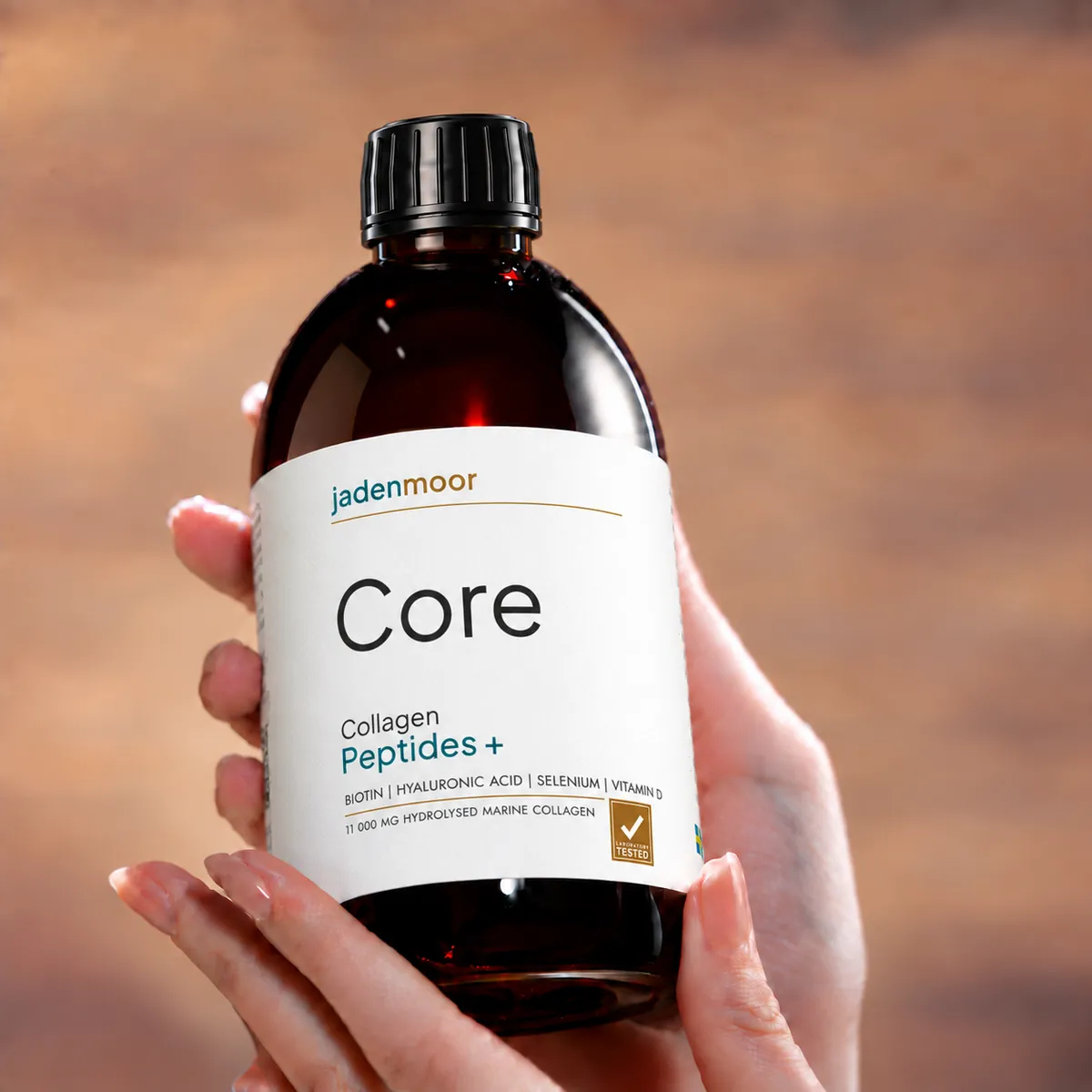
Core™ puts 11,000 mg of hydrolysed marine collagen, types I and III, into a single portion. Across the clinical trials behind this article, the daily amount ran between 1 g and 10 g of collagen peptides. It has a natural berry flavour and is sugar free and fat free.16
Alongside the collagen come nutrients whose roles are authorised health claims in the EU:17
- Vitamin C. Each portion has 120 mg, and vitamin C contributes to normal collagen formation for the normal function of skin.
- Biotin. Each portion has 5,000 µg, and biotin contributes to the maintenance of normal skin.
- Selenium. Each portion has 27.5 µg, and selenium contributes to the maintenance of normal nails.
- Vitamin D. Each portion has 60 µg, and vitamin D contributes to the maintenance of normal bones.
Hyaluronic acid and silica are in there as well, at 50 mg each.16 You take one portion a day. Shake, pour it into the cap, then drink it as it is or stirred into water or a smoothie. The Core™ product page has the full label.
What did women report on our liquid marine collagen?
In our user trial of our liquid marine collagen, 95% of women felt the appearance of their skin improved, 89% reported more moisture and glow and 99% found it easy to include in their daily routine. The 106 women took it every day for 8 weeks and then answered questions about what they had noticed, whereas the table above is other people's research on other formulas.16
felt that the appearance of their skin improved.
reported more moisture and glow.
found it easy to include in their daily routine.
Those figures are shares of the 106 women, drawn from their own answers. In that trial, women reported visible results in as little as 4 weeks, with further improvement by week 8.16 The week-by-week view is in our guide to how long collagen takes to work.
Two women, two starting points
Studies speak for groups, while the two accounts below are from one woman each, and both happen to mention her age.
“My skin looks great, with no fine lines. I'm 45 and will definitely keep using it.”
★★★★★
FrédériqueVerified purchase · Amazon, France · 18 May 2024
“My nails were the best I had ever had in my whole life.”
Her own starting line was her birthday: she took up marine collagen after turning 40. She wrote that her skin was more hydrated within the first month, and that by month six her hair felt thicker and fuller.
Charlotte DormonWriting in Hip & Healthy18
A verified buyer review of our liquid marine collagen as sold under our manufacturer's own label, and an independent first-person account of marine collagen published by the outlet named.
Questions about collagen and age
What age should I start taking collagen?
No study sets a starting age for collagen; the studies on this page record enrolled ages instead. A pooled analysis of 19 trials covered participants aged 20 to 70, and the single trials here ran from a lower limit of 30 to an upper limit of 75.
Is 30 too early for collagen?
Thirty is inside the studied age range, as one trial on this page enrolled healthy women from 30: 71 of them, aged 30 to 60, drank 20 ml a day containing 3,000 mg of fish-scale collagen peptides or placebo for 12 weeks. The pooled analysis on this page covered participants aged 20 to 70.
Is it too late to start collagen in your sixties?
Your sixties are within the studied ages, as several age ranges on this page reach past 60. A trial of 114 women took ages 45 to 65, a hair trial of 44 healthy women took ages 39 to 75, and the pooled analysis covered participants aged 20 to 70.
When does collagen in skin start to decline?
Collagen in skin starts to decline from early adulthood, according to a review of skin collagen through the life stages: the skin makes about 1.0% to 1.5% less collagen each year. A separate paper reports that as much as 30% of skin collagen is lost in the first five years after menopause.
How much collagen did the studies use?
Daily amounts in the clinical trials behind this article ran between 1 g and 10 g of collagen peptides, and each row of the table gives its own. Core™ has 11,000 mg of hydrolysed marine collagen per portion.