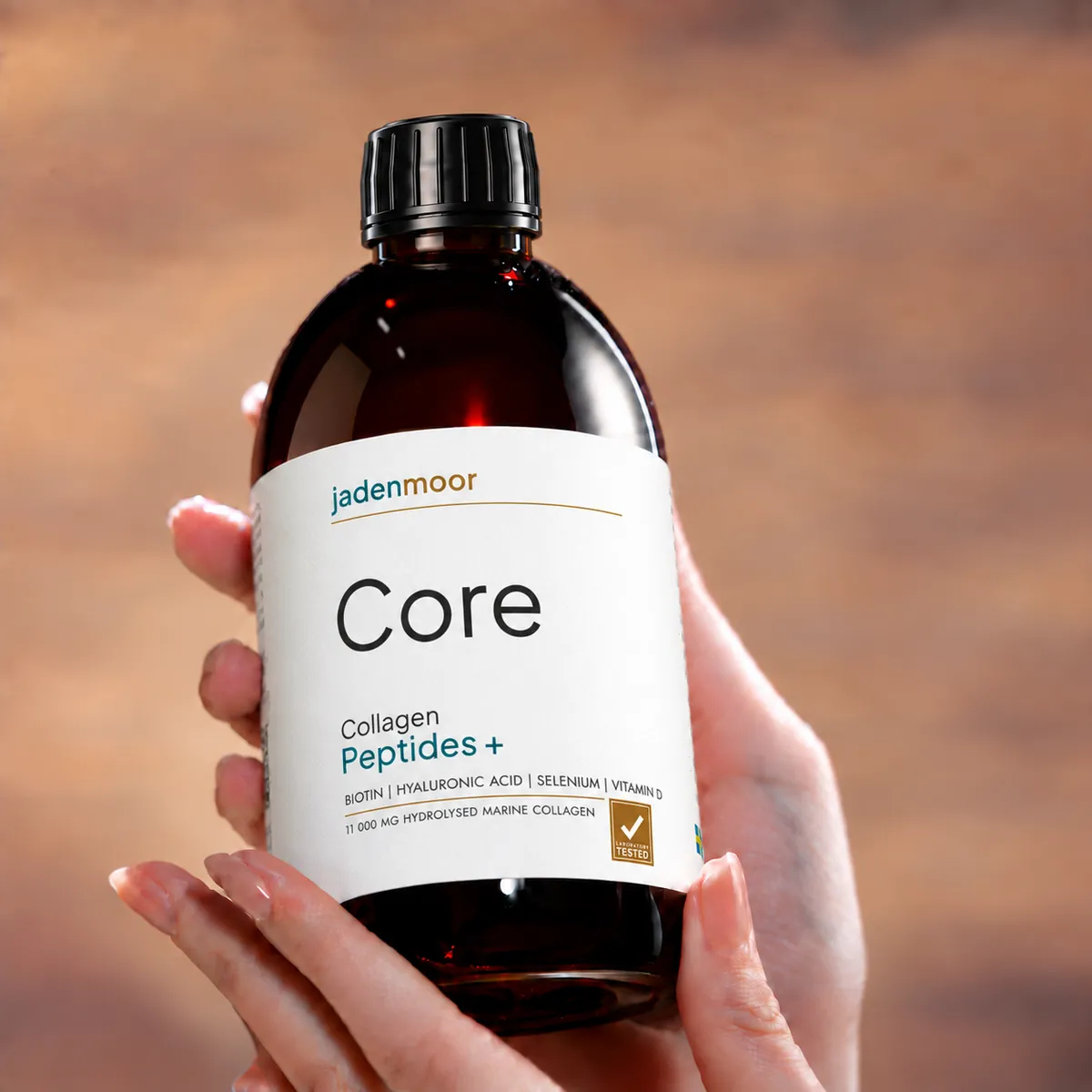
Among the nutrients in Core™, two hold an authorised EU hair claim. Biotin contributes to the maintenance of normal hair. Selenium contributes to the maintenance of normal hair.
- Biotin is a water-soluble B vitamin, and its hair claim rests on an EFSA opinion adopted on 2 July 2009.
- Selenium is the mineral on the list. One Core™ portion has 27.5 µg, which is 50% NRV.
- Collagen has trial evidence instead of a claim: hair thickness rose by 1.93 micrometres on average with 2.5 g of collagen peptides a day in a 16-week randomised, placebo-controlled trial of 44 healthy women aged 39 to 75.
of 106 women reported healthier hair after 8 weeks on our liquid marine collagen. This is a result for the whole drink.
- 76%reported stronger nails
- 95%felt the appearance of their skin improved
- 99%found it easy to include in their daily routine
Which vitamins are good for hair?
Biotin and selenium are the nutrients in Core™ that are allowed to make a hair claim. In the EU, the official list of permitted health claims sets out the wording a food may use to link a nutrient to hair. Core™ carries a set of vitamins and minerals alongside its collagen, and two of them have a hair line on that list.1
- Biotin, a vitamin. Biotin contributes to the maintenance of normal hair.
- Selenium, a mineral. Selenium contributes to the maintenance of normal hair.
Biotin is one of the B group, dissolves in water and counts as an essential nutrient.2 Inside the body it acts as a cofactor for five carboxylase enzymes.2 The full story of this vitamin, including its skin claim, is in our article on biotin for hair, skin and nails.
Selenium is the quieter name of the pair, and it is a mineral where biotin is a vitamin. Your body builds it into 25 selenoproteins.3 It appears on the EU list more than once, and our piece on selenium and the thyroid follows up its other well-known line.
If you came here with a search about vitamins and your hair, the short list from Core's recipe is one vitamin and one mineral, each with the same authorised sentence.
What does "maintenance of normal hair" mean on a label?
On a label, maintenance of normal hair means the brand is quoting the law, because the phrase is the authorised wording, taken word for word from the EU list, and it is the whole of the claim. We print it as written and add nothing to it.1
Behind biotin's line is a scientific review. The NDA Panel at EFSA, the European Food Safety Authority, adopted an opinion on 2 July 2009 and concluded that a cause and effect relationship has been established between the dietary intake of biotin and the maintenance of normal hair.4 The Panel based that on biotin's established role as a nutrient.4
The claim then entered Regulation (EU) No 432/2012, the list of permitted health claims. A food may use the biotin sentence when it is at least a source of biotin.1 Selenium's hair sentence sits on the same list, in the same words.1
When you see the phrase on a pack, you are reading wording from the authorised list.

assets/img/blog/hs-comb.webpWhere does a hair grow from?
A hair grows from a follicle below the surface of your skin. The part you wash, dry and style is the hair shaft, and it is made of keratin, which is a protein.5 The follicle that produces it is set down in the dermis.5
The dermis is the layer of skin that houses the hair follicles, and its deeper part is dense connective tissue made of collagen fibre bundles.6 Picture a follicle as a tiny workshop, and the dermis as the building it works in.
Scalp hair lengthens steadily, by about 1 cm a month.5
This anatomy is the idea behind the collagen hair research, the thinking being that the collagen-rich layer around the follicle is a sensible place to look. The two trials below report a reading of the hair itself.
What did the collagen hair studies measure?
Two randomised, placebo-controlled collagen studies measured hair: one the thickness of the hair, the other an expert-graded score for healthy hair appearance. Collagen is a protein, so its case is made by trials and not by a line on the EU list. Each used a different yardstick, so they are shown side by side and not added together.
Hair thickness: up 1.93 micrometres on average
This trial put a number on the width of the hair. With 2.5 g of collagen peptides a day, thickness rose by 1.93 micrometres on average across 16 weeks. With placebo there was a slight dip of 0.99 micrometres, and the gap between the two groups was significant.7
44 healthy women aged 39 to 75 · randomised, placebo-controlled
Expert-graded score for healthy hair appearance: improved by 31.9% on average
Here the yardstick was expert grading of how healthy the hair looked. By the end of the 12 weeks, that expert-graded score had improved by 31.9% on average with a daily marine collagen drink, against 9.4% with placebo. It is a change in a score. The drink supplied 8 g of hydrolysed collagen plus vitamin C.8
Adults aged 40 to 60, about 90% of them women · randomised, double-blind, placebo-controlled · daily-dose groups of 48 on collagen and 52 on placebo
The 12-week trial also handed its participants a questionnaire, and those answers are shares of people. In the collagen group, 66.7% agreed their hair felt thicker, against 44.2% on placebo. For smoothness, 77.1% of the collagen group agreed, against 55.8% on placebo.8
One trial measured thickness, while the other used expert grading and the participants' own answers. If you would like the charts and the week-by-week detail, they are in our full article on collagen for hair.
What is in one Core™ portion for hair?
For hair, one portion of Core™ has 5,000 µg of biotin, 27.5 µg of selenium and 11,000 mg of hydrolysed marine collagen, types I and III.9 The table shows the evidence that belongs to each line.
One Core™ portion, read for hair
Amount per portion, and the kind of evidence each ingredient carries.
| Ingredient | Per portion | What stands behind it |
|---|---|---|
| Biotin | 5,000 µg | Authorised EU claim. Biotin contributes to the maintenance of normal hair. |
| Selenium | 27.5 µg (50% NRV) | Authorised EU claim. Selenium contributes to the maintenance of normal hair. |
| Hydrolysed marine collagen, types I and III | 11,000 mg | Trial evidence for collagen. The two placebo-controlled studies above used 2.5 g of collagen peptides a day and a marine collagen drink with 8 g of hydrolysed collagen plus vitamin C. |
Everything in that table arrives in the same pour. You shake the pack, fill the cap and drink it straight, or stir it into water or a smoothie.9 It is sugar free, with a natural berry flavour.9 The rest of the recipe is on the Core™ product page.
What did women report on our liquid marine collagen?
In our user trial, 86% of women reported healthier hair and 76% reported stronger nails after taking our liquid marine collagen daily for 8 weeks. Those numbers from 106 women describe the complete drink, whereas the claims above belong to single nutrients.9
reported healthier hair.
reported stronger nails.
found it easy to include in their daily routine.
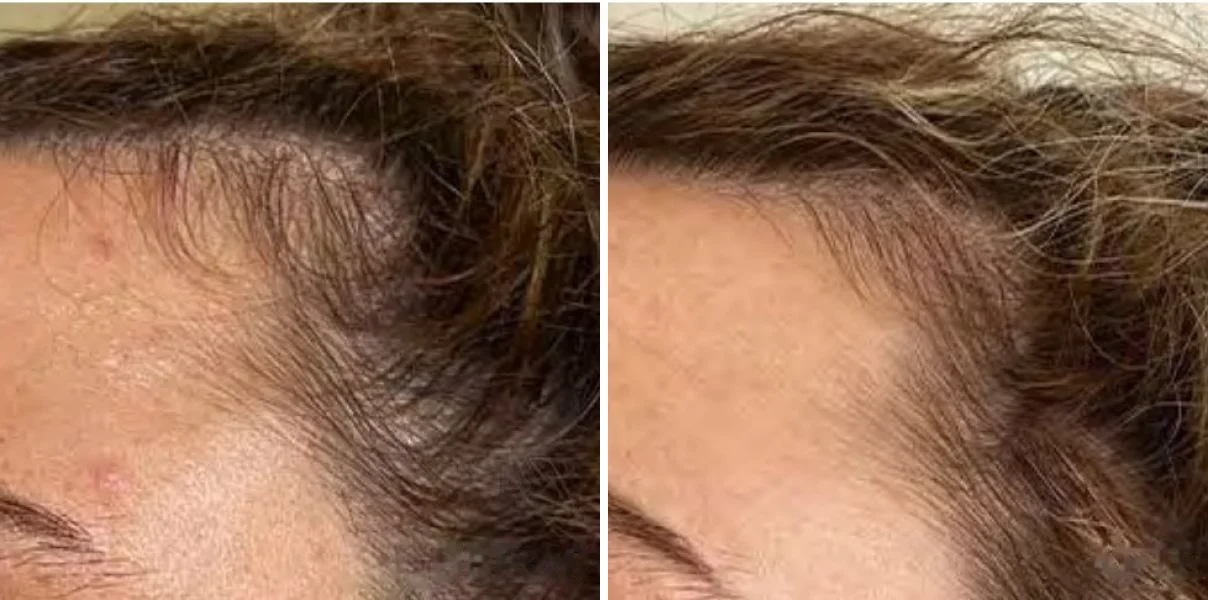
A participant in the 8-week user trial of our liquid marine collagen, photographed before and after. This is what it looked like for one woman in our studies.
These are the women's own reports after 8 weeks, and they speak for the drink as a whole. In the same trial, 99% found it easy to include in their daily routine.
What do two women say about their hair?
A buyer of our liquid marine collagen says she loves what it does to her hair, nails and skin, and a writer who started marine collagen after turning 40 describes hair that felt thicker and fuller by month six. Their two individual voices follow.
“The taste is amazing and it is sugar free! Love what it does to my hair, nails and skin.”
★★★★★
Suzanne H.Verified purchase · Amazon, United Kingdom · 26 August 2024
By month six, hair that felt thicker and fuller.
She started marine collagen after turning 40. Her account moves in stages: more hydrated skin within the first month, then, by month six, the change she describes in her hair.
Charlotte DormonWriting in Hip & Healthy11
A verified buyer review of our liquid marine collagen as sold under our manufacturer's own label, and an independent first-person account of marine collagen published by the outlet named.
Questions about vitamins and hair
Which vitamins help with hair shedding?
Biotin and selenium are the two nutrients in Core™ with a hair claim on the EU list, and this is its exact wording. Biotin contributes to the maintenance of normal hair. Selenium contributes to the maintenance of normal hair.
Is selenium a vitamin?
No, selenium is a mineral. On the EU list of permitted health claims it sits beside biotin for hair: selenium contributes to the maintenance of normal hair. One portion of Core™ has 27.5 µg of selenium.
Does collagen count as a hair vitamin?
No, collagen is a protein, and its hair evidence comes from trials. In a randomised, placebo-controlled trial of 44 healthy women aged 39 to 75, hair thickness rose by 1.93 micrometres on average over 16 weeks with 2.5 g of collagen peptides a day, against a slight dip of 0.99 micrometres with placebo.
How fast does hair grow?
Scalp hair grows about 1 cm a month. Each hair is produced by a follicle that sits in the dermis, and the visible shaft is made of keratin.
How do I take Core™?
Take Core™ as one portion a day. Shake the pack, pour into the cap, and drink it straight or stirred into water or a smoothie. Keep the pack in the fridge once it is open.
What did women say about their hair after 8 weeks?
In our user trial, 106 women took our liquid marine collagen daily for 8 weeks, and 86% of them reported healthier hair. That figure belongs to the whole drink.