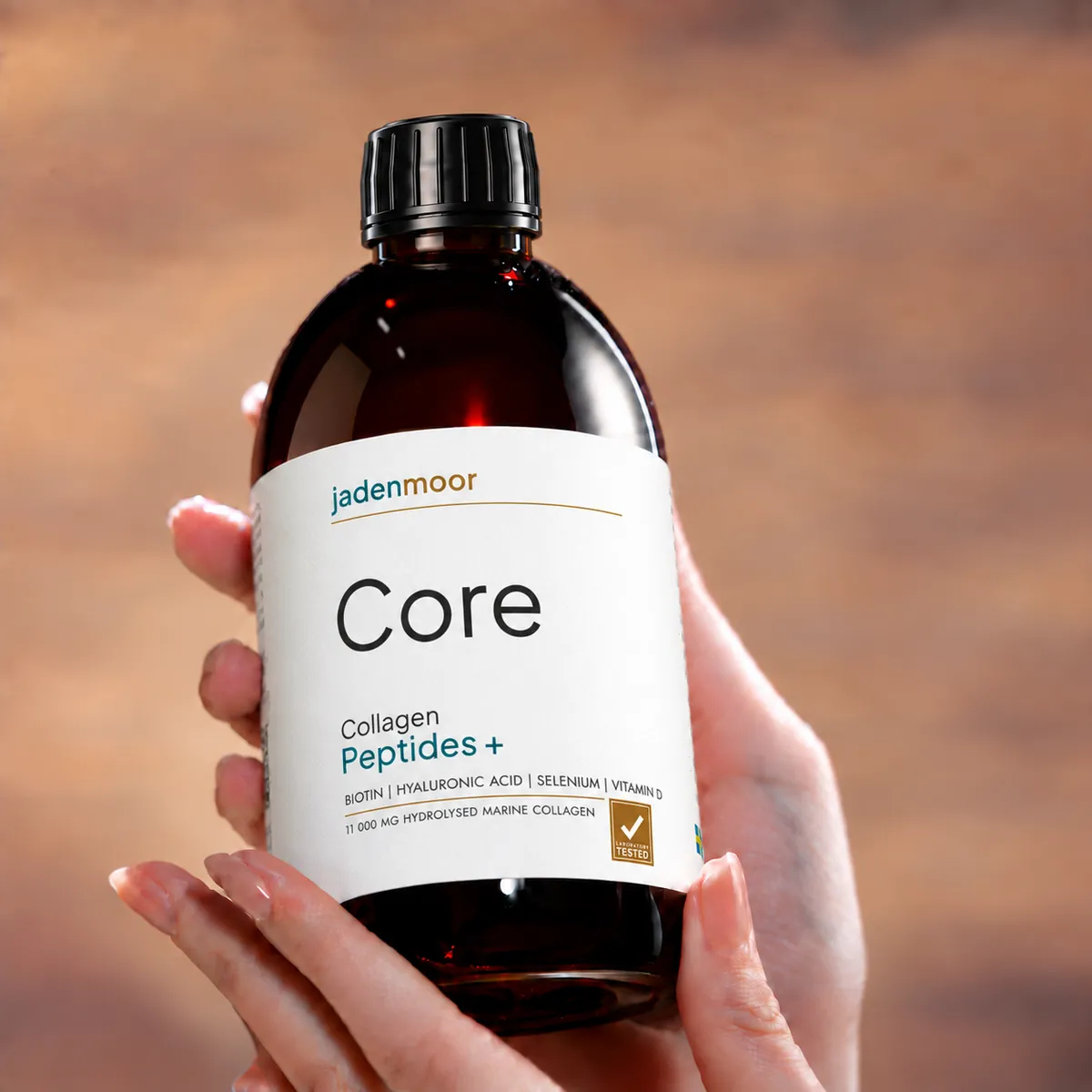
Vitamin C contributes to normal collagen formation for the normal function of skin. Your body cannot make vitamin C, so it has to come from your diet.
- A coenzyme in collagen synthesis. Vitamin C works with the enzymes that stabilise collagen's triple-helix structure.
- Present in both layers of your skin, with reported levels of about 6 to 64 mg per 100 g of wet weight in the epidermis.
- 80 mg is the adult daily reference intake. One portion of Core™ has 120 mg.
of 106 women felt the appearance of their skin improved after 8 weeks on our liquid marine collagen.
- 89%more moisture and glow
- 81%firmer skin
- 120 mgvitamin C per Core™ portion, 150% NRV
Do you need vitamin C with collagen?
Your body needs vitamin C to form collagen, and it has no way of producing the vitamin. Humans, unlike most animals, cannot make vitamin C in the body, so all of it has to arrive through your diet.1 The same fact sheet, from the US National Institutes of Health, describes vitamin C as required for the biosynthesis of collagen, an essential component of connective tissue.1
That link is written into EU food law. The list of permitted health claims includes this sentence: “Vitamin C contributes to normal collagen formation for the normal function of skin”.2 A food can carry it only when it is at least a source of vitamin C.
A collagen drink with vitamin C therefore holds two ingredients with separate jobs. The collagen peptides come with trial evidence, and the skin trials further down tested drinks that paired them with vitamin C. The vitamin C carries the authorised claim: vitamin C contributes to normal collagen formation for the normal function of skin. Core™ gives you both in one pour, with 11,000 mg of hydrolysed marine collagen and 120 mg of vitamin C in each portion.3
What does vitamin C do in collagen formation?
Vitamin C works as a coenzyme for the enzymes that add hydroxyl groups to proline and lysine, the step that stabilises collagen's triple helix as your body makes it. Collagen is a protein your body makes for itself, and making it takes more than amino acids.
The European Food Safety Authority sets it out in its scientific opinion. In collagen synthesis, vitamin C acts as a coenzyme for the prolyl and lysyl hydroxylases, the enzymes that add hydroxyl groups to the amino acids proline and lysine in the collagen molecule. This hydroxylation stabilises collagen's triple-helix structure.4
The authors of a 2017 review of vitamin C in skin give the same account and describe vitamin C as a co-factor for the proline and lysine hydroxylases that stabilise the collagen molecule.5
- The raw material: proline and lysine, amino acids in the collagen molecule.
- The workers: the prolyl and lysyl hydroxylases, which add hydroxyl groups to them.
- The coenzyme: vitamin C, which those enzymes work with.
- The outcome: a stabilised triple helix.
EFSA's panel weighed the evidence and adopted its opinion on 2 July 2009. It concluded that a cause and effect relationship has been established between the dietary intake of vitamin C and normal collagen formation, with the general population as the target population.4 The authorised wording on the EU list rests on that opinion.2

assets/img/blog/vc-pour.webpHow much vitamin C is in your skin?
Skin holds about 6 to 64 mg of vitamin C per 100 g of wet weight in the epidermis and about 3 to 13 mg per 100 g in the dermis, according to the published tissue measurements compiled in a 2017 review.5 The outer layer holds more, and the difference between layers is 2- to 5-fold.
Vitamin C reported in each layer of human skin
Ranges compiled from published tissue measurements, in mg per 100 g of wet weight.
| Skin layer | Where it sits | Reported vitamin C |
|---|---|---|
| Epidermis | The outer layer | About 6 to 64 mg per 100 g |
| Dermis | The layer beneath it | About 3 to 13 mg per 100 g |
Vitamin C, then, is a normal resident of skin, found in the epidermis and in the dermis alike.
What is the reference intake for vitamin C, and how much is in Core™?
The EU's adult daily reference intake for vitamin C is 80 mg, and one portion of Core™ holds 120 mg. The reference intake is set in Annex XIII of Regulation (EU) No 1169/2011, and it is the figure behind every “% NRV” you read on a label.6 One portion of Core™ contains 120 mg of vitamin C, which is 150% NRV.3
the adult daily reference intake for vitamin C in the EU.
of vitamin C in one portion of Core™.
of the nutrient reference value, from a single portion.
According to the NIH fact sheet, about 70% to 90% of vitamin C is absorbed at moderate intakes of 30 to 180 mg per day.1 That figure describes vitamin C intake in general.
The collagen in the portion follows its own evidence. Our guide to how much collagen to take per day walks through the amounts the trials used.
Which collagen trials included vitamin C?
Two placebo-controlled 12-week trials paired collagen with vitamin C in the study drink: one used 8 g of hydrolysed marine collagen, the other 2.5 g of bovine collagen peptides with acerola extract, zinc, vitamin E and biotin. Each result belongs to the whole drink that was tested.
The authors reported hydration +13.8% and elasticity +22.7% in the collagen group
This trial used a daily marine collagen drink with 8 g of hydrolysed collagen plus vitamin C. In the collagen group at 12 weeks, the authors reported skin hydration +13.8%, elasticity +22.7% and collagen fragmentation −44.6%. Hydration was already +7.5% at week 6.7
Adults aged 40 to 60, about 90% of them women · 48 on collagen, 52 on placebo · randomised, double-blind, placebo-controlled
Skin hydration +28.0% from baseline, placebo +9.0%
The drink held 2.5 g of bovine collagen peptides plus acerola extract, vitamin C, zinc, vitamin E and biotin. In the collagen group, skin hydration rose 28.0% from baseline at 12 weeks (placebo +9.0%) and skin density rose 24.8% from baseline (placebo +6.8%).8
72 women aged 35 and over, 36 per group · randomised, placebo-controlled
Core™ is built on the same idea as the first of these drinks, marine collagen and vitamin C taken together every day. For what the trials measured on fine lines, see collagen for wrinkles.
What else does vitamin C do?
Beyond skin, the EU list authorises vitamin C wording on collagen formation for bones, cartilage, gums, teeth and blood vessels, plus further claims that range from tiredness to the immune system. The parallel wording reads the same way each time.2
- Vitamin C contributes to normal collagen formation for the normal function of bones.
- Vitamin C contributes to normal collagen formation for the normal function of cartilage.
- Vitamin C contributes to normal collagen formation for the normal function of gums.
- Vitamin C contributes to normal collagen formation for the normal function of teeth.
- Vitamin C contributes to normal collagen formation for the normal function of blood vessels.
The same list authorises further claims for vitamin C beyond collagen.2
- Vitamin C contributes to the protection of cells from oxidative stress.
- Vitamin C contributes to the reduction of tiredness and fatigue.
- Vitamin C contributes to normal energy-yielding metabolism.
- Vitamin C contributes to the normal function of the immune system.
- Vitamin C contributes to normal functioning of the nervous system.
- Vitamin C contributes to normal psychological function.
All of these are authorised for vitamin C, and each portion of Core™ carries 120 mg of it.
What did women report on our liquid marine collagen?
After taking our liquid marine collagen daily for 8 weeks, 95% of the 106 women in our user trial felt the appearance of their skin improved, 89% reported more moisture and glow, and 81% reported firmer skin. 99% found it easy to include in their daily routine.3 These are results for the formula as a whole.
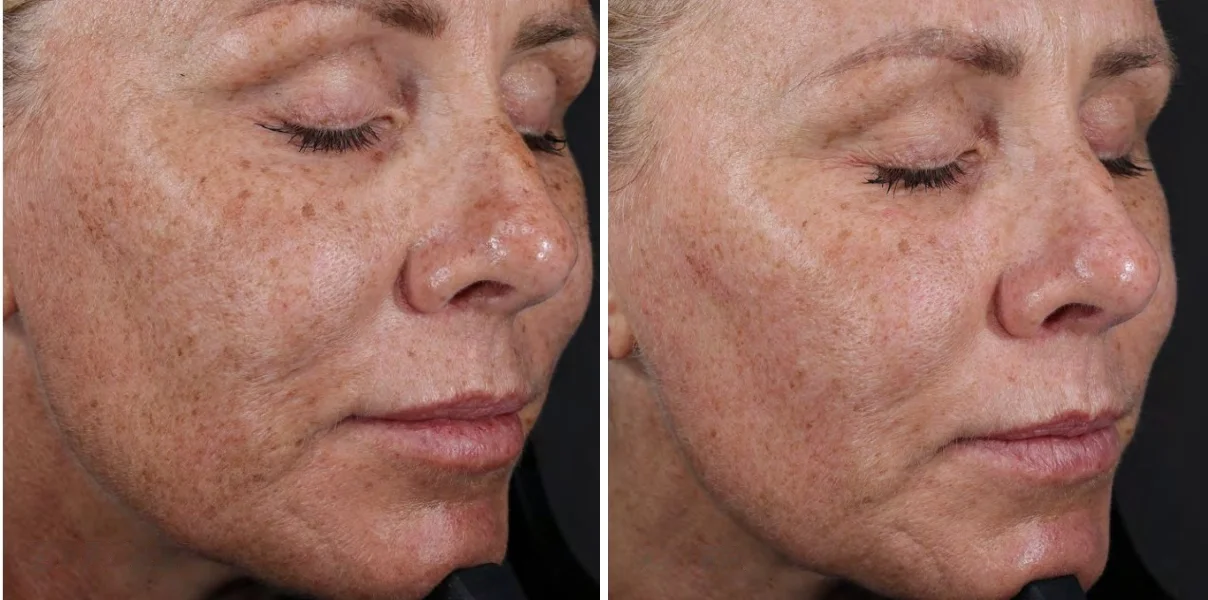

Participants in the 8-week user trial of our liquid marine collagen, photographed before and after.
Women in that trial reported visible results in as little as 4 weeks, with further improvement by week 8.3 Buyers and beauty writers describe the same kind of change in their own words.
“I can really see the visible changes in my skin and nails.”
★★★★★
Check4YouVerified purchase · Amazon, Germany · 27 December 2023
“The taste is amazing and it is sugar free! Love what it does to my hair, nails and skin.”
★★★★★
Suzanne H.Verified purchase · Amazon, United Kingdom · 26 August 2024
“And truthfully? My skin looks better than ever.”
A self-confessed sceptic, she took marine collagen every day for two months and found her skin plumper, healthier and noticeably more radiant.
Shannon LawlorBeauty editor, writing in Marie Claire UK9
Verified buyer reviews of our liquid marine collagen as sold under our manufacturer's own label, and an independent first-person account of marine collagen published by the outlet named.
Questions about vitamin C and collagen
Do you need vitamin C with collagen?
Your body needs vitamin C to form its own collagen. Vitamin C contributes to normal collagen formation for the normal function of skin, and humans cannot make it, so it has to come from the diet. Core™ includes 120 mg in every portion.
Does vitamin C help collagen absorption?
The established role of vitamin C is in collagen formation, rather than absorption. EFSA concluded that a cause and effect relationship has been established between the dietary intake of vitamin C and normal collagen formation. In that process vitamin C acts as a coenzyme for the enzymes that stabilise collagen's triple-helix structure.
Can you take vitamin C and collagen at the same time?
Yes, and trials have tested them in the same drink. A 12-week trial used a daily marine collagen drink with 8 g of hydrolysed collagen plus vitamin C. Core™ follows the same format, with both in one portion.
How much vitamin C is in Core™?
Core™ has 120 mg of vitamin C per portion, which is 150% NRV. The adult daily reference intake in the EU is 80 mg.
Is there vitamin C in your skin?
Yes, your skin holds vitamin C in both of its layers. Published measurements put it at about 6 to 64 mg per 100 g of wet weight in the epidermis and about 3 to 13 mg per 100 g in the dermis.
Can your body make its own vitamin C?
No, humans, unlike most animals, cannot make vitamin C in the body, so it comes from your diet.