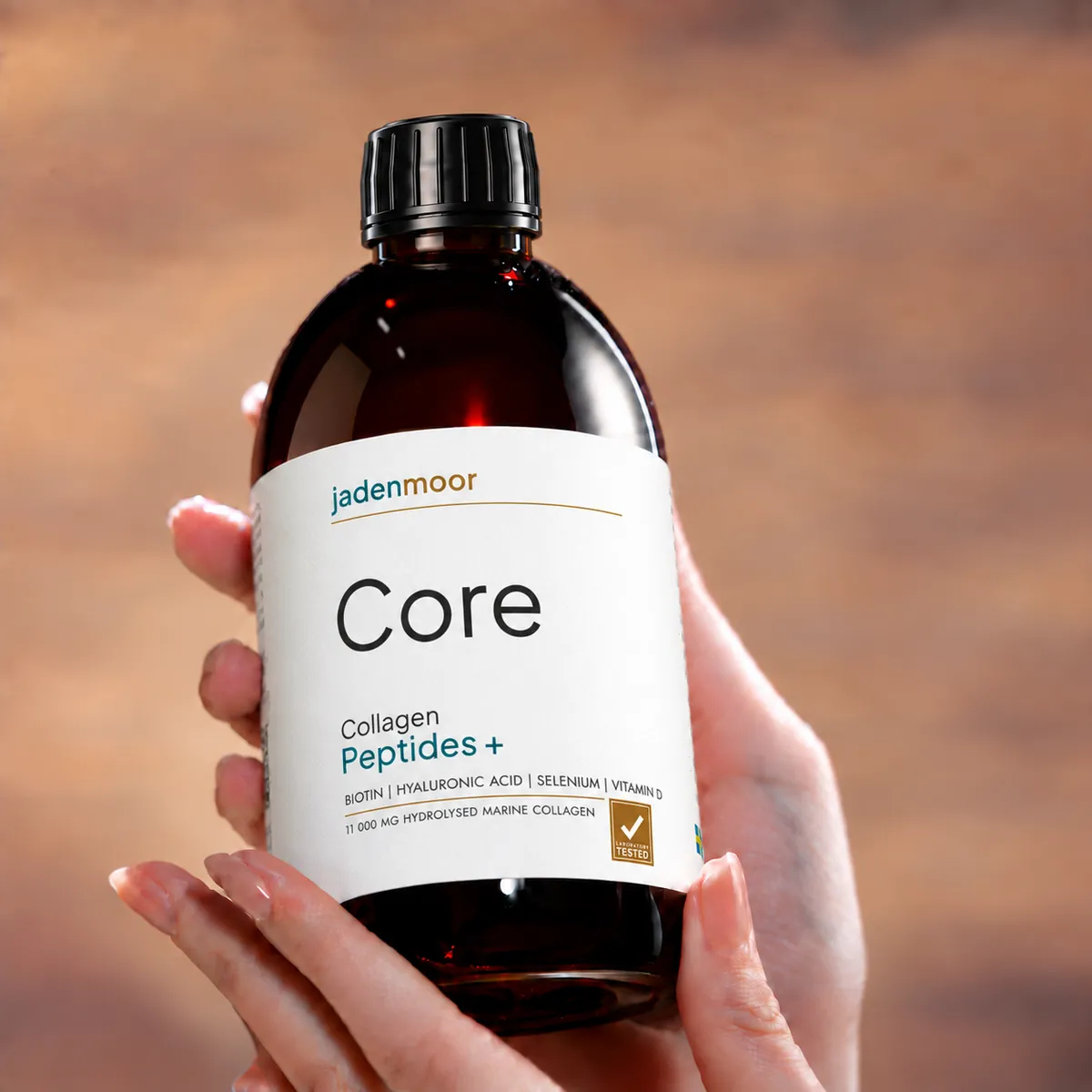
The EU list of permitted health claims gives selenium one line for each. Selenium contributes to the maintenance of normal hair, and selenium contributes to the maintenance of normal nails.
- Both claims, one mineral. Of the nutrients in Core™, selenium is the only one whose authorised wording covers hair and nails alike.
- 25 selenoproteins. That is how many proteins in the human body carry selenium as part of their structure.
- 27.5 µg per portion. Half of the 55 µg EU reference intake, in each portion of Core™.
of 106 women reported stronger nails after 8 weeks on our liquid marine collagen. This is a result for the whole drink.
- 86%reported healthier hair
- 95%felt the appearance of their skin improved
- 99%found it easy to include in their daily routine
What does selenium do for hair and nails?
Selenium has authorised EU wording for both, covering the maintenance of normal hair and the maintenance of normal nails. In the EU, a food or supplement may only link a nutrient to a part of your body in words taken from one official register, the list of permitted health claims made on foods, and selenium appears there with a hair entry and a nail entry.1
- Hair. Selenium contributes to the maintenance of normal hair.
- Nails. Selenium contributes to the maintenance of normal nails.
Both lines are about maintenance, and both are about what is normal. The register says nothing further on selenium, hair and nails, so neither do we. You will see the same two sentences, unchanged, everywhere on this page.
Several nutrients in the Core™ portion have authorised wording for skin, or for hair, and selenium stands out as the one that carries a hair line and a nail line together.
What is selenium?
Selenium is a mineral, and a tiny one in dietary terms: its amounts on a label are counted in micrograms (µg), where vitamin C is counted in milligrams.
According to the US National Institutes of Health fact sheet for health professionals, selenium becomes part of 25 selenoproteins, proteins that have the mineral in their make-up. The same fact sheet lists DNA synthesis and protection from oxidative damage among the jobs those proteins take part in.2
On a label, selenium is set against a daily reference intake, the yardstick EU food law uses for vitamins and minerals. For selenium that reference intake is 55 µg.3 It is a labelling reference, the figure behind the percentage printed beside the mineral.
assets/img/blog/sn-hands.webpWhat else is selenium authorised for?
Beyond hair and nails, selenium is authorised for the protection of cells from oxidative stress, the normal function of the immune system and normal thyroid function. The table shows all five of these entries, each line exactly as authorised.1
Authorised claims for selenium
Wording from the EU list of permitted health claims made on foods.
| Area | Authorised wording |
|---|---|
| Hair | Selenium contributes to the maintenance of normal hair. |
| Nails | Selenium contributes to the maintenance of normal nails. |
| Cells | Selenium contributes to the protection of cells from oxidative stress. |
| Immune system | Selenium contributes to the normal function of the immune system. |
| Thyroid | Selenium contributes to the normal thyroid function. |
The thyroid row has a story of its own, and we tell it in a separate guide: selenium and your thyroid.
Each row of the list is a separate entry with its own wording, so the hair line and the nail line are approved claims in their own right.
Selenium and biotin: who covers what?
Selenium and biotin both have authorised hair wording, biotin adds skin, and selenium adds nails. Among its entries on the permitted list are two lines: biotin contributes to the maintenance of normal hair, and biotin contributes to the maintenance of normal skin.1 On hair, the European Food Safety Authority's panel concluded that a cause and effect relationship has been established between the dietary intake of biotin and the maintenance of normal hair.4
The list contains no authorised biotin claim for nails.1 Selenium fills that place, so in Core™ the two nutrients work as a pair on the label. They share the hair line, biotin adds skin, and selenium adds nails.
Hair, nails and skin on the Core™ label
Which nutrients in Core™ have authorised wording for each area, quoted from the EU list of permitted health claims.
| Area | Nutrient in Core™ | Authorised wording |
|---|---|---|
| Hair | Selenium | Selenium contributes to the maintenance of normal hair. |
| Hair | Biotin | Biotin contributes to the maintenance of normal hair. |
| Nails | Selenium | Selenium contributes to the maintenance of normal nails. |
| Skin | Biotin | Biotin contributes to the maintenance of normal skin. |
| Skin | Vitamin C | Vitamin C contributes to normal collagen formation for the normal function of skin. |
With both in the portion, you do not have to choose between them. If biotin is the nutrient you came for, our guide to biotin for hair, skin and nails goes through its wording line by line.
How much selenium is in Core™?
One portion of Core™ has 27.5 µg of selenium.5 Against the 55 µg reference intake, that works out at 50% NRV.3 The same portion has 5,000 µg of biotin.5
of selenium in one portion of Core™.
is the EU daily reference intake for selenium.
of that reference intake in each portion.
Nothing needs measuring out. Take one portion a day: shake the pack, fill the cap, and drink it as it is or stir it into water or a smoothie. Once opened, the pack lives in the fridge.5 The full nutrition table is on the Core™ product page.
Selenium and biotin are the supporting cast. The ingredient the portion is built around is 11,000 mg of hydrolysed marine collagen, types I and III.5 Collagen is not a vitamin or a mineral, so its evidence comes from published studies and our own trial, each with a section below.
What did collagen studies measure for nails and hair?
The two collagen peptide studies measured nail growth rate and the frequency of broken nails over 24 weeks, and average hair thickness over 16 weeks. They tested collagen peptides, not selenium, and each one reports only its own participants. For background, the hair you can see is made of keratin, a protein, and scalp hair grows about 1 cm a month.6 Fingernails grow about 3.47 mm a month.7 The nail study ran for 24 weeks and the hair study for 16.
Nail growth rate up 12%, broken nails down 42%
In an open-label study, 25 participants took 2.5 g of collagen peptides daily. Their nail growth rate rose 12% and the frequency of broken nails fell 42%. A physician judged brittle nails clinically improved in 64% of them, a share that reached 88% four weeks after they stopped, and 80% agreed their nails looked better.8
25 participants · open-label, no placebo group · 2.5 g collagen peptides a day
Hair thickness up 1.93 micrometres with collagen peptides
44 healthy women aged 39 to 75 were randomised to 2.5 g of collagen peptides a day or a placebo. Average hair thickness rose by 1.93 micrometres in the collagen group, against a slight dip of 0.99 micrometres with placebo, and the gap between the groups was significant.9
44 healthy women aged 39 to 75 · randomised, placebo-controlled · 2.5 g collagen peptides a day
For the longer read on the nail study, see collagen for nails, which sets it out measure by measure.
What did women report on our liquid marine collagen?
In our own trial, 76% of 106 women reported stronger nails and 86% reported healthier hair. They took our liquid marine collagen daily for 8 weeks and then reported what they had noticed.5 These are results for the whole drink, reported by the women who took it.
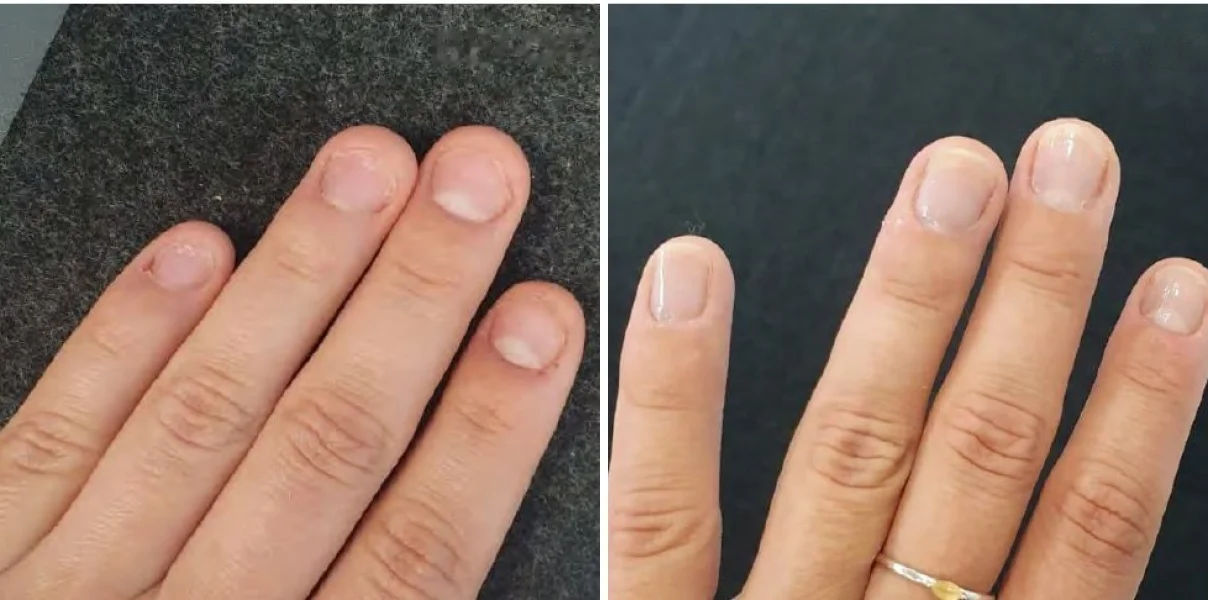
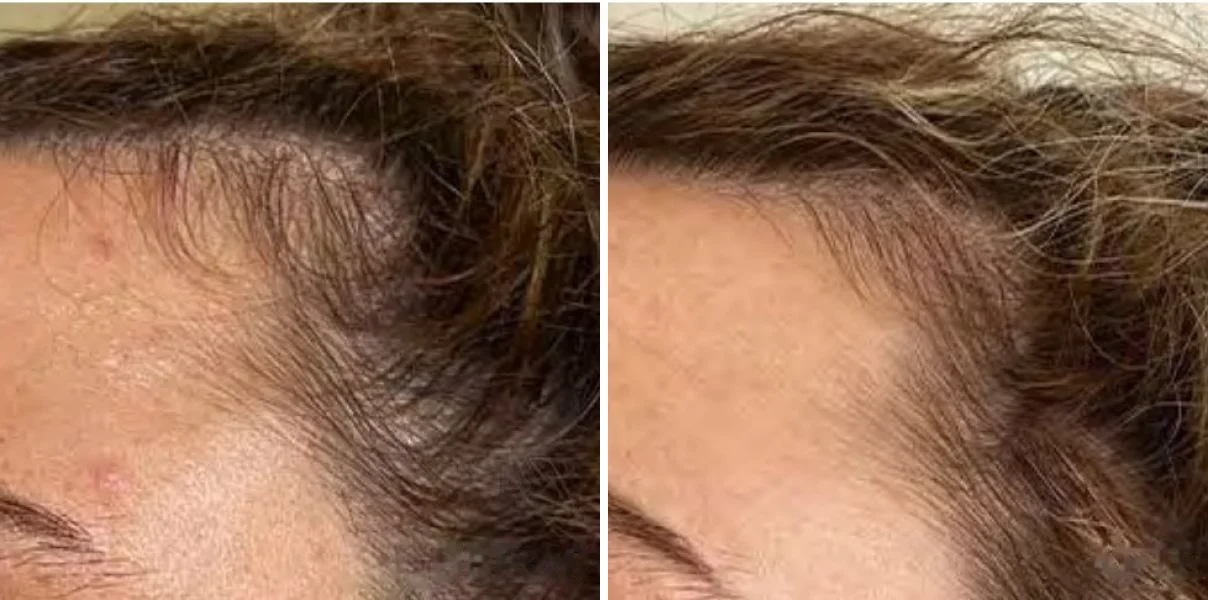
Participants in the 8-week user trial of our liquid marine collagen, photographed before and after. This is what it looked like for women in our studies.
Nails and hair also turn up in what individual women have written about marine collagen. Three of those accounts follow, each in the writer's own words.
“My nails were the best I had ever had in my whole life.”
She began marine collagen after turning 40, and by month six her hair felt thicker and fuller.
Charlotte DormonWriting in Hip & Healthy10
“To my surprise, these worked.”
After around six months on 10,000 mg of marine collagen a day she reported nails that were less brittle, along with glowier, more even skin.
Charlotte BitmeadWriting in Stylist11
“The taste is amazing and it is sugar free! Love what it does to my hair, nails and skin.”
★★★★★
Suzanne H.Verified purchase · Amazon, United Kingdom · 26 August 2024
Independent first-person accounts of marine collagen published by the outlets named, and a verified buyer review of our liquid marine collagen as sold under our manufacturer's own label.
Questions about selenium, hair and nails
Is selenium good for hair?
The EU list of permitted health claims has an entry for it: selenium contributes to the maintenance of normal hair. That sentence is the authorised wording in full.
What is the authorised wording for selenium and hair?
The authorised wording for selenium and hair is about maintenance: selenium contributes to the maintenance of normal hair. Those are the words the register approves, so those are the words we use.
Is selenium good for nails?
Selenium has an authorised nail claim: selenium contributes to the maintenance of normal nails. Of the nutrients in Core™, it is the only one with wording for nails.
Should I take selenium or biotin for hair?
Selenium and biotin both have an authorised hair line, in matching words. Selenium contributes to the maintenance of normal hair, and biotin contributes to the maintenance of normal hair. Core™ has the two in one portion.
How much selenium is in a portion of Core™?
Core™ has 27.5 µg of selenium in every portion. That is 50% NRV, measured against the EU reference intake of 55 µg.
What did women say about their nails and hair in your trial?
In our 8-week user trial of 106 women, 76% reported stronger nails and 86% reported healthier hair on our liquid marine collagen. Those figures describe the whole drink.