The trials give you a range to stand in. None of the studies below was limited to people in their thirties, but several accepted adults from 30, 31 or 35, and several of those took skin moisture readings.
- Lowest entry age among the single trials below: 30. A 12-week trial of 3,000 mg of fish-scale collagen peptides a day took in 71 healthy women aged 30 to 60.
- From 35, several trials read moisture. A trial of 99 healthy Japanese women aged 35 to 50 recorded more water in the stratum corneum and epidermis with 1 g or 5 g of collagen peptides daily for 12 weeks.
- The background figure: from early adulthood the skin makes about 1.0% to 1.5% less collagen each year.
of 106 women reported more moisture and glow after 8 weeks on our liquid marine collagen.
- 95%felt their skin's appearance improved
- 81%reported firmer skin
- 99%found it easy to include in their daily routine
Should you take collagen in your 30s?
No study in our file recruited people in their thirties alone, but several collagen trials opened their age range at 30, 31 or 35, and those wider groups are the closest evidence for your decade. Where the age ranges begin gives you a short, specific list.
The list starts at 30 with a randomised, placebo-controlled, double-blind trial that enrolled 71 healthy women aged 30 to 60.1 At 31 there is a pilot trial in 22 healthy Japanese adults aged 31 to 48, whose drink combined fish-derived collagen peptide with ornithine.2
At 35 several entries arrive together: a trial of 99 healthy Japanese women aged 35 to 50,3 a trial of 69 women aged 35 to 55,4 a trial in adults aged 35 to 60 with dry skin,5 and a trial of 72 women aged 35 and over whose drink paired bovine collagen peptides with acerola extract, vitamin C, zinc, vitamin E and biotin.6
Below 30 this list has a pooled figure only. A meta-analysis of 19 randomised double-blind trials counted 1,125 participants aged 20 to 70, about 95% women.7
Each of these ranges runs well past 39, so each finding belongs to the whole group enrolled. For more studies lined up by age, see our article on what age to start collagen.
When does skin's own collagen start to change?
From early adulthood, the skin makes about 1.0% to 1.5% less collagen each year, a gradual change according to a review of skin collagen across the life stages.8
That number is a yearly rate, counted from early adulthood, and your thirties are some of the years it describes.

assets/img/blog/a3-table.webpWhich collagen trials enrolled people from 30 and 35?
Six single trials did: one of 71 healthy women aged 30 to 60, a pilot of 22 healthy Japanese adults aged 31 to 48, and four that opened at 35, with 99 Japanese women, 69 women, adults with dry skin and 72 women. The table gives them with their paperwork: the ages on the entry form, the people, the daily amount and the length. Results follow in the next section.
Collagen trials whose age range opens at 30, 31 or 35
One row per study. The pooled analysis is listed last because it is a combination of trials, not a single one.
| Ages enrolled | Who took part | What they took each day | Length |
|---|---|---|---|
| 30 to 60 | 71 healthy women. Randomised, placebo-controlled, double-blind.1 | 20 ml containing 3,000 mg of fish-scale collagen peptides, or placebo | 12 weeks |
| 31 to 48 | 22 healthy Japanese adults. Randomised, double-blind, placebo-controlled pilot.2 | A 30 ml drink with 10 g of fish-derived collagen peptide plus 400 mg ornithine, or placebo | 8 weeks |
| 35 to 50 | 99 healthy Japanese women. Randomised, double-blind, placebo-controlled.3 | 1 g or 5 g of collagen peptides, or placebo | 12 weeks |
| 35 to 55 | 69 women. Double-blind, placebo-controlled.4 | 2.5 g or 5.0 g of collagen hydrolysate, or placebo, once daily | 8 weeks |
| 35 to 60 | Adults with dry skin, 50 randomised and 44 completed. Randomised, double-blind, placebo-controlled.5 | 1,000 mg of fish-scale collagen peptides, or placebo | 12 weeks |
| 35 and over | 72 women, 36 per group. Randomised, placebo-controlled.6 | A drink with 2.5 g of bovine collagen peptides plus acerola extract, vitamin C, zinc, vitamin E and biotin, or placebo | 12 weeks |
| 20 to 70 | 1,125 participants, about 95% women, pooled from 19 randomised double-blind trials.7 | Hydrolysed collagen | 90 days in the authors' conclusion |
What did those trials measure?
The collagen trials that enrolled from 30 and 35 mostly measured water in the skin, and the trial that opened at 30 also looked at wrinkles around the eyes. Moisture readings appear in several rows of the table, and the trial that opened at 30 looked at wrinkles around the eyes as well. Each card below is one study, read on its own.
More water in the skin's outer layers
With 1 g or 5 g of collagen peptides daily, water content in the stratum corneum and epidermis increased. Transepidermal water loss came down, and natural moisturising factor in the stratum corneum went up.3
99 healthy Japanese women aged 35 to 50 · randomised, double-blind, placebo-controlled
Moisture reading up 7.33%, against 2.83% with placebo
The ingredient was fish-scale collagen peptides at 1,000 mg a day, tested in adults with dry skin. A skin moisture reading improved by 7.33% versus 2.83% with placebo (p = 0.031). Natural moisturising factor in the stratum corneum also ended higher than with placebo (p = 0.006).5
Adults aged 35 to 60 with dry skin, 50 randomised and 44 completed · randomised, double-blind, placebo-controlled
Periorbital wrinkles down versus placebo
Of the single trials in the table, this one has the lowest entry age. Its drink supplied 3,000 mg of fish-scale collagen peptides in 20 ml a day. Periorbital wrinkles fell significantly versus placebo, and facial skin moisture and elasticity rose in the collagen group.1
71 healthy women aged 30 to 60 · randomised, placebo-controlled, double-blind
The remaining rows add their own readings.
- Water loss, ages 31 to 48. In the 8-week pilot, the 30 ml drink with 10 g of fish-derived collagen peptide plus 400 mg ornithine gave lower transepidermal water loss than placebo at 8 weeks. The finding belongs to the combined drink.2
- Elasticity, ages 35 to 55. With 2.5 g or 5.0 g of collagen hydrolysate once daily for 8 weeks, skin elasticity improved significantly in both collagen groups compared with placebo.4
- Hydration and wrinkle depth, ages 35 and over. On the drink with 2.5 g of bovine collagen peptides plus acerola extract, vitamin C, zinc, vitamin E and biotin, the collagen group's skin hydration was up 28.0% from baseline at 12 weeks (placebo 9.0%) and its wrinkle depth was down 26.8% from baseline (placebo 6.4%).6
- The pooled view, ages 20 to 70. The authors of the meta-analysis concluded that 90 days of hydrolysed collagen reduced wrinkles and improved skin elasticity and hydration.7
The measuring methods behind those moisture readings are explained in collagen for skin hydration, and the studies that open at 40 and 45 are sorted in collagen after 40.
What is in one Core™ portion?
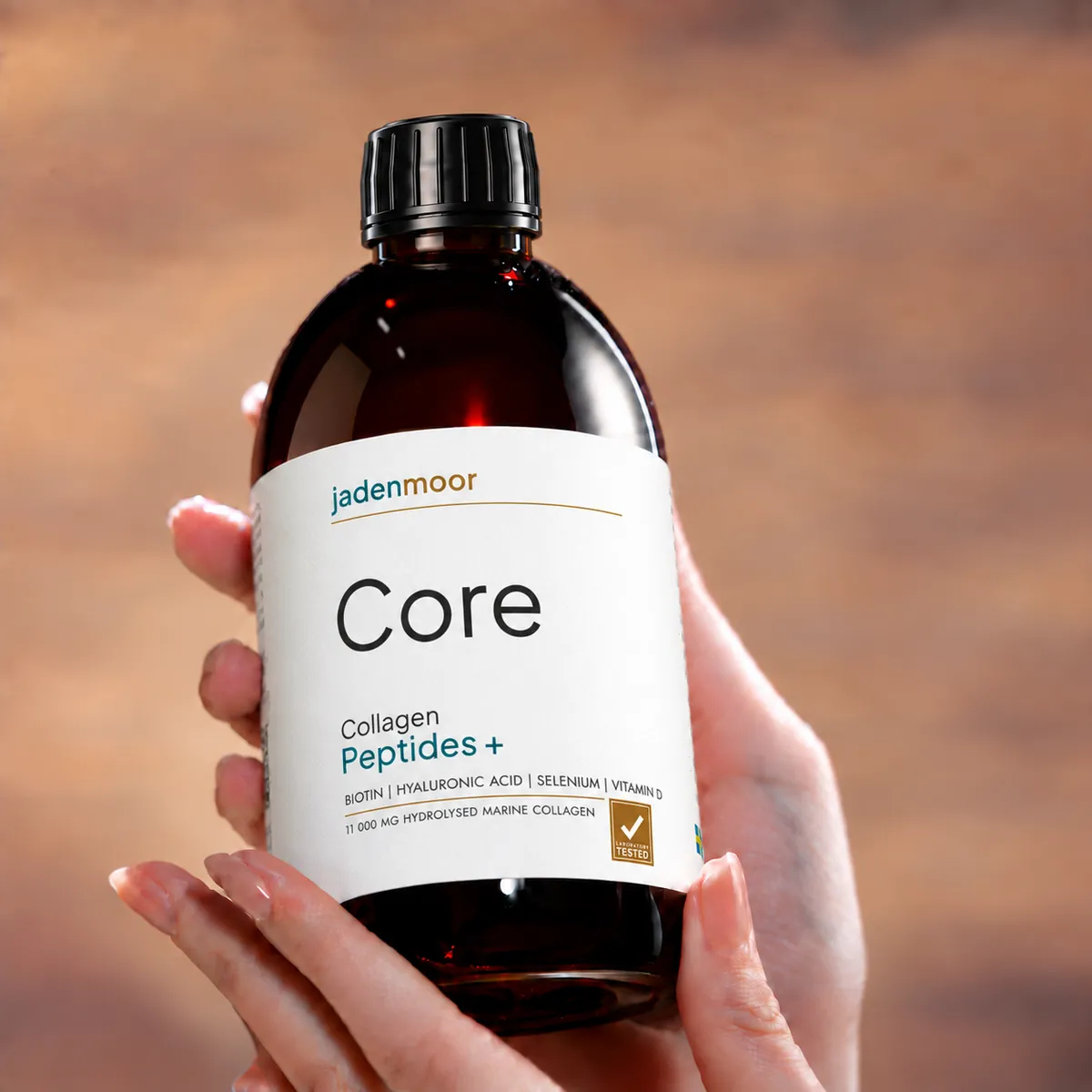
One Core™ portion is holding 11,000 mg of hydrolysed marine collagen, types I and III. The clinical trials in our evidence file used between 1 g and 10 g of collagen peptides a day. The collagen is hydrolysed to a low molecular weight of about 1,500 daltons. Each portion has 9.9 g of protein, a natural berry flavour, and is sugar free and fat free.9
The same portion carries vitamins and a mineral. Their roles below are worded exactly as the EU list of permitted health claims words them.10
- Vitamin C, 120 mg. Vitamin C contributes to normal collagen formation for the normal function of skin.
- Biotin, 5,000 µg. Biotin contributes to the maintenance of normal skin.
- Selenium, 27.5 µg. Selenium contributes to the protection of cells from oxidative stress.
Hyaluronic acid, 50 mg, and silica, 50 mg, complete the formula, with vitamin D, vitamin B5, vitamin B6 and vitamin B12 on the label too.9 To take it, shake the pack, pour a portion into the cap, and drink it straight or stirred into water or a smoothie. The Core™ page lists the complete label.
What did women report on our liquid marine collagen?
Of 106 women who took our liquid marine collagen daily for 8 weeks in a user trial, 89% reported more moisture and glow and 95% felt that the appearance of their skin improved.9 The research above was done on other formulas, and these answers are for ours.
reported more moisture and glow.
felt that the appearance of their skin improved.
found it easy to include in their daily routine.
Each figure is a share of those 106 women and comes from their own answers. Women in that trial reported visible results in as little as 4 weeks, with further improvement by week 8.9
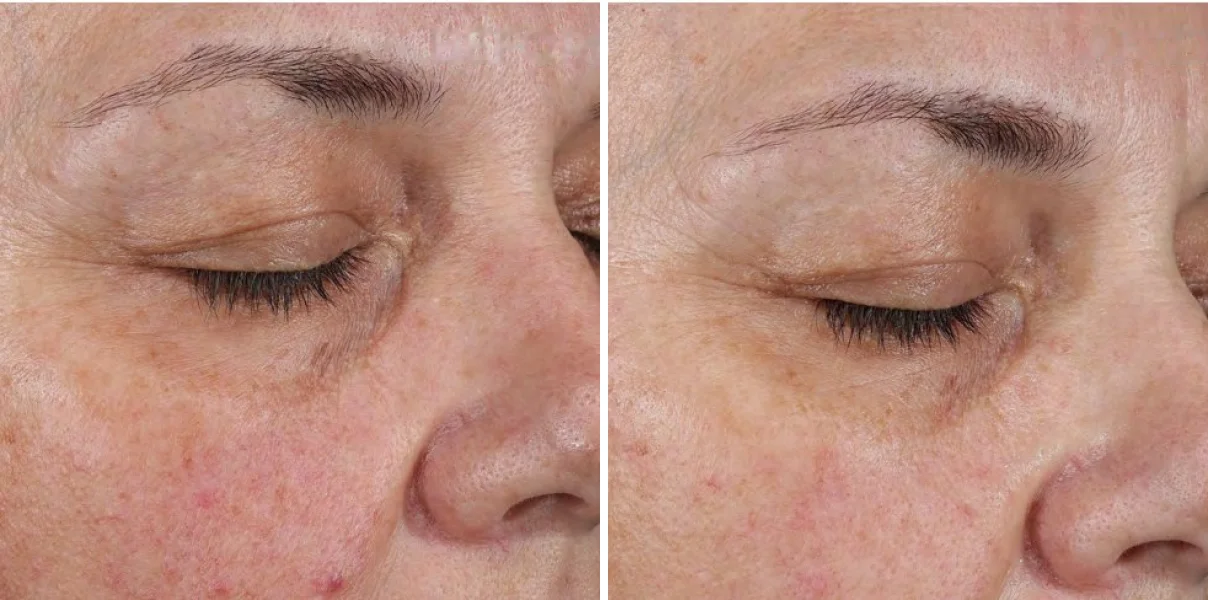
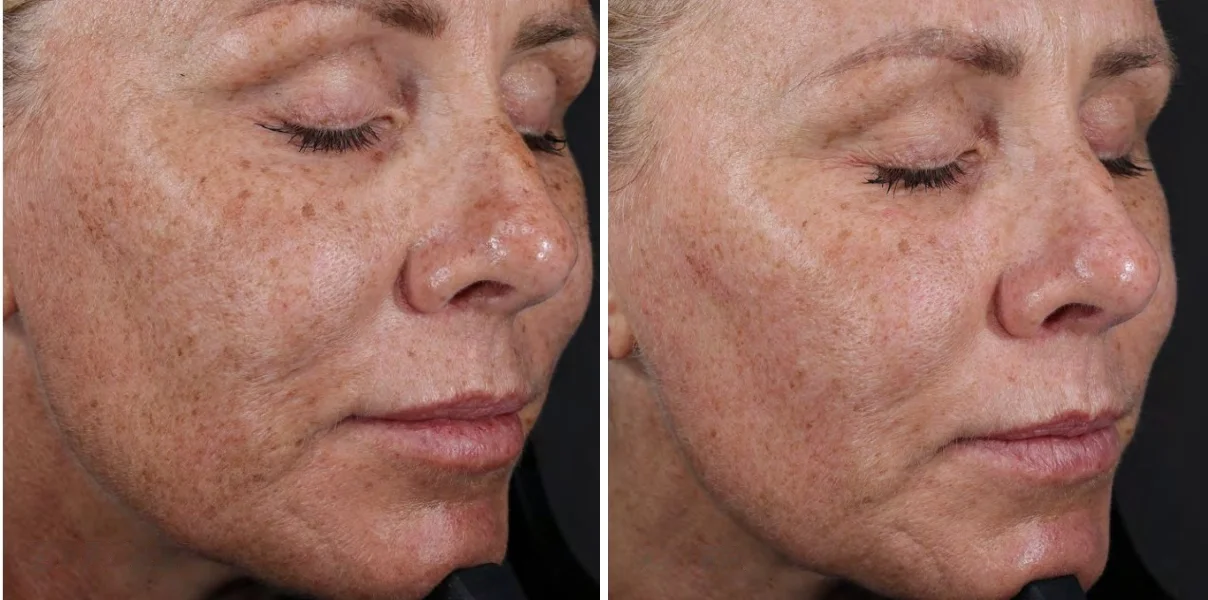
Participants in the 8-week user trial of our liquid marine collagen, photographed before and after.
In their own words
A trial reports on a group, whereas each account below comes from one person.
“I can really see the visible changes in my skin and nails.”
★★★★★
Check4YouVerified purchase · Amazon, Germany · 27 December 2023
“The taste is amazing and it is sugar free! Love what it does to my hair, nails and skin.”
★★★★★
Suzanne H.Verified purchase · Amazon, United Kingdom · 26 August 2024
“And truthfully? My skin looks better than ever.”
She calls herself a sceptic. Even so, a daily marine collagen habit kept up for two months left her skin plumper, healthier and noticeably more radiant, by her own account.
Shannon LawlorBeauty editor, writing in Marie Claire UK11
Verified buyer reviews of our liquid marine collagen as sold under our manufacturer's own label, and an independent first-person account of marine collagen published by the outlet named.
Questions about collagen in your 30s
Should I take collagen at 30?
Collagen at 30 is your choice, and the closest evidence starts right there: the lowest entry age among the single trials here is 30, in a 12-week trial of 71 healthy women aged 30 to 60. No study here recruited people in their thirties only, so each result belongs to the full range enrolled.
What did the trials that opened at 35 measure?
Moisture and elasticity, depending on the trial. A trial of 99 healthy Japanese women aged 35 to 50 recorded more water in the stratum corneum and epidermis with 1 g or 5 g of collagen peptides daily for 12 weeks. A trial of 69 women aged 35 to 55 recorded better skin elasticity than placebo in both of its collagen groups.
When does skin start making less collagen?
From early adulthood, according to a review of skin collagen across the life stages. Its figure, a yearly rate, is about 1.0% to 1.5% less collagen each year.
How much collagen did the trials from 30 and 35 use?
The single trials in the table used daily amounts from 1 g to 10 g, and each row states its own ingredient. Core™ has 11,000 mg of hydrolysed marine collagen in one portion.
How long did those trials run?
The single trials in the table lasted 8 weeks or 12 weeks. Our own user trial of our liquid marine collagen ran for 8 weeks, and women in it reported visible results in as little as 4 weeks.