The trials on this page gave collagen for set lengths, from 4 weeks to 6 months, and some of them took one more reading four weeks after the last dose.
- More than 8 weeks: in a pooled analysis of 26 trials, the skin hydration effect was larger when collagen was taken for longer than that.
- Four weeks after stopping: in a trial of 114 women aged 45 to 65, the effect on eye-wrinkle volume was still there.
- A course of Core™ is simple: one portion a day, every day, for the length you set.
of 106 women felt the appearance of their skin improved after 8 weeks on our liquid marine collagen.
- 99%found it easy to include in their daily routine
- 89%reported more moisture and glow
- 87%noticed fewer fine lines and wrinkles
How long should you take collagen?
A daily course of 8 to 12 weeks matches the published trials gathered here, which gave collagen for a fixed period from 4 weeks at the short end to 6 months at the long end, with 8 and 12 weeks appearing most often. A course is the same idea at home.
Length itself has been examined in pooled research. A 2023 meta-analysis brought together 26 randomised controlled trials with 1,721 participants. It found that oral collagen significantly improved skin hydration and elasticity compared with placebo, and the hydration effect was larger when collagen was taken for more than 8 weeks.1
A second meta-analysis worked with 19 randomised double-blind trials and 1,125 participants aged 20 to 70, about 95% of them women. Its authors concluded that 90 days of hydrolysed collagen reduced wrinkles and improved skin elasticity and hydration.2
For when each change first registers, see our week-by-week timeline of collagen results.
How long did the trials run?
The trials ran from 4 weeks to 6 months: the skin studies lasted 4, 8 or 12 weeks, the hair study 16 weeks, the nail study 24 weeks and the elasticity study in menopausal women 6 months. Below, they are sorted by duration, shortest first, and the middle column shows what the researchers chose to measure.
Collagen study lengths, shortest to longest
How long each study gave collagen, what it measured, and who took part.
| Study length | What was measured | Study |
|---|---|---|
| 4 weeks | Cheek skin elasticity compared with placebo, with a second check four weeks after stopping.3 | 36 postmenopausal women. 5 g of marine collagen hydrolysate a day. Randomised, double-blind, placebo-controlled. |
| 8 weeks | Eye-wrinkle volume against placebo at 4 weeks and at 8 weeks, with a further check four weeks after stopping. Procollagen type I and elastin in skin samples after 8 weeks.4 | 114 women aged 45 to 65. 2.5 g of collagen peptides a day. Randomised, double-blind, placebo-controlled. |
| 8 weeks | Skin elasticity compared with placebo, with a further reading 4 weeks after the last dose.5 | 69 women aged 35 to 55. 2.5 g or 5.0 g of collagen hydrolysate, or placebo, once daily. Double-blind, placebo-controlled. |
| 12 weeks | Skin hydration at 6 weeks and at 12 weeks. Crow's-feet wrinkling and skin elasticity at 12 weeks.6 | 64 women aged 40 to 60. 1,000 mg a day of low-molecular-weight fish collagen peptide. Randomised, double-blind, placebo-controlled. |
| 12 weeks | Skin hydration, wrinkle depth, skin density and skin elasticity as changes from baseline, with a second check four weeks after stopping.7 | 72 women aged 35 and over, 36 per group. A drink with 2.5 g of bovine collagen peptides plus acerola extract, vitamin C, zinc, vitamin E and biotin. Randomised, placebo-controlled. |
| 16 weeks | Hair thickness, in micrometres, against placebo.8 | 44 healthy women aged 39 to 75. 2.5 g of collagen peptides a day. Randomised, placebo-controlled. |
| 24 weeks | Nail growth rate, the frequency of broken nails and a physician's assessment of brittle nails, with a second check four weeks after stopping.9 | 25 participants. 2.5 g of collagen peptides daily. No placebo group. |
| 6 months | Skin elasticity as a change from baseline, compared with placebo.10 | Menopausal women aged 45 to 60. 5 g a day of collagen from freshwater fish skin. Randomised, placebo-controlled. |
Skin measurements fill the 4-week, 8-week and 12-week rows. The hair study lasted 16 weeks and the nail study 24 weeks, while the 6-month study measured skin elasticity.
For the amounts, see how much collagen to take a day.
Do you need to take breaks from collagen?
The studies on this page describe no breaks. Where a study in the table states its dosing, it is a daily amount kept up for the whole of the stated period: 5 g a day for 4 weeks,3 2.5 g a day for 8 weeks4 or for 16 weeks,8 2.5 g daily for 24 weeks,9 and 5 g a day for 6 months.10
Our own user trial had the same shape, with 106 women taking our liquid marine collagen daily for 8 weeks.11
These results were all recorded under one routine, a daily amount from the first dose to the last. Some of the same studies then measured once more after the daily dose had ended.

assets/img/blog/cb-diary.webpWhat did studies find four weeks after the last dose?
Four weeks after the last dose, the studies that measured again still found their results: the effect on eye-wrinkle volume and the difference in cheek elasticity were still there, elasticity in older women was still higher, the collagen group in one skin trial was still above baseline, and the share with improved brittle nails was 88%. The cards below give the readings they recorded.
Effect on eye-wrinkle volume still there four weeks after stopping
The collagen group took 2.5 g of collagen peptides a day for 8 weeks. Their eye-wrinkle volume was significantly lower than placebo, by about 20% at the 8-week reading, and the effect was still there four weeks after stopping.4
114 women aged 45 to 65 · randomised, double-blind, placebo-controlled
Cheek elasticity difference still there four weeks after stopping
The dose was 5 g of marine collagen hydrolysate a day for 4 weeks. Cheek skin elasticity improved compared with placebo, and when it was measured again four weeks after stopping, the difference was still there.3
36 postmenopausal women · randomised, double-blind, placebo-controlled
In older women, elasticity still higher 4 weeks after the last dose
The doses were 2.5 g or 5.0 g of collagen hydrolysate once daily, with a placebo group alongside. Over the 8 weeks, skin elasticity improved significantly in both collagen groups compared with placebo. In older women it was still higher 4 weeks after the last dose.5
69 women aged 35 to 55 · double-blind, placebo-controlled
Collagen group still above baseline four weeks after stopping
The drink held 2.5 g of bovine collagen peptides plus acerola extract, vitamin C, zinc, vitamin E and biotin. At 12 weeks the collagen group's skin hydration was up 28.0% from baseline (placebo 9.0%) and its skin density up 24.8% from baseline (placebo 6.8%). Four weeks after stopping, the collagen group's results were still above baseline.7
72 women aged 35 and over, 36 per group · randomised, placebo-controlled
Open-label study: 64% with a physician-assessed improvement in brittle nails, 88% four weeks after stopping
In an open-label study, participants took 2.5 g of collagen peptides daily for 24 weeks. A physician assessed their nails, and 64% of participants showed a clinical improvement in brittle nails, and that share was 88% four weeks after stopping.9
25 participants · no placebo group
Each card is a single reading, taken four weeks after the last dose, in a study that chose to look. Four weeks is the window this evidence covers.
What does a course of Core™ look like?
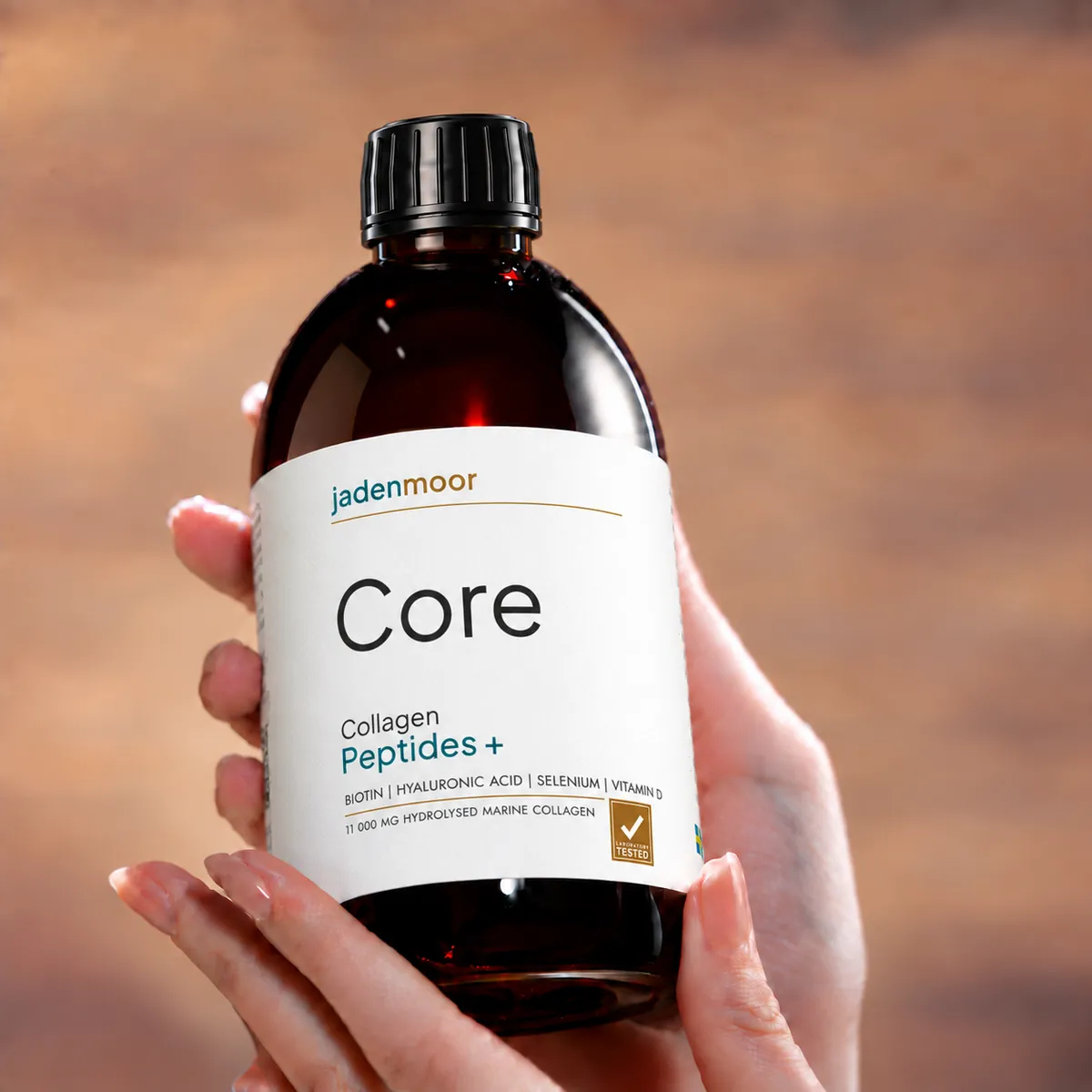
A course of Core™ is one portion a day, every day, for the length you choose. Eight weeks matches our own user trial, and 12 weeks or more matches the longer published trials above.11 Every portion provides 11,000 mg of hydrolysed marine collagen, types I and III.
- The daily step. Shake the pack, pour into the cap, then drink it straight or stir it into water or a smoothie.
- Storage. Keep the pack in the fridge once opened.
- Buying. Core™ is a one-off purchase with no subscription, so the length of your course is yours to set.
You can see what is in each portion on the Core™ product page.
What did women report after 8 weeks?
After 8 weeks of our liquid marine collagen daily, 95% of the 106 women in the user trial felt that the appearance of their skin improved, 89% reported more moisture and glow and 99% found it easy to include in their daily routine.11
felt that the appearance of their skin improved.
reported more moisture and glow.
found it easy to include in their daily routine.
On timing, women in that trial reported visible results in as little as 4 weeks, with further improvement by week 8.11
Among the remaining answers, each a share of the 106 women, 87% noticed a reduction in fine lines and wrinkles, 86% reported healthier hair, 81% reported firmer skin and 76% reported stronger nails.11 Photos of participants are in collagen before and after.
How long did other women take it for?
Three writers who published first-person accounts of marine collagen took it for two months, three months and around six months.
“And truthfully? My skin looks better than ever.”
Two months, every day. She describes herself as a sceptic, and at the end she found her skin plumper, healthier and noticeably more radiant.
Shannon LawlorBeauty editor, writing in Marie Claire UK12
“The fine lines have definitely softened.”
Three months, every day. From the first month her skin felt softer and smoother, and after that plumper and glowier.
Eleanor VousdenBeauty editor, writing in Who What Wear UK13
“To my surprise, these worked.”
Around six months, on 10,000 mg of marine collagen a day. She reported glowier, more even skin that held on to hydration for longer, and less brittle nails.
Charlotte BitmeadWriting in Stylist14
Independent first-person accounts of marine collagen published by the outlets named.
Questions about collagen courses and breaks
How long should you take collagen for?
More than 8 weeks is where a 2023 meta-analysis of 26 randomised controlled trials found the skin hydration effect was larger, and the studies on this page ran from 4 weeks to 6 months.
Should you take a break from collagen?
The studies here describe no break: their dosing is a daily amount for the full study period, from 4 weeks up to 6 months. Some then measured again four weeks after the last dose.
What happens when you stop taking collagen?
In the studies that measured again four weeks after the last dose, results were still there. In a trial of 114 women aged 45 to 65, the effect on eye-wrinkle volume was still there at that point. In a trial of 36 postmenopausal women, so was the difference in cheek skin elasticity.
What is a collagen course?
A collagen course is a planned length of daily collagen. With Core™, that means one portion a day for the whole period you set, the way the trials on this page gave a daily amount for their full length.
Is 8 weeks of collagen long enough to notice a difference?
In our user trial, 95% of 106 women felt the appearance of their skin improved after 8 weeks on our liquid marine collagen. In a published trial of 114 women aged 45 to 65, eye-wrinkle volume was about 20% lower than placebo after 8 weeks of collagen peptides.
Has collagen been studied for as long as 6 months?
Yes, collagen has been studied for 6 months: in a randomised, placebo-controlled trial of menopausal women aged 45 to 60, 5 g a day of collagen from freshwater fish skin for 6 months improved skin elasticity by 12.23% from baseline in the collagen group of 20 women, significantly more than placebo.